Key takeaways
- For long-term storage below water’s glass transition (around −130 to −135 °C), biobanks use liquid-phase LN2 (about −196 °C), vapor-phase LN2 (typically about −150 to −190 °C), or mechanical −150 °C freezers.
- Liquid nitrogen can carry contaminants between samples; a 1995 hepatitis B outbreak was traced to a contaminated cryopreservation tank, so sealed containers and vapor-phase storage are widely preferred.
- Vapor-phase storage avoids direct contact with liquid but has vertical temperature gradients that depend on LN2 level.
- Mechanical −150 °C freezers avoid LN2 supply and asphyxiation hazards but depend on electrical power and repair response.
- Whatever the system, plan for oxygen depletion monitoring, cold-burn and vial-rupture hazards, level or temperature alarms, and supply continuity.
In July 1995, The Lancet reported an outbreak of hepatitis B among patients at a London haematology unit. Bone marrow from one patient, harvested while acutely infected, had leaked from its cryopreservation bag into the shared storage tank. As the published abstract describes, the tank and its contents became contaminated and the virus was transmitted to other patients after transplantation. The authors called for primary containers sealed in a way that prevents exchange between specimen and liquid nitrogen.
That lesson still drives cryogenic freezer decisions. Biobanks storing samples below water’s glass transition have three main options: submerged in liquid nitrogen at about −196 °C, held in nitrogen vapor above the liquid, or kept in a mechanical freezer at around −150 °C, each with different contamination, temperature, supply, and safety trade-offs. This article compares them. For the wider cold storage landscape, see our comparison of lab cold storage options.
Why store samples below −135 °C?
Below the glass transition temperature of aqueous solutions, ice no longer recrystallizes and biological activity effectively stops, which makes indefinitely long storage possible. Estimates vary slightly: one manufacturer places it at approximately −130 °C, while a poster from the NCI Biorepositories symposium notes that glass transition occurs progressively rather than at exactly −132 °C, which is why storage well below that point, such as −150 °C, is preferred. Ultra-low freezers at −70 to −80 °C sit well above it; see our guide to ultra-low freezers for when that’s sufficient.
What is the difference between liquid-phase and vapor-phase LN2 storage?
| Criterion | Liquid Phase | Vapor Phase |
|---|---|---|
Temperature | About −196 °C, very stable | Typically about −150 to −190 °C, varying with height and LN2 level |
Contact with LN2 | Samples submerged | Samples held above the liquid |
Cross-contamination risk | Higher; LN2 can carry contaminants between containers | Much lower, provided samples stay out of the liquid |
Vial hazards | Liquid can seep into poorly sealed vials, which can rupture on warming | Reduced, though sealed containers remain good practice |
Usable capacity | Full volume | Lower; space occupied by the liquid reservoir can’t hold samples |
Temperature uniformity | Excellent | Vertical gradients, especially near the top of the chamber |
Vapor phase has become the common choice for valuable samples. As one manufacturer’s overview notes, vapor storage eliminated most cross-contamination risk but brought its own drawbacks: reduced capacity, dependence on the liquid level, and larger vertical temperature gradients. Well-designed vapor-phase systems can still be very stable; the Ottawa Hospital Research Institute’s biobank describes its vapor-phase freezers holding about −185 °C with a temperature gradient of only 4 °C, and maintaining samples below −132 °C for several weeks without refilling.
Are mechanical −150 °C freezers an alternative to liquid nitrogen?
| Criterion | Vapor phase LN2 | Mechanical −150 °C freezer |
|---|---|---|
Cooling source | Liquid nitrogen supply (dewars, bulk tank, or piping) | Electrical refrigeration |
Dependence | Reliable LN2 deliveries and fill systems | Reliable power and prompt repair service |
Behavior in a power outage | Continues cooling if LN2 is available | Warms unless backed up by generator power or LN2 backup |
Contamination | Low when samples are kept above the liquid | No LN2 contact |
Temperature uniformity | Gradients depend on design and LN2 level | Generally uniform top to bottom |
Room safety | Oxygen depletion and cold-burn hazards | Heat and noise; no asphyxiation hazard from the unit itself |
Running costs | Ongoing LN2 purchases | Electricity and maintenance |
Manufacturers on both sides make their case. One mechanical freezer maker argues that mechanical units provide generally uniform temperatures and avoid the ventilation logistics of LN2, while noting that they can cost more up front and may require more maintenance, and that mechanical freezers can themselves be backed up with LN2. LN2 advocates point to independence from electrical power. Many biobanks use both, choosing by sample value and storage duration.
Can samples be contaminated in liquid nitrogen?
Yes. Beyond the 1995 outbreak, a 2020 experimental study found that embryos stored in open devices in artificially contaminated liquid nitrogen became infected in 12.5% of cases, while none stored in closed devices did, and that storing infected embryos contaminated sterile liquid nitrogen. A review of microbes in LN2 storage tanks notes that bacteria have been found in tanks used for oocyte and embryo storage. Fertility guidance reflected in a 2023 Reproductive BioMedicine Online review advises separate tanks for virus-positive specimens and consideration of vapor-phase storage.
- Use closed, sealed containers rated for the storage phase.
- Prefer vapor-phase storage for valuable or clinical samples.
- Segregate known infectious specimens.
- Clean and decontaminate tanks periodically, following manufacturer guidance.
Safety in cryogenic storage rooms
- Oxygen depletion. Liquid nitrogen expands into a large volume of gas as it evaporates. Rooms with LN2 freezers or bulk supply need oxygen deficiency monitoring and adequate ventilation; see our guide to oxygen depletion monitoring.
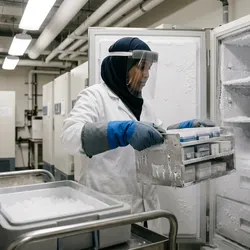
- Cold burns. Wear insulated gloves, a face shield over eye protection, and a lab coat when handling racks or transferring LN2; see our guide to face shields and eye protection.
- Vial rupture. Liquid nitrogen can be drawn into poorly sealed tubes, as one technical note on cryogenic storage explains, and the rapid expansion on warming can make vials burst. Use vials rated for liquid-phase storage, or store in vapor phase.
- Pressure and handling. Use dewars and transfer equipment designed for LN2, and never seal LN2 in airtight containers.
Monitoring and supply continuity
- Monitor temperature and LN2 level continuously, with remote alarms; see our guide to freezer temperature monitoring.
- Use auto-fill systems with alarms, and track LN2 consumption to catch failing vacuum insulation early.
- Secure LN2 supply with scheduled deliveries and adequate bulk or dewar reserve.
- Include cryogenic units in the freezer failure plan, with backup capacity and dry shippers for transfers; see our freezer failure contingency plan.
A cryogenic storage checklist
- Storage temperature is chosen by sample type and storage duration. Long-term storage of viable cells and tissues generally needs temperatures below the glass transition; many other samples are fine at −80 °C. Matching temperature to need avoids unnecessary LN2 or electricity costs.
- Vapor phase is the default for valuable or clinical samples. It sharply reduces cross-contamination risk. Where liquid phase is required, use containers rated and sealed for it.
- Temperature gradients are mapped. Vapor-phase gradients vary with design and LN2 level. Measure top-of-rack temperatures, and keep the most sensitive samples in the coldest positions.
- Mechanical −150 °C units have power protection. Generator-backed circuits or LN2 backup cooling cover outages. Without them, mechanical units warm when power fails.
- Oxygen monitoring and ventilation are in place. LN2 rooms need oxygen deficiency monitoring. Assess room volume, LN2 inventory, and ventilation with EHS.
- PPE and handling procedures are defined. Face shields, cryogenic gloves, and training reduce cold-burn and vial-rupture injuries.
- LN2 supply is secure. Delivery schedules, reserve capacity, and level alarms prevent tanks running low. Plan for holidays and supply disruptions.
- Infectious specimens are segregated. Separate tanks for known infectious material limit cross-contamination.
- Cryogenic units are in the failure plan. Backup space, dry shippers, and response roles should cover cryogenic storage as well as mechanical freezers.
Cryogenic storage protects a biobank’s longest-lived and often most irreplaceable samples. Keep them below the glass transition, keep them out of the liquid where you can, and protect the people working around the nitrogen as carefully as the samples in it.
This article was produced under Lab Manager’s AI Editorial Guidelines