Key takeaways
- Flammable materials that need refrigeration belong in a flammable material storage (“lab-safe”) refrigerator, which keeps ignition sources out of the storage compartment.
- Explosion-proof refrigerators protect against flammable atmospheres outside the unit and are needed only in hazardous locations such as solvent dispensing rooms.
- Household refrigerators have switches, lights, and fans inside the cabinet that can ignite vapors, and they have caused lab explosions.
- NFPA 45 sets expectations for refrigerators used to store flammable liquids, including listed units and signage; check the current edition and your institution’s rules.
- Label every lab refrigerator and freezer as safe or unsafe for flammable storage, and keep food out of all of them.
In the search for a safe place to chill solvents, many labs reach for the phrase “explosion-proof.” Most don’t need it. Oregon State University’s refrigerator guidance puts it plainly: in a typical lab setting, explosion-proof refrigerators are usually not necessary. What labs do need is a refrigerator designed so that vapors inside the cabinet can’t meet a spark, and what they must avoid is the ordinary household unit that has caused fires and explosions on several campuses.
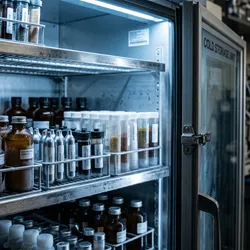
Flammable liquids that need refrigeration belong in a flammable material storage refrigerator, sometimes called “lab-safe,” where ignition sources are kept out of the storage space; an explosion proof refrigerator is a different, more specialized unit for locations where the surrounding air itself may be flammable. This article explains the difference, what NFPA 45 expects, and how to label and manage lab refrigerators. For the wider cold storage picture, see our comparison of lab cold storage options.
Why do household refrigerators ignite flammable vapors?
A household refrigerator has thermostats, light switches, defrost heaters, and fans inside or near the storage compartment. Vapors from a loosely capped solvent bottle can build up in that closed space until a switch clicks or a fan motor sparks. Case Western Reserve University’s solvent refrigerator guidance collects examples from the University of Vermont, the University of Virginia, and Michigan State University, where a flammable liquid in a household refrigerator found an ignition source inside the unit.
It isn’t only obvious solvents. The University of Texas at Austin’s refrigerator procedures note that storage rules apply to any solution or specimen that may release flammable vapors, citing animals euthanized with ether as an example of material that has caused problems.
What is the difference between a flammable storage and an explosion-proof refrigerator?
| Household (domestic) | Flammable material storage (“lab-safe”) | Explosion-proof |
Protects against | Nothing specific to flammables | Ignition of vapors inside the storage compartment | Ignition of flammable atmospheres outside and inside the unit |
Design | Switches, lights, and fans in or near the cabinet | Electrical components kept out of the storage compartment | Sealed or enclosed electrical components rated for hazardous locations |
Installation | Plug and cord | Usually plug and cord | Often hard-wired through metal conduit to meet hazardous location wiring rules |
Appropriate use | Non-flammable materials only, such as aqueous solutions | Storage of flammable liquids in ordinary labs | Hazardous locations, such as solvent dispensing rooms |
Labeling | “Not for flammable storage” | Listed as flammable material storage | Bears a UL or FM explosion-proof label |
UC Berkeley’s fact sheet describes flammable material refrigerators as designed to prevent ignition of vapors inside the storage compartment, with all electrical components outside it, and recommends buying one whenever a refrigerator is needed to store flammable liquid. UC Riverside’s guidance adds that in most cases a lab-safe unit, rather than an explosion-proof one, is sufficient.


Lab Safety Management Certificate
The Lab Safety Management certificate is more than training—it’s a professional advantage.
Gain critical skills and IACET-approved CEUs that make a measurable difference.
When do you need an explosion-proof refrigerator?
Only when the room itself may contain a flammable atmosphere. Typical examples include solvent dispensing rooms, flammable liquid storage rooms, and other areas classified as hazardous locations under the electrical code. Explosion-proof units meet Class I, Division 1 electrical requirements, usually need hard-wired installation, and cost considerably more. If you think you need one, involve EHS and facilities, since the electrical classification of the room drives the requirement.
The same distinction appears with lab ovens, where a solvent-rated oven manages vapors inside the unit and explosion-proof construction addresses the room; see our guide to lab oven safety and NFPA 86.
What does NFPA 45 require?
NFPA 45, the Standard on Fire Protection for Laboratories Using Chemicals, addresses refrigerators used in labs. A University of Colorado code review based on the 2008 edition summarizes provisions on refrigerator signage, the use of listed refrigerators for flammable liquids, and the conditions under which modified domestic refrigerators may be used. Section numbers have changed between editions, so check the current edition and your institution’s interpretation. Many institutions also reference OSHA electrical requirements for hazardous locations.
Can freezers and cold rooms store flammables?
- Freezers follow the same logic. Flammable materials need a freezer listed for flammable storage; household freezers aren’t suitable.
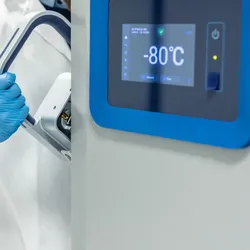
- Ultra-low freezers need special care. Berkeley’s fact sheet notes that very low-temperature units generally can’t be approved for flammable storage. Consult EHS before storing flammables in a ULT; see our guide to ultra-low freezers for wider ULT considerations.
- Cold rooms are usually unsafe for flammables. Michigan State University’s rules require all cold rooms to be marked unsafe for flammable storage.
Labeling and day-to-day practice
- Label every unit. MSU requires all lab refrigerators and freezers to be marked “safe for flammable storage” or “unsafe for flammable storage.” Washington State University’s lab safety manual recommends labeling ordinary units “Not for flammable storage.”
- Keep food out. Never store food or drinks in any chemical or sample refrigerator, as UC Riverside’s guidance stresses.
- Cap and contain. Use tightly sealed containers and secondary containment, even in flammable storage units.
- Know your institution’s exceptions. Some institutions, such as USC, allow very limited flammable storage in household-type units under strict conditions on quantity, boiling point, and containment. Don’t assume an exception applies without checking.
- Audit regularly. Include refrigerator contents and labels in routine lab inspections, and remove old or unlabeled containers.
A flammable storage refrigerator checklist
- Every refrigerator and freezer is labeled for flammable use. Clear “safe” or “unsafe” labels prevent the most common mistake. If replacing units isn’t immediately possible, labeling household units “Not for flammable storage” is a quick, cheap first step.
- Flammables are stored only in units listed for that purpose. Flammable material storage refrigerators and freezers keep ignition sources out of the cabinet. Budget for them when planning new labs or replacing old units.
- Explosion-proof units are used only where required. They cost more and need special wiring. Confirm with EHS and facilities whether the room is a classified hazardous location before buying one.
- Specimens and solutions that release vapors are included. Rules apply to anything that releases flammable vapors, not just solvent bottles. Include specimens, extracts, and mixtures in your assessment.
- Freezers and cold rooms are assessed separately. Cold rooms are usually unsafe for flammables, and ultra-low freezers generally can’t be approved for them. Plan alternative storage.
- Containers are sealed and contained. Tight caps and secondary containment reduce vapor build-up and limit spills, even in rated units.
- Food and drink are never stored with chemicals or samples. Separate, clearly labeled units outside the lab are the only appropriate place for food.
- Contents and labels are checked during inspections. Regular checks catch unlabeled containers, misplaced flammables, and missing signage before they cause incidents.
The right refrigerator for solvents is rarely the most expensive one. It’s the one designed to keep vapors away from sparks, clearly labeled, and used only for what it’s rated to hold.
This article was produced under Lab Manager’s AI Editorial Guidelines