Key takeaways
- A flammable storage cabinet is a double-walled, fire-resistant cabinet designed to protect its contents from an outside fire, not to ventilate vapors.
- OSHA 29 CFR 1910.106 limits a cabinet to 60 gallons of Category 1–3 flammable liquids or 120 gallons of Category 4 liquids, and requires a 10-minute fire test with internal temperatures staying at or below 325 °F.
- Venting isn’t required; if a cabinet is vented, it must be ducted outdoors without compromising its fire performance, and if not, the bungs must stay sealed.
- NFPA 30 generally limits a single fire area to three cabinets, with exceptions, and fire codes such as the IFC expect self-closing doors.
- Place cabinets away from exits and ignition sources, keep them for flammables only, and store acids and corrosives in separate, compatible cabinets.
Every metal flammable storage cabinet has two capped openings on its sides, and almost everyone who sees them assumes they’re meant to be connected to exhaust. Usually they aren’t. As a University of California, Davis safety note explains, venting a flammable storage cabinet isn’t required or recommended by NFPA 30, because the cabinet is designed to protect its contents from a fire outside it, and an improperly vented cabinet can lose that protection.
A flammable storage cabinet is a fire-resistant enclosure built to OSHA 29 CFR 1910.106 and NFPA 30 requirements, holding up to 60 gallons of most flammable liquids, normally unvented with its bungs sealed, and sited away from exits and ignition sources. This article covers construction, capacity, venting, cabinet limits, doors, placement, and how flammable cabinets differ from corrosive storage. For the wider casework picture, see our comparison of laboratory casework.
What makes a cabinet a flammable storage cabinet?
OSHA 29 CFR 1910.106 sets the performance requirement: storage cabinets must limit their internal temperature to no more than 325 °F during a 10-minute fire test using the NFPA 251 standard time-temperature curve, with joints and seams staying tight and the door staying closed. Cabinets must be labeled in conspicuous lettering, “Flammable – Keep Fire Away.” The regulation also describes constructions deemed to comply:
| Element | Metal Cabinets | Wood Cabinets |
|---|---|---|
Walls | 18-gauge sheet steel, double-walled with a 1½-inch air space | Exterior-grade plywood at least 1 inch thick that won’t delaminate in fire |
Joints | Riveted, welded, or made equally tight | Rabbetted and fastened in two directions |
Doors | Three-point latch | Hinged and mounted so they don’t lose holding power in fire |
Spill containment | Door sill raised at least 2 inches above the cabinet bottom | Confirm spill containment details in the manufacturer’s listing |
The wood construction details are summarized from the regulation by an insurer’s loss-control bulletin. Buy cabinets listed or labeled as meeting OSHA and NFPA 30, rather than improvising.
How much can a flammable storage cabinet hold?
Under 1910.106(d)(3), a single cabinet may hold no more than 60 gallons of Category 1, 2, or 3 flammable liquids, or no more than 120 gallons of Category 4 flammable liquids. Lab-specific fire codes can set lower limits for the whole lab or control area, so a cabinet’s capacity isn’t the same as what the room may hold; see our guide to NFPA 45 quantity limits.
Do flammable storage cabinets need to be vented?
No. The UC Davis note quotes NFPA 30: the cabinet isn’t required to be vented for fire protection purposes. If it is vented for whatever reason, it must be vented outdoors or to a fume hood exhaust duct in a way that doesn’t compromise the cabinet’s performance; if it isn’t vented, the vent openings must be sealed with the bungs supplied or specified by the manufacturer. A CASRAI explainer on cabinet rules adds that 1910.106 doesn’t require venting either, and that both OSHA and NFPA guidance generally advise against venting unless it’s done correctly.
- Default: keep the bungs in. An open, unducted vent lets fire and heat into the cabinet.
- Vent only for a reason, such as odor control for toxic or malodorous materials, or a local code requirement.
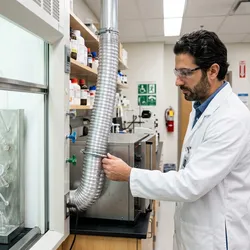
- If you vent, do it properly. Use rigid, non-combustible ducting to the outdoors or an approved exhaust, following the manufacturer’s instructions and code; flexible plastic tubing defeats the purpose.
- Involve EHS and facilities before connecting any cabinet to building exhaust.
How many flammable cabinets can you have in one area?
NFPA 30 generally allows no more than three cabinets in a single fire area, with exceptions for groups separated by distance or fire-rated construction, as one safety cabinet supplier’s compliance guide summarizes. Some codes and editions allow more in sprinklered areas. Because the details depend on the adopted code and building protection, check with your fire marshal or EHS before adding cabinets.


Interested in lab design?
Do flammable cabinet doors need to be self-closing?
OSHA 1910.106 requires a three-point latch but doesn’t itself mandate self-closing doors. Fire codes often do: UW–Madison’s chemical storage guidance recommends cabinets that are OSHA and NFPA approved, meeting UL 1275, with self-closing doors to comply with the International Fire Code. Self-closing, self-latching doors also prevent the most common real-world failure, cabinets left open during use. Never prop doors open.
Where should flammable cabinets go?
- Away from exits, stairways, and egress routes, so a fire can’t block escape.
- Away from heat and ignition sources, including hot plates, ovens, and electrical equipment.
- On a level floor where doors close and latch properly.
- Close to where the liquids are used, to minimize carrying containers across the lab.
- In locations that don’t push the room past its fire code limits.
- With grounding and bonding available where liquids are dispensed into or out of metal containers.
Refrigerated flammables need a refrigerator designed for flammable storage, not a cabinet; see our guide to flammable-safe refrigerators.
What about acid and corrosive cabinets?
Flammable cabinets are for flammable liquids only. Acids and corrosives can attack metal cabinets and are often incompatible with flammables, so they belong in separate corrosive or acid cabinets, typically lined or made of corrosion-resistant materials such as polyethylene or treated wood. Oxidizing acids such as nitric acid need separation from organic materials even within corrosive storage. See our storage compatibility chart and our guide to lab chemical storage.
A flammable storage cabinet checklist
- Cabinets are listed as meeting OSHA 1910.106 and NFPA 30. Labeled, tested cabinets avoid guesswork. If you inherit older or unmarked cabinets, ask EHS to evaluate them before relying on them.
- Capacity limits are respected. No more than 60 gallons of Category 1–3 liquids or 120 gallons of Category 4 per cabinet, and within room or control area limits.
- Bungs are sealed unless the cabinet is properly vented. Unducted vent openings compromise fire protection. If venting is needed, use rigid ducting to the outdoors or approved exhaust, designed with EHS.
- Cabinet counts per fire area are checked. NFPA 30 generally allows three cabinets per fire area, with exceptions. Confirm with your fire marshal before adding more.
- Doors self-close and latch, and are never propped open. Fire codes often require self-closing doors. Retrofit kits exist for some older cabinets.
- Cabinets are sited away from exits and ignition sources. Placement failures are common. Review locations during lab design and inspections.
- Only flammables go inside. Acids, oxidizers, and general chemicals belong elsewhere. Clear labeling of storage groups helps.
- Labels and inspections are maintained. “Flammable – Keep Fire Away” labeling, door function, sill integrity, and contents should be checked during routine inspections.
A flammable storage cabinet does its job by staying closed, sealed, and in the right place. Keep the bungs in unless there’s a properly engineered reason to vent, respect the 60-gallon limit and the room’s total, and let the doors close themselves.
This article was produced under Lab Manager’s AI Editorial Guidelines