Key takeaways
- The three main lab evaporators are rotary evaporators for one larger-volume sample at a time, nitrogen blowdown evaporators for many small samples in tubes, and centrifugal evaporators for many samples, plates, and high-boiling solvents.
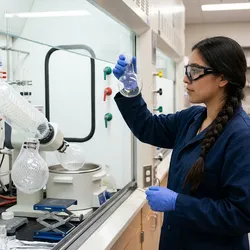
- Rotary evaporators spread solvent in a thin film inside a rotating flask under vacuum, which speeds evaporation and allows solvent recovery, but they handle one sample at a time.
- Nitrogen blowdown sweeps vapor from each sample’s surface with a gas stream at atmospheric pressure; one manufacturer cites about 20 to 30 minutes for a 10 mL sample.
- Centrifugal evaporators combine vacuum, heat, and centrifugal force, which makes samples boil from the top down and prevents bumping, and they handle DMSO and water well.
- Choose by sample count, volume, solvent, and whether you need to recover the solvent.
In 1950, Rockefeller University biochemist Lyman C. Craig and colleagues published a short paper describing a “versatile laboratory concentration device”: a rotating flask under vacuum. As Lab Manager reported years ago, the first commercial version followed from Walter Büchi in 1957. The rotary evaporator became so common that most chemists can’t picture a lab without one.
But one rotovap handles one flask at a time, and many modern labs need to dry dozens or hundreds of samples a day. What types of evaporators are used in labs? Three dominate: the rotary evaporator for single, larger-volume samples and solvent recovery; nitrogen blowdown evaporators for many small samples in tubes; and centrifugal evaporators for many samples, microplates, and high-boiling solvents. This overview explains how each works and how to choose, starting with your sample count and volume.
What types of evaporators are used in labs?
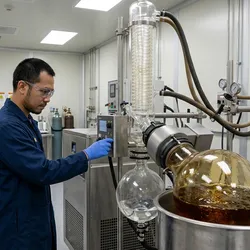
Rotary evaporators
- How it works: a flask rotates in a heated bath under reduced pressure; vapor condenses on a cooled condenser and collects in a receiving flask.
- Best for: single samples from tens of milliliters to several liters, reaction workups, extracts, and solvent recovery.
- Throughput: one sample at a time, with an operator watching the endpoint.
- Watch-outs: bumping and foaming with some samples, glassware under vacuum, and hands-on time; see Rotary Evaporator Safety: Implosion, Bumping, and Solvent Exposure.
Nitrogen blowdown evaporators
- How it works: heated samples sit in a block or bath while needles direct nitrogen or another dry gas onto each sample’s surface, sweeping away solvent vapor.
- Best for: many small samples in tubes or vials, typically after extraction, especially volatile organic solvents.
- Throughput: dozens of samples at once; one manufacturer cites an average of about 20 to 30 minutes for a 10 mL sample, according to its blog.
- Watch-outs: gas consumption, solvent vapors that must be exhausted, and slower drying of water and high-boiling solvents.
Centrifugal evaporators and vacuum concentrators
- How it works: samples spin in a rotor inside a vacuum chamber while heat is applied; centrifugal force creates a pressure gradient so samples boil from the top down, as a general reference explains, which prevents bumping.
- Best for: large numbers of tubes or vials, microplates, aqueous samples, and high-boiling solvents such as DMSO and DMF.
- Throughput: hundreds of samples or multiple plates per run in larger systems.
- Watch-outs: all samples share one chamber, vacuum level, and temperature; vacuum pump maintenance; chamber compatibility with aggressive solvents.
Other options fill niches: parallel evaporators that apply vacuum and vortexing to several vessels at once, Kuderna-Danish concentrators in environmental methods, and freeze dryers for aqueous samples that must stay cold; see our guide to laboratory freeze dryers.
How do you choose? Start with sample count and volume
- One or a few samples, 25 mL to several liters: rotary evaporator.
- Many samples, roughly 1 to 50 mL each, mostly volatile organic solvents: nitrogen blowdown.
- Many samples or microplates, small volumes, aqueous or high-boiling solvents: centrifugal evaporator.
- Large volumes where you want the solvent back: rotary evaporator with an efficient condenser; see Solvent Recovery in the Lab: Cutting Purchase and Disposal Costs.
- Heat-sensitive aqueous samples that must stay frozen: freeze dryer.
Solvent matters as much as count. A selection guide from nitrogen evaporator maker Organomation notes that centrifugal systems excel with high-boiling solvents such as DMSO, DMF, and water, because vacuum lowers their boiling points. The same company’s head-to-head test found nitrogen blowdown evaporated 1.5 mL of methanol from 2 mL tubes in 30 minutes versus 40 minutes in a centrifugal concentrator, while acknowledging centrifugal systems keep the advantage for DMSO, DMF, and water. As a manufacturer test, treat the exact numbers as indicative.
Three labs, three answers
Scenario: the environmental lab drowning in extracts
An environmental testing lab concentrates 60 solid-phase extraction eluates a day in dichloromethane, one at a time on two rotovaps. Analysts spend hours watching flasks and releasing vacuum to check volumes. Moving the final concentration step to a 24-position nitrogen blowdown evaporator lets one analyst run whole batches in parallel, with the rotovaps kept for larger extracts. The cost shifts from labor to nitrogen, which the lab now tracks; that trade-off is covered in Nitrogen vs. Centrifugal Evaporators for High-Throughput Sample Concentration.


Lab Quality Management Certificate
The Lab Quality Management certificate is more than training—it’s a professional advantage.
Gain critical skills and IACET-approved CEUs that make a measurable difference.
Scenario: a compound library stuck in DMSO
A medicinal chemistry group needs to dry hundreds of compounds dissolved in DMSO in 96-well plates. Nitrogen blowdown would take far too long with a solvent that boils near 189 °C. A centrifugal evaporator lowers the boiling point under vacuum and keeps samples from bumping between wells; the centrifugal evaporator reference notes that high-performance systems remove DMSO and NMP while keeping sample temperature below 40 °C.
Scenario: two liters of botanical extract
A natural products lab extracts plant material in two liters of ethanol per batch. Neither blowdown nor centrifugal systems are built for that volume, and buying fresh ethanol for every batch adds up. A rotary evaporator with an efficient condenser concentrates the extract and recovers most of the ethanol for reuse. Larger-scale ethanol extraction is covered in Rotary Evaporation in Cannabis and Botanical Extraction Labs.
What to look for in a rotary evaporator
- Vacuum control: a controller that ramps and holds pressure reduces bumping and speeds evaporation.
- Condenser and cooling: match condenser type and chiller capacity to your solvents; the Delta 20 rule and chiller sizing are covered in our guide to recirculating chillers. Replacing tap-water cooling saves water; see our guide to single-pass cooling.
- Flask sizes and lift: motorized lifts help with large flasks and safety.
- Coated glassware and shields: reduce injury risk if glassware fails under vacuum.
- Automation: endpoint detection or auto-distillation reduces operator time.
- Solvent purity: recovered solvent quality depends on what you evaporate; see our guide to choosing solvent grades.
As Büchi’s technology overview explains, keeping the liquid in motion in a rotating flask greatly improves heat transfer compared with a static flask, which is why rotary evaporation is both faster and gentler on the product.
A lab evaporator buying checklist
- Count your samples per day and per batch. One at a time points to a rotovap; dozens point to blowdown or centrifugal systems.
- Note typical volumes and vessel formats. Liters, tubes, vials, and microplates each favor different equipment.
- List your solvents, including the hardest. Volatile organics suit blowdown; water, DMSO, and DMF favor vacuum-based systems.
- Decide whether you need the solvent back. Rotary evaporators recover solvent; blowdown systems exhaust it.
- Plan utilities. Rotovaps need cooling and vacuum; blowdown needs a gas supply and exhaust; centrifugal systems need a suitable vacuum pump.
- Consider heat sensitivity. Vacuum systems evaporate at lower temperatures; blowdown relies on heat and gas flow.
- Account for hands-on time. Automation and parallel processing often save more than the equipment costs.
- Plan safety and ventilation. Solvent vapors, vacuum glassware, and exhaust need controls for every type.
Craig’s spinning flask is still the best tool for a flask of solvent you want back. But when the work is 60 extracts a day or a plate of DMSO, the right evaporator is the one that matches the sample count, the volume, and the solvent, not the one the lab has always had.
This article was produced under Lab Manager’s AI Editorial Guidelines