Key takeaways
- Laboratory homogenizers break up tissues, cells, and particles using four main mechanisms: rotor-stator shear, bead impact, ultrasonic cavitation, and high-pressure flow.
- Rotor-stator homogenizers suit soft tissues and emulsions one sample at a time; bead mills suit tough tissues, microbes, and many samples in sealed tubes; sonicators suit small volumes and cell lysis; high-pressure homogenizers suit larger volumes of cells and emulsions.
- Sample type drives the choice: bacteria, yeast, plant material, and fibrous tissue need very different forces, and bead size alone can make or break a bead mill protocol.
- Throughput and cross-contamination often decide between probe-based and tube-based methods.
- All high-energy methods generate heat, so cooling and pulsed runs protect proteins, RNA, and enzymes.
Auguste Gaulin patented a machine for homogenizing milk in France in 1899 and showed it at the Paris World’s Fair a year later. As the history of his machine records, its first big commercial customers were ice cream makers, who found that homogenized mix came out noticeably smoother. More than a century on, the lab version of Gaulin’s idea does very different work: cracking open bacteria for protein, releasing RNA from mouse brain, and grinding seeds for DNA.
A lab homogenizer breaks down tissues, cells, or particles to release their contents or create uniform mixtures. The four main designs, rotor-stator, bead mill, ultrasonic, and high-pressure, each use a different force, and the right one depends mostly on sample type and how many samples you run. This overview compares them and works through real lab scenarios where the choice matters. Lab Manager’s earlier look at homogenization technologies covers additional background.
What types of laboratory homogenizers are there?
As one microbiology reference summarizes, rotor-stator devices produce intense shear, bead mills use impact and friction, and ultrasonic devices produce acoustic cavitation. High-pressure homogenizers force liquid through a narrow valve. Here’s how each compares in practice.
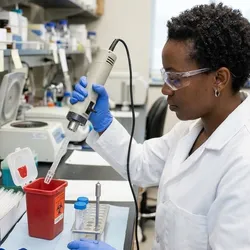
Rotor-stator homogenizers
- How it works: a fast-spinning rotor inside a fixed stator draws the sample in and shears it in the narrow gap.
- Best for: soft tissues, cell suspensions, and emulsions, with flexible volumes from microliters to liters.
- Throughput: one sample at a time, unless you add disposable probes or automation.
- Watch-outs: probe carryover between samples, heat, and foaming. Probe choice matters; see Lab Manager’s guide to rotor-stator generator probes.
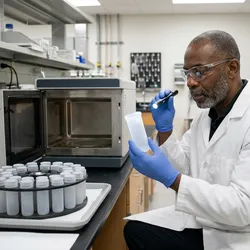
Bead mill homogenizers (bead beaters)
- How it works: samples are shaken or stirred with small glass, ceramic, or steel beads that crack cells and tissue on impact.
- Best for: tough tissues, microbes, spores, plant material, and many samples at once in sealed tubes or plates.
- Throughput: high; benchtop models run dozens of tubes simultaneously.
- Watch-outs: heat, bead selection, and volume limits per tube.
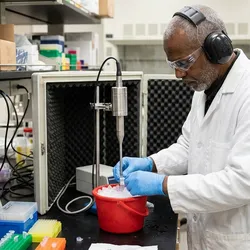
Ultrasonic homogenizers (sonicators)
- How it works: a probe vibrating at ultrasonic frequency creates cavitation bubbles whose collapse disrupts cells.
- Best for: small to moderate volumes of cell suspensions, DNA and chromatin shearing, and dispersions.
- Throughput: usually one sample at a time with a probe; cup horns and plate systems process several closed tubes.
- Watch-outs: considerable heat, noise, aerosols, and probe erosion; see Ultrasonic Homogenizer Safety: Noise, Aerosols, and Heat.
High-pressure homogenizers
- How it works: liquid is pumped at high pressure through a narrow valve or microchannels, and turbulence, shear, and pressure drop break cells or droplets.
- Best for: larger volumes of microbial cells, and emulsions or nanoemulsions; one food industry overview notes pressures can reach 4,000 bar.
- Throughput: continuous flow, scaling from lab to production.
- Watch-outs: temperature rise, minimum sample volumes, and cleaning; see High-Pressure Homogenizers for Cell Disruption and Nanoemulsions.
Matching the method to the sample
Sample type matters more than any other factor. A cell disrupter review from bead mill maker BioSpec gives a useful starting point for bead size alone: 0.1 mm beads for bacteria and spores; 0.5 mm for yeast, mycelia, microalgae, and cultured cells; and 1.0 or 2.5 mm for tissues such as brain, muscle, leaves, and skin.
- Soft animal tissue (brain, liver, kidney): rotor-stator or bead mill with 1.0 mm beads; both work, so throughput and contamination usually decide.
- Tough or fibrous tissue (skin, heart, muscle, cartilage): bead mill with denser zirconia or steel beads; BioSpec notes denser beads may be needed for skin or cartilage.
- Bacteria: bead mill with 0.1 mm beads, sonication for small volumes, or high-pressure homogenization for larger volumes.
- Yeast, fungi, and spores: bead mill with 0.5 mm beads or high-pressure homogenization; their walls resist gentler methods.
- Plant material: bead mill for fresh leaves; dense beads or cryogenic grinding for dry leaves and seeds.
- Cultured mammalian cells: gentle sonication, a Dounce homogenizer, or detergent lysis, depending on what you need to keep intact.
- Emulsions and nanoemulsions: high-pressure homogenizer, or rotor-stator for coarser emulsions.
Tissue-specific choices are covered in more depth in Tissue Homogenizers: Matching Disruption Technique to Sample Type.
How throughput and contamination change the decision
Scenario: 96 mouse tissues and a carryover problem
A genomics lab homogenizes mouse liver for RNA one sample at a time with a rotor-stator probe, cleaning between samples. It works, but a 96-sample study takes most of a day, and occasional unexpected signals in negative controls point to carryover. Moving to a bead mill with prefilled, sealed bead tubes processes dozens of samples at once, and because each sample stays in its own closed tube, carryover essentially disappears. BioSpec’s microtube bead beater instructions add a practical detail: avoid snap-top tubes, which can release aerosols during beating, and exclude as much air as possible. Cross-contamination strategies for probe users are covered in Preventing Cross-Contamination in Homogenization: Disposable Probes and Cleaning.
Scenario: 50 mL of E. coli and a hot sonicator
A protein lab lyses a 50 mL bacterial pellet suspension with a probe sonicator. To get complete lysis, it takes many cycles, the sample warms despite the ice bath, and activity of the target enzyme drops. The BioSpec review notes that ultrasonic disintegrators generate considerable heat and that samples should be kept ice cold. For larger bacterial volumes, a high-pressure homogenizer, or a bead mill with a cooling jacket, lyses more consistently and with better temperature control. Sonication stays in the lab for what it does best: small volumes, and shearing DNA and chromatin.
Managing heat
- Every high-energy method warms the sample. Bead beaters warm samples by about 10 °C per minute, according to a general reference on cell disruption.
- Run in pulses with cooling. BioSpec suggests one minute of beating followed by a minute in ice water for heat-sensitive material.
- Pre-chill everything: buffers, beads, tube holders, and probes.
- Check the endpoint by assay, not just appearance; BioSpec notes cells may look intact under a microscope after bead beating even when disrupted.
Safety basics
- Aerosols: homogenizing infectious material can create aerosols; use sealed tubes and work in a biological safety cabinet where required; see our guide to biosafety for sample prep.
- Noise: sonicators can be loud enough to need enclosures or hearing protection.
- Sharp edges and breakage: use tubes rated for bead beating, and don’t overfill.
- Hybrid shortcuts: avoid adding glass beads to rotor-stator homogenizers; one engineering review notes this can contaminate samples with fine glass and steel particles and cause abrasive wear.
A lab homogenizer buying checklist
- List every sample type you’ll process. Soft tissue, fibrous tissue, microbes, plants, and emulsions each point to different technologies. Plan for the toughest sample.
- Estimate throughput honestly. One-at-a-time probes suit occasional work; bead mills and plate formats suit studies with dozens or hundreds of samples.
- Decide how much contamination risk you can accept. Sealed tubes nearly eliminate carryover; probe methods need disposable probes or validated cleaning.
- Match volumes to the method. Microtubes suit bead mills and sonicators; liters suit rotor-stator and high-pressure systems.
- Plan temperature control. Look for cooling jackets, pre-chillable holders, pulse modes, and temperature monitoring.
- Budget for consumables. Beads, tubes, disposable probes, and probe tips add up over time.
- Consider downstream analysis. RNA, proteins, enzymes, and organelles tolerate heat and shear differently.
- Check safety and noise. Sonicators may need sound enclosures; biohazardous samples need containment.
Gaulin’s machine solved one problem for one product. Lab homogenizers have to handle bacteria on Monday and brain tissue on Tuesday. Start with the hardest sample, count how many you’ll run, and choose the force and format that gets everything out of the sample without letting anything else in.
This article was produced under Lab Manager’s AI Editorial Guidelines