Key takeaways
- Solvent recovery is usually worth it when a lab generates steady volumes of a single, non-halogenated solvent, such as acetone from glass washing or xylene and ethanol in histology.
- Most of the savings often come from buying less new solvent, not from disposal; Cornell estimated about $8,000 a year in reduced xylene and ethanol purchases versus about $1,500 in disposal savings.
- Recovery rates are high but not total; CU Boulder’s campus acetone program reports about 76% overall efficiency.
- Recovered solvent quality must match its use: cleaning and histology are common, while analytical work needs verified purity.
- Segregated waste streams, EHS involvement, hazardous waste rules, and safe distillation practices are what make recovery work.
When Cornell University’s EHS department and its Animal Health Diagnostic Center jointly bought a solvent recycling unit for histology, they expected less hazardous waste, and they got it: about 3 tons a year less non-halogenated solvent waste, according to Cornell’s hazardous waste manual. But the money told a different story. Reduced disposal saved about $1,500 a year. Buying less new xylene and ethanol saved just over $8,000. The unit was expected to pay for itself in just over two years.
Is solvent recovery worth it for a laboratory? Often, yes, but only under the right conditions. Solvent recovery pays back fastest when a lab generates steady volumes of one or two non-halogenated solvents that it keeps separate from other waste, and when the recovered solvent goes back into uses that don’t need analytical purity. This article explains where the savings come from, which solvents make good candidates, what real programs have achieved, and how to handle quality, regulations, and safety. For evaporators that can capture solvent during sample concentration, see our guide to lab evaporators.
Is solvent recovery worth it for a laboratory?
It usually is when:
- Volumes are steady, gallons a week or more of the same solvent.
- Streams are clean and segregated, without halogenated solvents or reactive contaminants mixed in.
- The solvent is expensive or heavily used, such as xylene, ethanol, acetone, or methanol.
- Recovered solvent has a home, in cleaning, histology processing, extraction, or other uses that tolerate its quality.
- Disposal costs and waste handling are significant, including staff time to move and manifest waste.
It usually isn’t when:
- Waste is mixed or halogenated. Cornell notes that its histology-style recycling isn’t feasible in all labs because of an inability to segregate halogenated from non-halogenated solvents.
- Volumes are small or irregular. A recycler sitting idle doesn’t pay back.
- Every use needs certified purity, such as HPLC or LC-MS mobile phases; see our guide to choosing solvent grades.
Where the savings come from
- Purchases: usually the largest saving, because every recovered liter replaces a new one.
- Disposal fees: hazardous waste pickup and incineration costs fall with volume.
- Handling and storage: fewer waste containers to label, store, and move, and fewer new drums to receive.
- Generator status: reducing waste volumes can, in some cases, help an institution stay in a lower hazardous waste generator category; confirm with EHS.
- Environmental impact: less incineration and less manufacturing and shipping of new solvent.
Cornell’s numbers show the balance: purchase savings were more than five times the disposal savings. Manufacturer case studies tell a similar story. One histology laboratory spending more than $1,300 a month to buy and dispose of xylene and ethanol reports cutting that to $111 a month, with payback in under two years, and the University of Washington’s EHS department reportedly saves about $40,000 a year in xylene purchases versus $1,500 in disposal, according to a histology supplier. Treat vendor-published figures as best-case examples.
The best candidates
- Xylene, ethanol, and formalin in histology and pathology: high volume, consistent, and well proven; Columbia University’s pathology labs report recycling more than 3,000 gallons of xylene and ethanol a year, according to the equipment maker’s case study.
- Acetone from glassware washing: large volumes of lightly contaminated solvent in chemistry departments.
- Ethanol from extraction: botanical and cannabis extraction labs recover ethanol at scale; see Rotary Evaporation in Cannabis and Botanical Extraction Labs.
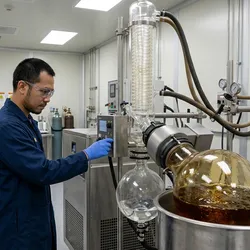
- Single solvents from rotary evaporation: the receiving flask already holds condensed solvent, which can be collected for reuse in cleaning or similar tasks when it’s a single, known solvent.
Two programs, two models
A campus-wide acetone program at CU Boulder
Rather than buy recyclers for each lab, the University of Colorado Boulder runs a central solvent recycling and reuse program. Labs collect spent acetone, methanol, or ethanol in empty 4 L jugs, label them as hazardous waste with an accumulation start date, and send them for distillation; recycled solvent goes back to participating labs for free. The program reports an overall efficiency of about 76% for acetone, and 1,612 gallons reused between 2013 and 2023, worth about $30,160 at 2024 prices. The model works because the program, not each lab, owns the equipment and the paperwork.


Lab Quality Management Certificate
The Lab Quality Management certificate is more than training—it’s a professional advantage.
Gain critical skills and IACET-approved CEUs that make a measurable difference.
A chemistry lab that changed its glassware habits
At UC Merced, a chemistry lab that recycles its acetone reports that about 80% comes back ready for reuse each run, and that six months of recycling diverted 500 pounds of solvent waste and saved $3,000 in hazardous waste fees, according to the equipment maker’s case study. The lab also found that recycling made it cost-effective to wash and reuse small glass vials instead of discarding them, a knock-on saving that rarely appears in a payback calculation.
Making it work: quality, rules, and safety
- Segregate at the source. Separate containers for each recyclable solvent, kept free of halogens, acids, and reactive residues.
- Verify quality for the use. Check purity and water content, for example by GC or Karl Fischer titration, especially before reusing solvent in any process sensitive to impurities.
- Label and track correctly. Until it’s recovered, spent solvent is typically hazardous waste; follow your EHS program, as CU Boulder does with standard waste tags and accumulation dates. Canadian labs should confirm provincial requirements.
- Distill safely. Use equipment designed for flammable solvent recovery, in a suitable location, with spill containment; rotovap safety principles also apply; see our guide to rotary evaporator safety.
- Store recovered solvent like new. It’s still flammable and counts toward storage limits; see our guides to lab chemical storage and NFPA 45 quantity limits.
- Don’t forget evaporator choice. Blowdown evaporators exhaust solvent rather than capturing it, while vacuum systems can collect it; see our comparison of nitrogen and centrifugal evaporators.
Running the payback math
- Annual purchase savings: liters recovered per year × price per liter of new solvent.
- Annual disposal savings: liters of waste avoided × disposal cost per liter.
- Annual operating costs: electricity, consumables, maintenance, and staff time to run the recycler.
- Payback: equipment and installation cost divided by (purchase savings + disposal savings − operating costs).
Use a realistic recovery rate, such as 75% to 80% from the examples above, rather than 100%.
A solvent recovery checklist
- Measure your solvent use and waste by type. Volumes per solvent per month tell you whether recovery is worth exploring.
- Confirm streams can be segregated. Halogenated or mixed waste usually rules recovery out; segregation has to start at the bench.
- Decide where recovered solvent will be used. Cleaning, histology, and extraction tolerate recovered solvent well; analytical uses need verified purity.
- Run the payback numbers with real recovery rates. Include purchases, disposal, operating costs, and staff time, using 75% to 80% recovery as a starting assumption.
- Consider a central program. A shared, EHS-run program can serve many labs and handle the paperwork.
- Involve EHS from the start. Hazardous waste rules, labeling, permits, and equipment location all need EHS input.
- Verify quality routinely. Test purity and water content, and set acceptance criteria for each use.
- Store and handle recovered solvent safely. Treat it like new solvent for flammability, storage limits, and compatibility.
Solvent recovery isn’t a universal win, but where the conditions are right it’s one of the few sustainability projects that pays for itself in a couple of years. Start with the solvent you buy most and waste most consistently, keep it clean, and count the purchase savings, not just the disposal bill.
This article was produced under Lab Manager’s AI Editorial Guidelines