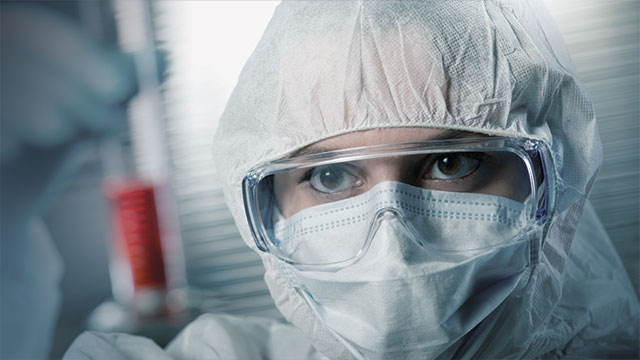
Personal Protective Equipment—Lab Safety's Last Defense
What if you were working in your lab and a grenade went off? In general, we are reluctant to play the fear card, but this accident got us thinking, and led to this month’s topic. Here is a brief description:
A laboratory was seriously damaged when the rotor of an ultracentrifuge failed while in use. Flying metal fragments damaged walls, the ceiling, and other equipment. The shock wave blew out the laboratory’s windows and shook down shelves.
The subsequent explosion completely destroyed the centrifuge. The safety shielding in the unit did not contain all the metal fragments. The half-inch-thick sliding steel door on top of the unit buckled, allowing fragments, including the steel rotor top, to escape. Fragments ruined a nearby refrigerator and an ultra-cold freezer, in addition to making holes in the walls and ceiling.1
In today’s laboratory workplace we commonly find basic equipment that could prove potentially hazardous. That is why OSHA requires the first line of defense against workplace hazards to be engineering controls. However, engineering controls are not perfect, as our example shows. But controlling a hazard at its source is the first choice because this method can either eliminate it from the workplace altogether or isolate it from the worker. These controls might include proper ventilation, machine guarding, hazardous product substitution, biosafety cabinets and ventilated work stations, anesthetic gas scavenging systems, etc. Protection concepts are built into current OSHA standards (29 CFR 1910 Subpart I–1910 Subpart I, Personal Protective Equipment).2

Personal protective equipment (PPE) is our last defense because it means the hazard is actually at hand— and without the PPE, hazardous exposure or injury may very likely occur. PPE includes items such as gloves, lab coats, footwear, face shields, goggles, hearing protection, and respirators. Fortunately, no one was in the room when the ultracentrifuge in our example exploded. If someone had been there, PPE may have provided only limited protection, but theoretically would have reduced injury to critical organs (eye protection/face shields). Regardless, from a good practice (and OSHA) perspective, engineering or administrative controls are preferred over the use of PPE unless we can demonstrate that engineering controls are not feasible. We may also use PPE during the interim period when a hazard has been discovered but engineering controls have yet to be installed. OSHA goes on to say:
“Employers are required to determine if PPE should be used to protect their workers. If PPE is to be used, a PPE program should be implemented. This program should address the hazards present; the selection, maintenance, and use of PPE; the training of employees; and monitoring of the program to ensure its ongoing effectiveness.”2
OSHA requires documentation that the equipment selection is based on the hazard, that employees have properly fitted equipment and are trained on the equipment assigned, and that the equipment is kept in good repair. A good PPE program also includes a monitoring aspect to ensure the equipment used is still appropriate for the job and that the employees are actually wearing and maintaining it properly.
Let’s take a look at these elements individually.
Workplace survey:
The first step in identifying hazards and proper controls is conducting thorough workplace surveys and job hazard analyses (JHA). Safety Guys have published articles on these topics, and a quick Internet search will get you up to speed. It is through these processes that we figure out the potential risks associated with a particular job and devise ways to control or eliminate them before an injury or accident occurs. The JHA technique focuses on the individual tasks associated with a job and the identification of controls for the hazards in each job step. When the hazard cannot be removed or controlled adequately, say, for example, unexpected splashes, PPE must be used if the work process is to continue.


Lab Safety Management Certificate
The Lab Safety Management certificate is more than training—it’s a professional advantage.
Gain critical skills and IACET-approved CEUs that make a measurable difference.
Selection of appropriate PPE:
Systematically consider each body area: eyes, face, head, hands, feet, ears/ hearing, respiratory system, and whole body. Using the splash example, the JHA should identify eye hazards (chemical/biological splash, impact) and chemical splash to the body, face/head, and hands, etc. Protection from splash back into mucous membranes, the mouth, or the eyes and face might well be accomplished using chemical goggles and a face shield. Gloves would be selected that prevent skin contact and contamination. This may involve consulting chemical compatibility charts (available from all major chemical glove manufacturers or distributors) before a decision is made. Determining exposure to toxic materials where air sampling and analysis may be required is often best conducted by a safety and health professional. Employees should also be given a choice, where possible, of several different PPE options (that meet the safety requirement) based on personal comfort and preference. OSHA provides good assistance through the use of eTools and other guidance.3
Interested in lab health and safety?

Fitting:
If PPE does not fit properly, its effectiveness is often drastically reduced. If you have safety glasses that slide down your face because they are too large, protection is lost. Respirators must fit properly or they are ineffective. There are respirator fit test methods using specialized equipment to quantitatively assess fit, or qualitative challenge tests where isoamyl acetate, saccharin, bitrex, or irritant smoke is used. Gloves may be too large, creating entanglement hazards, or they may be too tight. Once the proper fit is identified, it should be noted in the employee’s records.
Training:
Workers need to know:
- When PPE is necessary—what jobs or areas require use of PPE.
- What PPE is necessary—all the PPE required for specific tasks.
- How to properly check, put on, adjust, wear, and take off their assigned PPE.
- Limitations of the PPE—For example, you don’t want someone wearing a dust mask for protection against anesthetic gases. Injuries and fatalities have resulted from misunderstanding the limits of PPE use.
Proper care, maintenance, useful life, and disposal of the PPE:
Training should be conducted by a competent person or safety professional who really understands these key points and can answer questions accurately. The workers should have a thorough understanding before being allowed to conduct work requiring the use of PPE. This should not be a “paperwork exercise.” OSHA inspectors will often quiz workers to see if they understand why they are wearing PPE, the hazards they are protecting themselves against, and how they care for and store their equipment.
Maintenance:
All too often we see old, damaged, and potentially dangerous PPE used by employees. Examples include dirty, misshapen respirators with ancient cartridges or missing valves; glasses or goggles so scratched that one could not imagine wearing them; filthy, torn-up ear muffs; contaminated gloves or coveralls; etc. PPE must be taken care of to adequately protect the worker. Poorly maintained and cleaned equipment can actually put workers in greater danger. Making sure that equipment is properly maintained is a key component of the program.
Monitoring of the program:
As PPE is the last defense for our workers, it is very important to audit the program on an ongoing basis. This includes a thorough investigation of any accidents or near-misses involving the use of PPE.
In addition to the excellent resources provided by OSHA online, equipment vendors and their technical support groups can provide information on specific protective equipment. Many people equate safety with PPE. It can be very effective in preventing injury, but it is also the most vulnerable to failure as it relies on people to consistently and properly use it each time. Develop and implement solid JHA and PPE programs to ensure your employees maximize protection.
References
1. Lab Safety Explosion Incidents, American Industrial Hygiene Association. Falls Church, VA. https://www.aiha.org/get-involved/VolunteerGroups/LabHSCommittee/Incident%20Pages/Lab-Safety-Centrifuge-Explosions-Incidents.aspx
2. Personal Protective Equipment, US Department of Labor, Occupational Safety and Health Administration. Washington, D.C. http://www.osha.gov/SLTC/personalprotectiveequipment/index.html
3. eTools, eMatrix, Expert Advisors and v-Tools, US Department of Labor, Occupational Safety and Health Administration. Washington, D.C. https://www.osha.gov/dts/osta/oshasoft/index.html