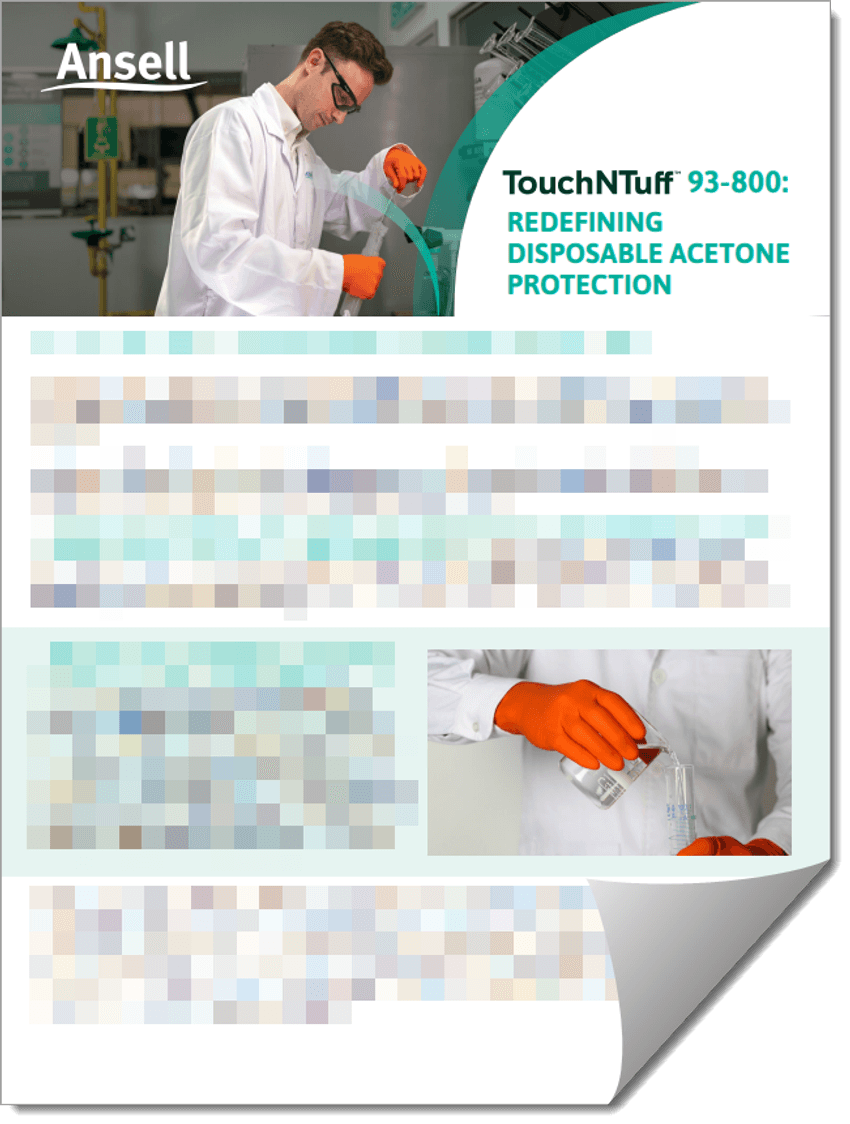
TouchNTuff 93-800: REDEFINING DISPOSABLE ACETONE PROTECTION
Acetone in the Laboratory: Risks, Responsibilities, and the Role of Innovative PPE
In modern research, quality control (QC), and analytical laboratories, acetone is everywhere. As one of the most widely used solvents for cleaning glassware, preparing samples, and dissolving organic materials, it plays an essential role in daily scientific workflows. But its usefulness comes with significant risks, both to workers and to the operational efficiency of the lab.
At the center of this delicate balance is the lab manager, who must keep operations smooth, maintain safety, oversee compliance, manage inventory, and stay current with evolving technologies. When it comes to chemical hazards like acetone, safety and innovation intersect more urgently than anywhere else.
Acetone (C3H6O) is the simplest ketone, a colorless, highly volatile liquid found naturally in the human body and widely produced industrially via the cumene process (co‑produced with phenol). It is a powerful solvent used for sample preparation, cleaning and degreasing lab equipment, chromatography workflows, dissolving plastics/resins/adhesives, cell‑culture hood cleaning routines, and pharmaceutical/cosmetics formulation. Industrial demand remains high across chemicals, electronics, and manufacturing.
OSHA incident reports highlight further risk: acetone‑related workplace accidents related to the risk of fire or explosion from acetone vapors, particularly in industrial and lab settings, continue to cause severe injuries and fatalities. Poison center data also documents frequent exposure cases each year, underscoring the need for robust controls. Beyond chemical hazards, the lab manager must oversee equipment readiness, compliance and audit preparedness, inventory and cost control, training and SOPs, and staff ergonomics. Solvent handling, especially acetone, sits at the intersection of nearly all of these responsibilities.
Laboratory workers may be exposed to acetone through inhalation, skin contact, or accidental ingestion. Its rapid evaporation increases the likelihood of airborne exposure in poorly ventilated areas. Short‑term health effects include eye and respiratory irritation, headaches, dizziness, confusion, nausea or vomiting, and skin dryness/redness/cracking due to strong defatting effects. A landmark study by Fukabori et al. (1990) demonstrated that acetone readily absorbs through the skin, with dermal exposure for 2–4 hours producing internal levels similar to inhalation exposure over the same period, confirming that hands represent a critical exposure route.
PPE for acetone is a surprisingly complex problem. Many thin disposable gloves break down rapidly when exposed to acetone, sometimes within minutes. Gloves that resist acetone tend to be thicker, reusable styles that reduce dexterity. Double‑gloving increases waste and cost while adding ergonomic burden. Frequent glove changes disrupt work and inflate consumption, and inventories can balloon into dozens of glove references that are hard to manage.
These concerns are not just theoretical. Studies on technicians handling solvents (e.g., ANSES research on nail technicians) show that acetone can degrade standard nitrile gloves, increasing the skin’s exposure to co‑handled chemicals, principles that transfer directly to scientific labs.
To address the long-standing challenge of disposable glove failure with acetone, Ansell developed TouchNTuff 93-800, an advanced multipolymer glove engineered to resist acetone for at least 15 minutes, a performance level 15 times longer than standard nitrile disposable gloves, extending safe handling time with aggressive solvents while preserving fine-motor performance for lab tasks.
Key Advantages of TouchNTuff 93‑800
Breakthrough acetone resistance:
Unlike typical thin nitrile gloves that degrade almost instantly, TouchNTuff 93‑800 maintains performance for significantly longer, allowing safer handling during cleaning, sample prep, and transfer tasks.
Dexterity for precision work:
The glove remains thin and flexible, enabling pipetting, cuvette handling, instrument operation, and other delicate manipulations without switching to bulky reusable gloves.
Waste and inventory reduction:
Longer wear times mean fewer changes, which can lower total consumption, reduce stock diversity, and simplify reordering and storage.
Supports compliance:
Improved chemical‑exposure control strengthens risk assessments, SOPs, and PPE validation, aiding audit readiness.
Acetone will remain a cornerstone solvent in laboratories, but its risks are real. Robust safety practices, ventilation, training, exposure limits, and especially effective PPE, are critical to protecting lab professionals. As scientific workloads intensify, laboratories need protective solutions that keep pace with both chemical reality and workflow demands.
Ansell’s TouchNTuff 93-800 multipolymer glove meets this need by delivering unprecedented acetone performance in a disposable format, bridging the gap between safety, dexterity, and operational practicality. It also features a TÜV-certified bio-based formulation containing over 60% bio-based carbon for lower emissions and a smarter, more sustainable choice in hand protection.
Ansell, ® and TM are trademarks owned by Ansell Limited or one of its affiliates. © 2026 Ansell Limited. All rights reserved.
Learn more about our TouchNTuff range of disposable glove protection solutions at TouchNTuff.com