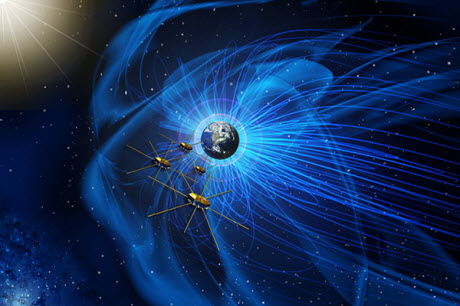
 This NASA artist’s rendition shows the four MMS spacecraft in formation as they collect data on magnetic reconnection.Illustration credit: NASAFor the first time, scientists are looking at real data—not computer models, but direct observation—about what is happening in the fascinating region where the Earth's magnetic field breaks and then joins with the interplanetary magnetic field.
They don't know exactly what this new window of science will open to us—that's the thrill of discovery and, for some, the scary part, too.
But enormous amounts of data now are arriving daily—and publicly accessible—from NASA's $1 billion Magnetospheric Multiscale Mission, called MMS for short, which was launched in March 2015.
It's a giant leap for plasma physics.
University of Delaware professors Michael Shay and William Matthaeus, both in the Department of Physics and Astronomy, are among scores of scientists involved in the project, which aims to understand magnetic reconnection, a process that produces powerful phenomena including solar flares and large releases of plasma from the sun's corona. (See video in which they discuss the mission.)
On May 12 on its website, the journal Science published the team's first analysis of data received from the MMS sensors. Shay is among 52 listed authors, with J.L. Burch of the Southwest Research Institute in San Antonio, Texas, the principal investigator.
The list of represented institutions includes NASA, half a dozen universities in the United States, and research programs in the United Kingdom, Austria, Sweden, France and Japan.
Shay says the single event analyzed in the Science article showed more similarities with simple simulations than many scientists expected to see. But this is one event out of thousands, Shay stressed, so it is just the beginning.
"This is going to dominate my research field for many years," Shay said. "And we'll still be looking at the data in 20 years."
Shay's primary contribution is in calculating and defining the parameters of the regions the team is studying—the electron diffusion regions, areas where the Earth's magnetic field breaks and reconnects with the interplanetary magnetic field. It is in those regions that scientists hope to learn how reconnection occurs.
Using four identical spacecraft, flying in formation, the MMS Mission makes it possible to get high-resolution measurements of the particles and the electric and magnetic fields at the electron scale, with time stamps marked in milliseconds.
To do it, the spacecraft sensors gather measurements of the plasma and the electric and magnetic fields within a very narrow (2-kilometer) and fast-moving area (50 kilometers per second) where the Earth's magnetic field and the solar wind meet. Those areas are called electron diffusion regions. Magnetic reconnection, which releases kinetic energy and heat, is most likely to be observed in those regions.
Understanding the area where the reconnection occurs has been, until now, a matter of computer modeling and laboratory work. With these instruments now on duty, direct observation is possible.
But no one knows what the mission might ultimately reveal.
"This mission really reinforces the notion that science is a collective process," Shay said. "Discoveries of this magnitude are not often driven by breakthroughs by a single individual, but instead by many scientists collaborating together."
Shay and Matthaeus both were at Cape Canaveral, Florida, to witness the mission launch in March 2015. Four identical spacecraft went into orbit, where they now fly in formation collecting data.
Each is equipped with an array of instruments including plasma analyzers, energetic particle detectors, magnetometers, electric field instruments, and a system that prevents the spacecraft's charging process from interfering with those measurements.
After several months of calibrating and verifying the data during the commissioning phase of the mission, the scientific process started in September, with high-resolution data arriving in significant quantities.
Only about 4 percent of the data collected can be transmitted back to Earth, so making wise choices about what to download is an essential part of the process. It is a two-step arrangement, with an automated system in place to recognize certain patterns as significant and a "scientist-in-the-loop" who does an additional evaluation and selection.
The first phase of the mission is focused on what is called the magnetopause area, the place where the force of the sun's solar wind and the Earth's magnetic field are balanced. The second phase will focus on the far side, what is known as the geomagnetic tail.
By mid-December, the spacecraft had crossed the diffusion region more than 2,000 times, and researchers believe at least half of those crossings were made during magnetic reconnection events. It is in that area that magnetic energy is converted to particle kinetic energy.
"All in all, the data we have gotten so far has just been astounding,” Burch said at the time. “Now we're sifting through those observations and we’re going to be able to understand the drivers behind magnetic reconnection in a way never before possible."
Shay said the scientists had regular teleconferences for several months to talk about—and sometimes argue about—how to interpret the data and met in San Antonio, Texas, in early November for a few days.
Magnetic reconnection has been explored many times in the past, but never at the high time/space resolution that the MMS Mission offers.
"On one hand, you have an expectation about the way things will be," Shay said, "but measurements of nature are always surprising, with new physics that we didn’t or even couldn’t anticipate.”
That's the thrill and the challenge of science, he said.
"You think you have an idea that can explain things and the next day you might get information that says that whole idea is wrong. As with any creative process, it's both exhilarating and sometimes honestly frustrating. It's very exciting, not necessarily comfortable. But it is wonderful working with all of these scientists—just a pleasure."












