As sustainability mandates become as important as budget mandates, the reuse of high-quality scientific instrumentation is becoming a badge of operational efficiency rather than a sign of budget distress.
The Pre-Owned Equipment Playbook: Maximizing Budgets Without Compromising Quality
As the secondary market for scientific instrumentation matures, savvy lab managers are leveraging refurbished technology to stretch grant dollars—but navigating the risks of downtime and reliability remains a critical hurdle.
Trevor Henderson BSc (HK), MSc, PhD (c), has more than two decades of experience in the fields of scientific and technical writing, editing, and creative content creation.
For decades, the procurement of laboratory equipment followed a rigid path: you either bought brand new from the Original Equipment Manufacturer (OEM) or you didn't buy at all. The secondary market was often viewed with suspicion, whispered about as a "wild west" of unreliable hardware and orphaned systems without technical support.
However, the landscape is shifting. In an era defined by 81.1% of laboratories facing strict cost-reduction mandates and escalating global supply chain volatility, the "new-only" philosophy is being replaced by a more pragmatic approach. The secondary market has matured into a sophisticated ecosystem of certified refurbishers, asset recovery specialists, and OEM-backed trade-in programs.
The Motivations: Stretching the Scientific Dollar
The adoption of pre-owned technology is no longer a niche strategy for underfunded startups. According to data from the Fall 2025 Purchasing Trends Survey, 35.4% of respondents actively purchase pre-owned laboratory equipment as part of their standard procurement strategy.
Flow (2026)
The primary driver is clear: 38.3% of all survey takers cite saving money as their chief motivation. In an environment where 33.7% of labs anticipate their technology investment budgets will actually increase in the next 12 months, the goal isn't just to spend less—it’s to do more.
By opting for refurbished analytical instruments—like HPLCs, mass spectrometers, or centrifuges—labs can often acquire high-end, name-brand technology for 50-70% of the original sticker price. This allows a single grant to cover a whole suite of instruments rather than just one, drastically increasing the throughput and capabilities of the lab without requiring a proportional increase in capital expenditure.
Addressing the Skeptics: Valid Fears of the "New-Only" Crowd
Despite the potential for massive savings, a significant portion of the industry remains hesitant. The survey data reveal that 26.3% of lab professionals strictly refuse to buy pre-owned.
Their reasons are well-founded and center on three critical pillars:
Reliability Concerns: In a high-stakes research environment, an instrument failure doesn't just cost repair money; it costs weeks of lost time and potentially irreplaceable samples.
Lack of Warranties: Skeptics fear that once a pre-owned unit is delivered, they are "on their own" without the safety net of an OEM service contract.
Contamination and History: For labs working in genomics or clinical diagnostics, the unknown history of a pre-owned incubator or shaker presents a perceived risk of cross-contamination that could invalidate years of data.
To move past these hurdles, the secondary market has had to evolve, moving away from "as-is" auctions toward "certified pre-owned" models that mimic the experience of buying new.
The Buyer’s Checklist: Navigating the Secondary Market
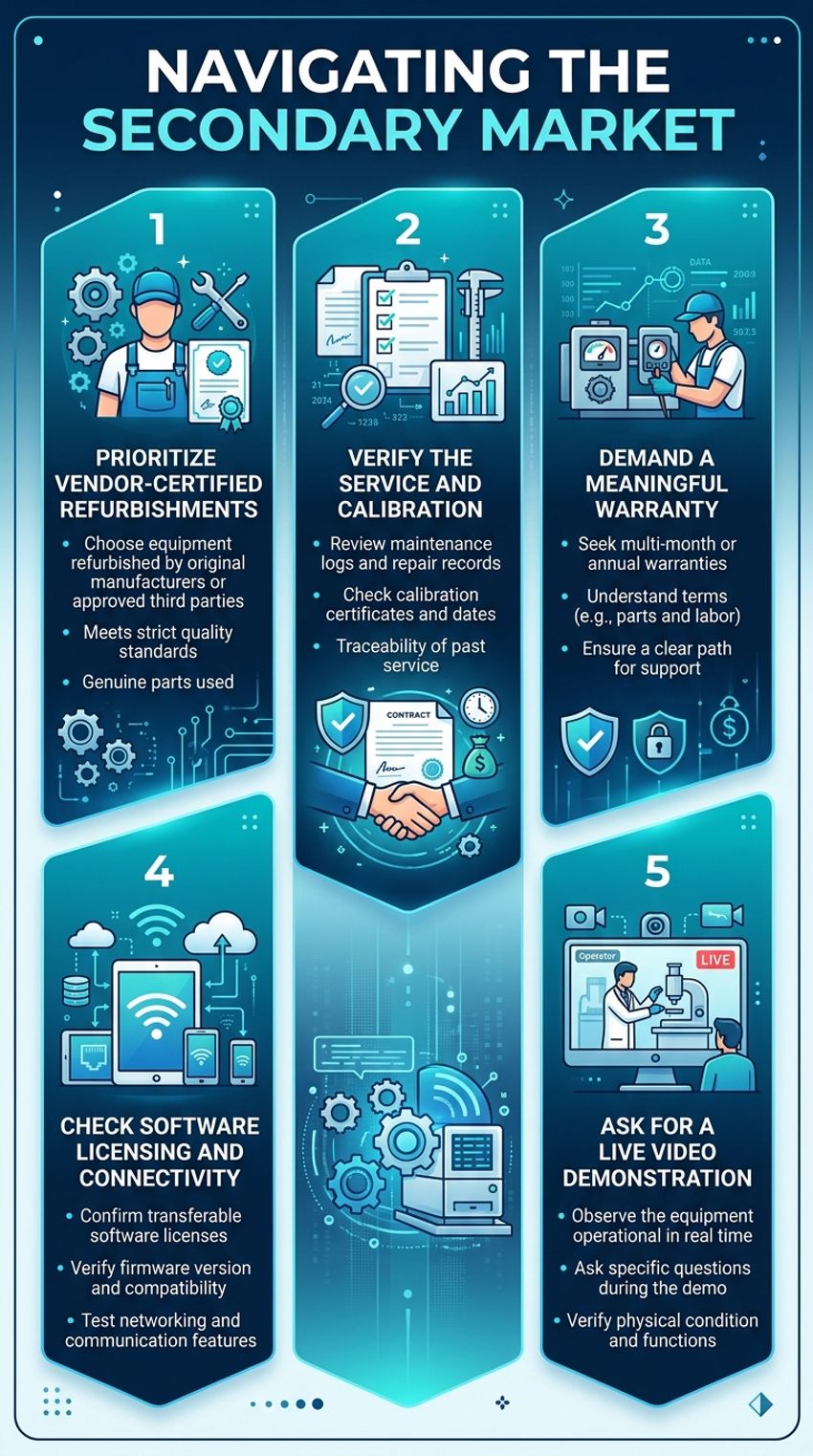
Buying refurbished equipment requires a higher level of due diligence than buying new. If you are one of the 33.7% planning to increase your technology investment this year, use this checklist to ensure your pre-owned purchase is an asset, not a liability.
Flow (2026)
1. Prioritize Vendor-Certified Refurbishments
Don't buy from a general liquidator. Seek out specialist refurbishers who have in-house, factory-trained technicians. A "certified" unit should have undergone a documented multi-step process including disassembly, component replacement (seals, lamps, tubing), recalibration, and performance validation against original specifications.
2. Verify the Service and Calibration History
A reputable seller should be able to provide the service logs of the instrument. Has it been regularly maintained? Was it decommissioned because of a catastrophic failure or simply because a larger facility upgraded to a newer model? Transparency is the ultimate green flag.
3. Demand a Meaningful Warranty
Avoid any seller offering less than a 90-day warranty. The best refurbishers now offer one-year warranties that mirror OEM terms. Furthermore, ask about post-warranty support—do they stock spare parts locally, and can they provide on-site service?
4. Check Software Licensing and Connectivity
In 2026, a machine is only as good as its software. Ensure the pre-owned unit includes the necessary licenses and dongles. Verify that the operating system is compatible with your current IT infrastructure and that the firmware isn't so obsolete that it creates a cybersecurity vulnerability.
5. Ask for a Live Video Demonstration
If you can't visit the warehouse in person, ask for a live video of the instrument "powering on and lighting up." Seeing the unit run a self-test or a standard sample in real-time provides a level of assurance that photos alone cannot match.
The Future of Procurement
The divide between "new" and "pre-owned" is blurring. As sustainability mandates become as important as budget mandates, the reuse of high-quality scientific instrumentation is becoming a badge of operational efficiency rather than a sign of budget distress. By following a structured playbook, lab managers can bridge the gap between financial responsibility and scientific excellence.
Add Lab Manager as a preferred Google source to see more of our trusted coverage.
Trevor Henderson BSc (HK), MSc, PhD (c), has more than two decades of experience in the fields of scientific and technical writing, editing, and creative content creation. With academic training in the areas of human biology, physical anthropology, and community health, he has a broad skill set of both laboratory and analytical skills. Since 2013, he has been working with LabX Media Group developing content solutions that engage and inform scientists and laboratorians. He can be reached at thenderson@labmanager.com.