While genuine machine consciousness is still years into the future, we are beginning to see computers make choices that previously demanded a human’s input
Brought to you byRasmus Rørbæk-Aarhus University News Office
Today, people of all backgrounds can contribute to solving serious scientific problems by playing computer games. A Danish research group has extended the limits of quantum physics calculations and simultaneously blurred the boundaries between man and machine further. We are still superior–in some ways.
The saying of philosopher René Descartes of what makes humans unique is beginning to sound hollow. ‘I think–therefore soon I am obsolete’ seems more appropriate. When a computer routinely beats us at chess and we can barely navigate without the help of a GPS, have we outlived our place in the world? Not quite. Welcome to the front line of research in cognitive skills, quantum computers and gaming.
Today there is an on-going battle between man and machine. While genuine machine consciousness is still years into the future, we are beginning to see computers make choices that previously demanded a human’s input. Recently, the world held its breath as Google's algorithm AlphaGo beat a professional player in the game Go—an achievement demonstrating the explosive speed of development in machine capabilities.
But we are not beaten yet–human skills are still superior in some areas. This is one of the conclusions of a recent study by Danish physicist Jacob Sherson, published in the prestigious science journal Nature.
”It may sound dramatic, but we are currently in a race with technology—and steadily being overtaken in many areas. Features that used to be uniquely human are fully captured by contemporary algorithms. Our results are here to demonstrate that there is still a difference between the abilities of a man and a machine,” explains Jacob Sherson.
To continue reading this article, sign up for FREE to
Membership is FREE and provides you with instant access to eNewsletters, digital publications, article archives, and more.
Today, people of all backgrounds can contribute to solving serious scientific problems by playing computer games. A Danish research group has extended the limits of quantum physics calculations and simultaneously blurred the boundaries between man and machine further. We are still superior–in some ways.
The saying of philosopher René Descartes of what makes humans unique is beginning to sound hollow. ‘I think–therefore soon I am obsolete’ seems more appropriate. When a computer routinely beats us at chess and we can barely navigate without the help of a GPS, have we outlived our place in the world? Not quite. Welcome to the front line of research in cognitive skills, quantum computers and gaming.
The Danish research team, CODER, has found out, that the human brain can beat the calculating powers of a computer, when it comes to solving quantum-problems.Illustration credit: Colourbox
Today there is an on-going battle between man and machine. While genuine machine consciousness is still years into the future, we are beginning to see computers make choices that previously demanded a human’s input. Recently, the world held its breath as Google's algorithm AlphaGo beat a professional player in the game Go—an achievement demonstrating the explosive speed of development in machine capabilities.
But we are not beaten yet–human skills are still superior in some areas. This is one of the conclusions of a recent study by Danish physicist Jacob Sherson, published in the prestigious science journal Nature.
”It may sound dramatic, but we are currently in a race with technology—and steadily being overtaken in many areas. Features that used to be uniquely human are fully captured by contemporary algorithms. Our results are here to demonstrate that there is still a difference between the abilities of a man and a machine,” explains Jacob Sherson.
At the interface between quantum physics and computer games, Sherson and his research group at Aarhus University have identified one of the abilities that still makes us unique compared to a computer's enormous processing power: our skill in approaching problems heuristically and solving them intuitively. The discovery was made at the AU Ideas Centre CODER, where an interdisciplinary team of researchers work to transfer some human traits to the way computer algorithms work. ?
Quantum physics holds the promise of immense technological advances in areas ranging from computing to high-precision measurements. However, the problems that need to be solved to get there are so complex that even the most powerful supercomputers struggle with them. This is where the core idea behind CODER—combining the processing power of computers with human ingenuity—becomes clear. ?
Our common intuition
Like Columbus in QuantumLand, the CODER research group mapped out how the human brain is able to make decisions based on intuition and accumulated experience. This is done using the online game "Quantum Moves”. Over 10,000 people have played the game that allows everyone contribute to basic research in quantum physics.
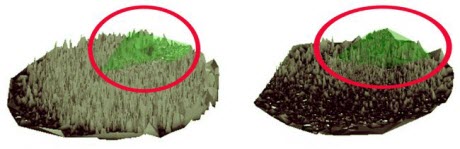
This is how the "Mind Atlas" looks. Based on 500.000 completed games the group has been able to visualize our ability to solve problems. Each peak on the 'map' represents a good idea, and the area with the most peaks - marked by red rings - are where the human intuition has hit a solution. A computer can then learn to focus on these areas, and in that way 'learn' about the cognitive functions of a human.Illustration credit: CODER/AU"The map we created gives us insight into the strategies formed by the human brain. We behave intuitively when we need to solve an unknown problem, whereas for a computer this is incomprehensible. A computer churns through enormous amounts of information, but we can choose not to do this by basing our decision on experience or intuition. It is these intuitive insights that we discovered by analysing the Quantum Moves player solutions,” explains Jacob Sherson. ?
The laws of quantum physics dictate an upper speed limit for data manipulation, which in turn sets the ultimate limit to the processing power of quantum computers—the Quantum Speed ??Limit. Until now a computer algorithm has been used to identify this limit. It turns out that with human input researchers can find much better solutions than the algorithm.
"The players solve a very complex problem by creating simple strategies. Where a computer goes through all available options, players automatically search for a solution that intuitively feels right. Through our analysis we found that there are common features in the players' solutions, providing a glimpse into the shared intuition of humanity. If we can teach computers to recognize these good solutions, calculations will be much faster. In a sense we are downloading our common intuition to the computer" says Jacob Sherson.
And it works. The group has shown that we can break the Quantum Speed Limit by combining the cerebral cortex and computer chips. This is the new powerful tool in the development of quantum computers and other quantum technologies.
We are the new supercomputer
Science is often perceived as something distant and exclusive, conducted behind closed doors. To enter you have to go through years of education, and preferably have a doctorate or two. Now a completely different reality is materialising. ?
In recent years, a new phenomenon has appeared—citizen science breaks down the walls of the laboratory and invites in everyone who wants to contribute. The team at Aarhus University uses games to engage people in voluntary science research. Every week people around the world spend 3 billion hours playing games. Games are entering almost all areas of our daily life and have the potential to become an invaluable resource for science.
Humans spend 3.000.000.000 hours gaming away on smartphones and other mobile devices. If it is possible to tap into that calculating resource by just one percent, we would be more than a match for the computer.Photo credit: Colourbox"Who needs a supercomputer if we can access even a small fraction of this computing power? By turning science into games, anyone can do research in quantum physics. We have shown that games break down the barriers between quantum physicists and people of all backgrounds, providing phenomenal insights into state-of-the-art research. Our project combines the best of both worlds and helps challenge established paradigms in computational research,” explains Jacob Sherson.
The difference between the machine and us, figuratively speaking, is that we intuitively reach for the needle in a haystack without knowing exactly where it is. We 'guess' based on experience and thereby skip a whole series of bad options. For Quantum Moves, intuitive human actions have been shown to be compatible with the best computer solutions. In the future it will be exciting to explore many other problems with the aid of human intuition.
"We are at the borderline of what we as humans can understand when faced with the problems of quantum physics. With the problem underlying Quantum Moves we give the computer every chance to beat us. Yet, over and over again we see that players are more efficient than machines at solving the problem. While Hollywood blockbusters on artificial intelligence are starting to seem increasingly realistic, our results demonstrate that the comparison between man and machine still sometimes favours us. We are very far from computers with human-type cognition," says Jacob Sherson and continues:
"Our work is first and foremost a big step towards the understanding of quantum physical challenges. We do not know if this can be transferred to other challenging problems, but it is definitely something that we will work hard to resolve in the coming years."
Video courtesy of ScienceAtHome
What are quantum computers and how goes playing games help physicist in cutting edge research?
Get a few answers in this video about ScienceAtHome.