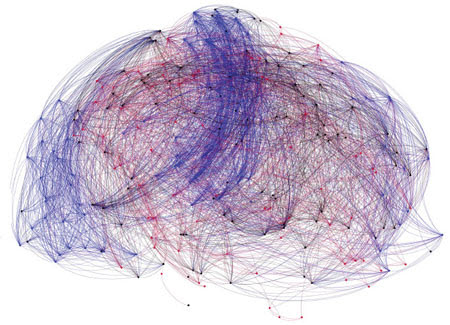
 Side view of a model of the brain with the connector hubs shown in red.Image courtesy of Maxwell BertoleroSwinging a bat at a 90-mph fastball requires keen visual, cognitive and motor skills. But how do diverse brain networks coordinate well enough to hit the ball?
A new University of California, Berkeley study suggests the human brain’s aptitude and versatility can be credited in large part to “connector hubs,” which filter and route information. They coordinate and integrate the flow of data so that brain networks dedicated to specific roles, such as vision and movement, can focus on their jobs.
“Our findings show that connector hubs allow for distinct networks to each do their own thing, yet still interact with each other effectively,“ said study lead author Maxwell Bertolero, a PhD student in neuroscience at UC Berkeley.
Related article: Neuroscience-Based Algorithms Make for Better Networks
Moreover, the brain’s two dozen or so connector hubs play a key role in complex cognitive tasks, and are vulnerable to brain damage and dysfunction. Thus, the findings could “help neuroscientists shed more light on the neural bases of disorders such as schizophrenia and Alzheimer’s, ” which are marked by malfunctions in the brain’s wiring, Bertolero said.
The findings are the result of a meta-analysis conducted in January by Bertolero and fellow researchers at UC Berkeley and the National University of Singapore of more than 9,000 brain imaging studies in the BrainMap database that cover more than 75 cognitive tasks.
The study, just published in the Proceedings of the National Academy of Sciences, found heightened neural activity in the brain’s connector hubs during complex tasks, such as puzzles and video games, while networks dedicated to specific functions did not need to put in extra work.
Related article: INSIGHTS on Neuroimaging
The more complex the task, in that more networks are required for the job, the greater the activity in the connector hubs, keeping the burden off individual networks, the study found.
Like an airline hub, the brain’s main connector hubs link to multiple brain networks like transfer stations. These hubs have been found in the brains of many mammals, including mice and macaque monkeys.
Previous studies have linked connector hubs to the coordination and integration of information between multiple brain networks, but this latest study measured exactly how much of the work was being done by the hubs vis–à–vis networks dedicated to specific tasks.
The experiments used functional magnetic resonance imaging to measure increased blood flow throughout the brain, a marker of increased neural activity, during a wide range of activities, including finger-tapping, whistling, chewing, drawing, writing, reading, watching a movie and playing video games and memory games.
Researchers mapped the brain’s connections as one would analyze a large-scale network such as the U.S electrical grid, global flight patterns or Linkedin professional connections, creating a model of the brain’s “connectome.“
Using “graph theory,” which is used in many scientific fields to study networks, they identified 14 distinct networks of tightly interconnected regions and roughly 25 connector hubs.
Related article: Researchers Provide First Peek at How Neurons Multitask
They then compared neural activity in the connector hubs to activity in each of the brain’s dedicated networks during all the tasks recorded in the BrainMap database.They found that activity increased only at connector hubs as more networks were required for a task, indicating that connector hubs, but not individual networks, must process more information during these more complex tasks.
Next, Bertolero said, he and his co-authors plan to look into why evolution built a brain with distinct networks and connector hubs, precisely how connector hubs integrate and coordinate, and what happens when they are damaged by a stroke, for example.
In addition to Bertolero, co-authors of the study are Mark D’Esposito at UC Berkeley and B.T. Thomas Yeo at the National University of Singapore. The research was funded by grants from the National Institute of Health, the National Science Foundation, the National University of Singapore and the Singapore Ministry of Education.