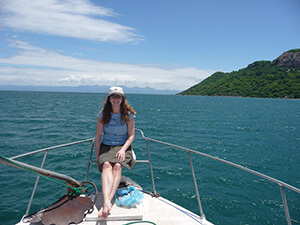
 Melissa Berke on Lake Malawi.Photo courtesy of the University of Notre DameFrom the depths of Lake Malawi, Melissa Berke has helped uncover evidence that offers new insights into a long-held theory about Africa’s climate history.
The research from Berke, assistant professor in the Department of Civil and Environmental Engineering and Earth Sciences at the University of Notre Dame and Environmental Change Initiative affiliate, suggests that Africa has gradually become wetter over the past 1.3 million years—instead of drier as was thought previously. The findings shine new light on the “savanna hypothesis,” which held that humans in Africa as a whole migrated to grasslands due to a changing climate.
The sediment samples that Berke studied came from Lake Malawi in southeast Africa, whereas data used for the savanna hypothesis came from the north. Her research suggests that climate conditions across Africa may have been more variable than once thought.
Importantly, Berke’s samples also reflect the longest continuous record of temperature data ever collected on the African continent. Apart from their age, the materials she analyzed were of exceptional quality.
“Lake Malawi is one of the deepest lakes in Africa, and the sediment samples taken from it are finely laminated. You can readily see how it changes across intervals of time,” said Berke.


Berke’s research specialty is to look for biochemical markers—“chemical fossils” that help scientists measure changes in vegetation and climate over time. One of the most enduring markers she examines is a commonplace substance known as leaf wax.
“All terrestrial leaves have wax,” she said. “It’s what makes water bead on grass or an oak leaf. Long after stems and roots have faded away, leaf wax residue can be preserved for hundreds of millions of years. Each leaf has its own chemistry, so when it washes into a lake or ocean we use it to tell us about its environment.”
Earlier this year, Berke boarded a research vessel in the Indian Ocean with 29 international scientists to retrieve sediment cores off the coast of southern Africa. Her findings will build on the Lake Malawi research and examine sediments that date seven million years, the oldest such samples taken in this location.
Berke’s work takes a decidedly long view. As a geologist, she can speak of events that happened “only 23,000 years ago.” Yet she’s also quick to point out why this look back at Africa’s geologic past should matter now.
“When we look at today’s climate, at flooding in Louisiana or West Virginia, or fires in California, we need historical context to understand what’s happening,” she said. “We can’t just rely on modern climate data to understand the past. Those records only go back 150 years. The more data we have about what’s happened across millions of years of climate, the better our predictions of the future will be.”
Berke’s research, “A progressively wetter climate in southern East Africa over the past 1.3 million years,” was recently published in the journal Nature. It can be accessed online here: www.nature.com/nature/journal/vaop/ncurrent/full/nature19065.html.