The recent crash in oil prices notwithstanding, an economy based on fossil fuels seems unsustainable. Supplies of oil, coal and similar fuels are finite, and even if new sources are found, global warming must be considered. Limitless solar power remains the Holy Grail, but among other obstacles to widespread adoption, society needs ways to store solar energy and deliver power when the sun isn't shining.
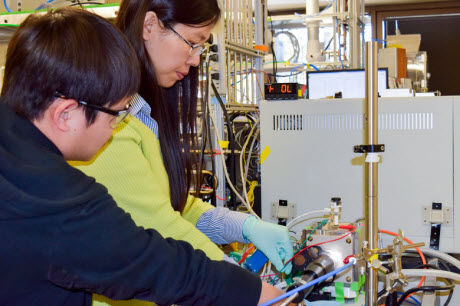 Graduate student Xiaofei Ye (left) helps postdoctoral scholar Liming Zhang adjust an experimental device that, confounding conventional wisdom, showed that heating metal oxide solar cells increased their efficiency.Photo credit: Tom AbateAs energy experts would say, engineers must make solar power "dispatchable," using an industry term to describe how utilities boost power output or throttle back depending on demand, something they now do by burning more or less fossil fuel.
Now a team led by William Chueh, an assistant professor of materials science and engineering at Stanford University, and Nicholas Melosh, an associate professor in the same department, has made a discovery that could make large-scale solar power storage a reality.
The breakthrough is based on the fact that ordinary metal oxides, such as rust, can be fashioned into solar cells capable of splitting water into hydrogen and oxygen.
Related Article: World’s First Solar Battery Hits Milestone
Using solar cells to split H2O by day is a way to store energy for use at night. The photons captured by the cell are converted into the electrons that provide the energy to split water. Recombining hydrogen and oxygen after dark would be a way to reclaim that energy and "dispatch" power back into the electrical grid–without burning fossil fuels and releasing more carbon into the atmosphere.
The solar power potential of metal oxides was previously known. But metal oxide solar cells were also known to be less efficient at converting photons to electrons than silicon solar cells.
A discovery reported in the journal Energy & Environmental Science makes metal oxide solar cells a better candidate for energy storage. The Stanford team showed that as metal oxide solar cells grow hotter, they convert photons into electrons more efficiently. The exact opposite is true with silicon solar cells, which lose efficiency as they heat up.
"We've shown that inexpensive, abundant and readily processed metal oxides could become better producers of electricity than was previously supposed," Chueh said.
This unexpected discovery could lead to a revolutionary change in how we produce, store and consume energy.
"By combining heat and light, solar water-splitting cells based on metal oxides become significantly more efficient at storing the inexhaustible power of the sun for use on demand," he said.
Achieving cost-efficiency
So far it has been impractical to use water-splitting as a way to store the sun's energy. One reason is cost-efficiency. Silicon-based solar cells, such as those used in rooftop solar arrays, are good at converting visible and ultraviolet light into electricity. But silicon cells waste the infrared light, which bears heat, beating down on them.
"Standard cells utilize a relatively small portion of the spectrum, and the rest is lost as heat," Chueh said.
Until the recent Stanford experiments, it was believed that metal oxides also became less efficient as they became hotter. And since they were less efficient than silicon to start with, that made them less interesting as a water-splitting technology.
The Stanford experiments change that misconception.
The researchers tested three metal oxides–bismuth vanadium oxide, titanium oxide and iron oxide, more commonly known as rust. They wanted to see how efficient these oxides were at converting photons to electrons–and splitting water into hydrogen and oxygen–at different temperatures. (See video of side-by-side comparisons.)
"In all three cases we observed increased production of hydrogen and oxygen at higher temperatures," said Liming Zhang, a postdoctoral scholar in Chueh's lab and co-lead author of the paper. "We realized that the higher temperatures were enhancing the carrier mobility of these cells–the speed at which electrons can pass through the metal oxides."
The increase in efficiency was remarkable, said Xiaofei Ye, the other co-lead author of the paper, who recently defended his thesis centered on this project.
"Our results shows that heating up metal oxides with sunlight can double rate of hydrogen generation," Ye said.
Bismuth vanadium oxide was the most efficient of the three oxides they tested. But team members believe this heat-enhancing effect may work for many different metal oxides, and they plan to test more materials previously considered impractical as solar cell material.
"We'll also be looking for those temperature sweet spots where performance is optimized," said graduate student and team member Madhur Boloor.
Discovering that heating up metal oxides produces more energy means that relatively simple engineering could be applied to heat these solar cells to enhance their efficiency.
"You don't have to add energy from an outside source," said graduate student and team member Andrey Poletayev. "You can do it for free by concentrating solar radiation, either through a magnifying lens or parabolic mirrors."
Chueh believes that this discovery will refocus attention on developing metal oxides as cost-effective alternatives to silicon solar cells. Quite apart from their potential use in a day-to-night energy storage scenario, he envisions that pure hydrogen gas produced by water-splitting could be used to power vehicles or other machines directly and without pollution.
"We can store these gases, we can transport them through pipelines, and when we burn them we don't release any extra carbon," said Chueh. "It's a carbon-neutral energy cycle."
This research was supported by Stanford's Global Climate and Energy Project and by the National Science Foundation.