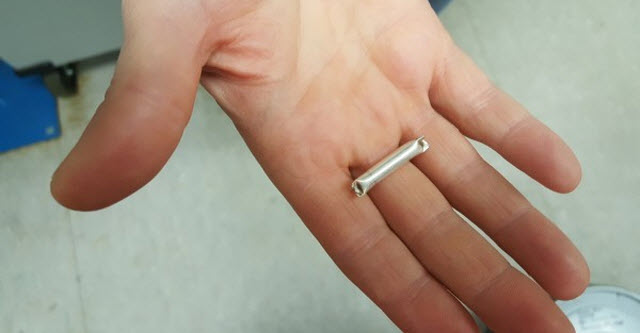
 Jessica Larsen holds a mock packet that ground rock would go into to heat into magma.Photo Courtesy of: Diana Campbell
The best way to figure out how something is made is to take it apart and put it back together again.
That is what Jessica Larsen and her students do at the Geophysical Institute’s Petrology Lab in order to understand active volcanoes in Alaska.
Larsen takes a tiny sliver of volcanic rock, crushes it into rock flour and adds water and other ingredients.
She then puts the tiny sample into a super-heat-resistant cooking device and heats it until it becomes magma again.
Once the experiment cools, a tiny rock is reborn.
Related Article: Atmospheric Signs of Volcanic Activity Could Aid Search for Life
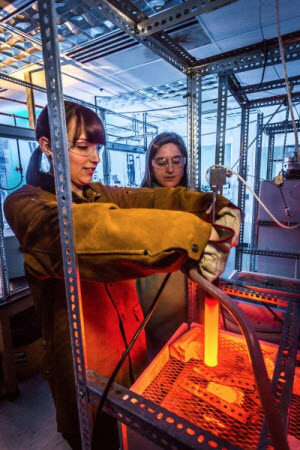 Ph.D. candidate Amanda Lindoo pulls a rod containing remnants of a volcanic eruption from a furnace in the Reichardt Building petrology lab while Professor Jessica Larsen watches.Photo Courtesy of: Todd Paris“What we find out by recreating magma are the temperatures and pressure at which the lava was created,” said Larsen, head of the Petrology Lab. “By doing this we can ‘image’ the inside of a volcano.”
It’s almost like putting a puzzle back together. The temperature and pressure, as well as the rock’s mineral content, tell Larsen how deep the rock came from inside a volcano.
It’s a good alternative method of understanding volcanoes. Taking a real look inside one isn’t practical.
Magma re-creation, along with other research, helps researchers to understand eruptions and possibly ways to better predict them.
At the University of Alaska Fairbanks, where the GI’s Petrology Lab is located, scientists look at a volcano’s surface using GPS. This allows them to see the surface bulge as lava forms in the magma chamber and moves up the main vents. Other researchers use seismometers to note the movement of a volcano’s internal grumblings. Adding what the recreated magma reveals gives a more detailed understanding of volcanoes.
“This is the peak of cutting edge,” Larsen said. “And we can do all this type of research here at UAF.”
Making magma is difficult work, however. The sample is tiny and assembling the experiment has to be exact, Larsen said.
“You have to be very good with your hands to get the sample to fit inside the capsule,” she said. “And then put it inside the furnace.”
It’s important work for Alaska, which is home to 52 active volcanoes. Even the viscosity of the magma is important to know, as two of Larsen’s students are discovering.
Related Article: Simulating Path of ‘Magma Mush’ Inside an Active Volcano
What they find out could help save lives and money. Volcanoes spew ash clouds that scour the insides of airplane engines, causing serious enough damage to bring a jetliner down, Larsen said. Also, many Alaskans live near active volcanoes and would need to know when to take shelter or prepare for poor air quality.
“We might expect eruptions to be similar to what happened in the past,” Larsen said. “But volcanoes are unpredictable and surprise us, even the ones we know well. So we have to be objective and watch for changes.”