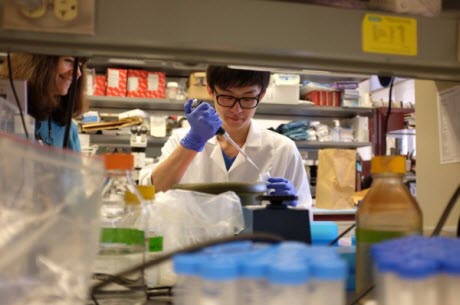
 University of Chicago graduate student Kevin Lei, with Maria-Luisa Alegre, MD, PhD.Photo credit: Matt Wood, University of ChicagoResearchers from the University of Chicago have shown that microbiota—the bacteria, viruses and other microbes living on the skin and in the digestive system—play an important role in the body's ability to accept transplanted skin and other organs.
In a June 20 study, published in The Journal of Clinical Investigation, the team demonstrated that skin grafts between mice treated with antibiotics prior to transplantation survive roughly twice as long as mice that didn't receive the medications. Grafts between mice raised in a sterile, germ-free environment also survived longer. Meanwhile, the team found that if germ-free mice were dosed with microbes from conventional, untreated mice, they rejected the skin grafts more quickly. But if they were dosed with the microbes that survived the antibiotic treatment of conventional mice, they retained the skin grafts similarly to sterile mice. This suggests the composition of the microbiota influences the fate of the graft.
"The species that form the community of microbes colonizing the mice—and supposedly humans too—have different effects," said Maria-Luisa Alegre, MD, PhD, professor of medicine at the University of Chicago and co-senior author of the study. "One community of bacteria from the normal mice is capable of inducing accelerated rejection of a transplant, but another community of bacteria, those that are left after antibiotics, doesn't have that capacity."
Related Article: Making Liver Tissue in the Lab for Transplants and Drug Screening
Success rates for transplants of skin, lungs, and intestines—organs that are exposed to the outside world—are much worse than transplants of internal organs like kidneys and hearts, in both clinical settings for humans and in laboratory animals. One hypothesis has been that the difference may be due to the fact that skin, lungs, and intestines are colonized by microbiota and so-called sterile internal organs are not.
Alegre and her team, including graduate student and lead author Kevin Lei, tested this hypothesis by treating both donor and recipient mice with antibiotics for ten days before performing skin transplants. The skin grafts survived roughly twice as long in the treated mice compared to controls (a mean survival time of 53 versus 27 days) and the specific immune response against the skin graft was decreased. Skin grafts between mice that had been raised in germ-free conditions also survived longer than controls.
By contrast, when germ-free mice were given fecal microbiota transfers from conventional, untreated mice, they rejected the grafts more quickly. Surprisingly, germ-free mice given fecal microbiota transfers from mice that had been treated with antibiotics still rejected the skin grafts slowly, demonstrating distinct effects on graft outcome by these two different communities of microbes. Changing the microbiota also affected the fate of other organ transplants—hearts transplanted into conventional mice pre-treated with antibiotics survived longer as well.
Genetic analysis of bacteria present on the skin of the animals that were treated with antibiotics showed that the overall amount of bacteria was the same as in untreated mice, but with significantly fewer distinct species.
"In terms of the total number of bacteria that are present, it's the same before and after antibiotics. But instead of 1,000 species, let's say you have just 500 after treatment," Alegre said. "So it's not the bacterial load that makes the difference, it's the composition of the bacterial community."
Alegre said a better understanding of the role microbes play to prime or suppress the immune response against a transplanted organ could lead toward new strategies to improve transplant outcomes in humans. One could be the development of more narrow-spectrum antibiotics that target only the bacteria that trigger a rejection response, or conversely, using probiotics with bacteria known to suppress the immune response. However, the specific species that cause either type of response after transplantation are still unknown, and Alegre warns that altering the balance of microbes in the body can have unintended consequences.
Related Article: Gearing Up for Microbiome Research
"We have evolved to cohabit effectively with our microbes, and they are very beneficial," she said. "We need them. They make vitamins we need. They digest foods we can't digest. They help maintain our health by poising our immune system for fighting infections. So we have to be careful with anything that's going to alter that balance."
The study, "The composition of the microbiota modulates allograft rejection," was supported by the National Institute of Allergy and Infectious Diseases and the Roche Organ Transplantation Research Foundation. Additional authors include Luqui Chen, Ying Wang, Andrew T. Stefka, Luciana L. Molinero, Betty Theriault, Keston Aquino-Michaels, Ayelet S. Sivan, Cathryn R. Nagler, Thomas F. Gajewski, Anita S. Chong, and Caroline Bartman, all from the University of Chicago.