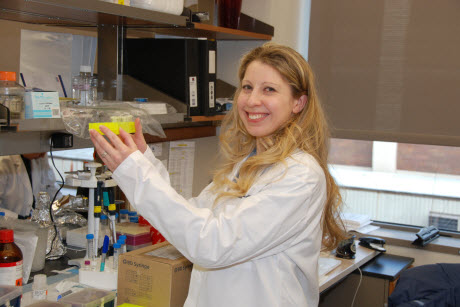
 Jill Kramer, assistant professor in the Department of Oral Biology in the UB School of Dental Medicine, will examine an antibody's effect in Sjögren’s syndrome, which affects more than 1 million Americans.Photo courtesy of the University at BuffaloBUFFALO, N.Y. – For years, researchers believed IgM, a protective type of antibody, played an insignificant role in Sjögren’s syndrome.
However, new research, led by University at Buffalo oral biology researcher Jill Kramer, aims to re-examine whether this seemingly harmless antibody is pathogenic, or capable of causing disease.
The results may lead to a better understanding of IgM’s effect on Sjögren’s syndrome–an incurable autoimmune disorder that affects more than 1 million Americans, 90 percent of whom are women–and other autoimmune diseases, such as lupus and rheumatoid arthritis.
The research, “Analysis of the Source and Significance of IgM in Sjögren’s syndrome,” is one of several studies funded through a $16 million Clinical and Translational Science Award provided to UB from the National Institutes of Health to quicken the delivery of new drugs, diagnostics, and medical devices to patients.
“The best patient care goes hand-in-hand with clinical research,” says Timothy Murphy, MD, principal investigator, SUNY Distinguished Professor of Medicine, and senior associate dean for clinical and translational research in the Jacobs School of Medicine and Biomedical Sciences.
“Dr. Kramer’s study will use novel approaches to identify the type of autoantibodies responsible for Sjögren’s syndrome and is critical in guiding the development of better therapies for this disease.”
Sjögren’s syndrome is an autoimmune disorder in which the body’s white blood cells attack healthy cells that produce saliva and tears. The disorder is characterized by dryness of the eyes and mouth, placing patients at a high risk for tooth decay and other oral health complications.
“Patients with Sjögren’s syndrome are more prone to dental problems, and often experience difficulty in talking and swallowing food,” says Kramer, DDS, PhD, assistant professor in the Department of Oral Biology in the UB School of Dental Medicine. “It is important we understand why the disease occurs and develop new ways to prevent the immune system from attacking healthy tissues.”
Using mice that lack the ability to produce their own antibodies, Kramer will administer IgM from mice with Sjögren’s syndrome and examine whether the rodents develop symptoms related to the disease, a sign that the class of antibody may be pathogenic. A separate set of mice will receive IgG, another type of antibody that is harmful in many autoimmune diseases, including Sjögren’s syndrome.
While IgG is produced primarily to attack bacteria and other pathogens, IgM functions as the body’s garbage man, helping to clean up cellular debris and reduce inflammation before a stronger response with IgG is triggered, says Kramer.
Because of IgG’s harmful nature in autoimmunity, more Sjögren’s syndrome-related research exists on this antibody class than its weaker counterpart. But after recent studies found that those diagnosed with the disorder produce a high amount of IgM, Kramer speculated that the antibody plays a greater role than previously thought.
By testing how IgM effects salivary function in mice, Kramer can learn whether the antibody is harmful or released as part of a protective measure, which could aid the development of medicine and other treatments.
Additional contributors to the project include co-investigator Daniel Gaile, PhD, assistant professor in the Department of Biostatistics in the School of Public Health and Health Professions, and Liam McCabe, a research technician in the School of Dental Medicine.