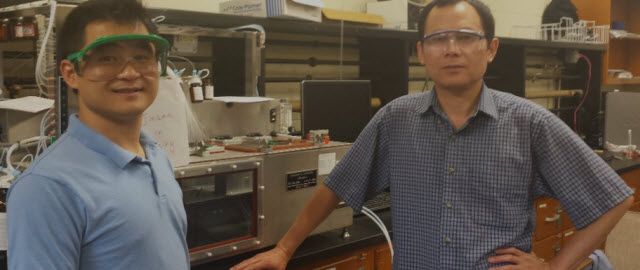
 Postdoc Jinsen Chen, left, and chemistry professor Shiyue Fang in the lab where they and other members of Fang's group discovered a new way to synthesize DNA.Photo courtesy of Michigan Technological University
Michigan Technological University scientists have developed a process that could lead to stickier—and better—gene therapy drugs.
The drugs, called antisense DNA, are made from short, single strands of synthetic DNA. They work by blocking cells from making harmful proteins, which can cause maladies ranging from cancer to Ebola to HIV-AIDS. Only a couple of these synthetic DNA drugs are on the market, but a number are in clinical trials, including a potential treatment for ALS, also known as Lou Gehrig’s disease.
Disease organisms can inject harmful proteins into our bodies, and so can mutations in our own genetic material.
When Messenger RNA Goes Rogue
Here’s how it works in a nutshell. When all goes well, messenger RNA molecules in our cells produce the good proteins that are essential to life. However, when mutations occur, messenger RNA can go rogue and start making proteins that make us sick.
Drugs made from synthetic DNA are tailored to grab onto these mutant messenger RNA molecules, binding to them and preventing them from churning out toxic proteins. However, a serious shortfall with synthetic DNA is that it can be wimpy. Sometimes it loosens its grip, setting the messenger RNA free to resume its dirty work.
Scientists know how to make synthetic DNA stickier, says Shiyue Fang, a professor of chemistry. One way is to tack on some functional groups of atoms with a partial positive charge, called electrophiles. The electrophiles react with nucleophiles—groups in the RNA with a partial negative charge. This forms a powerful covalent bond, locking the RNA up for good.
Toxic Ammonia Bath
Unfortunately, the conventional process for making synthetic DNA involves a final bath in ammonia. The ammonia washes away the chemical groups used to assemble synthetic DNA, called linkers and protecting groups—and it also neutralizes electrophiles. And other processes are expensive, unreliable and can involve toxic materials.
“So far, it’s been very difficult to incorporate electrophiles in synthetic DNA,” Fang said. “It’s been like treating a garden with an herbicide that kills everything.”
That’s about to change, he said. “Our method just takes out the weeds.”
In synthesizing DNA, Fang’s group uses different chemicals to make linkers and protecting groups. These chemicals wash away easily in a relatively harmless solution that doesn’t destroy electrophiles.
The new process has other advantages: it’s cheap and safe, making it ideal for manufacturing life-saving drugs. Plus, it gives a new tool to microbiologists and biochemists, who could use the technique to develop synthetic DNA with a whole array of new properties.
An article on this work, “Synthesis of Oligodeoxynucleotides Containing Electrophilic Groups,” was published July 22 in Organic Letters, https://pubsdc3.acs.org/articlesonrequest/AOR-DK397V7jsTDrTsz6ifBF. A limited number of free copies are available at Fang’s website, https://www.chemistry.mtu.edu/~shifang/.The coauthors are Fang, PhD graduate Xi Lin, PhD student Shahien Shahsavari, undergraduate Nathanael Green, postdoctoral researchers Jinsen Chen, and Deepti Goyal, all of Michigan Tech’s Department of Chemistry.