"We investigated the site, which is between two and five meters under water, and found that it is actually a natural geologically occurring phenomenon," researcher said.Photo courtesy of the University of East Anglia
The ancient underwater remains of a long lost Greek city were in fact created by a naturally occurring phenomenon—according to joint research from the University of East Anglia and the University of Athens (Greece).
When underwater divers discovered what looked like paved floors, courtyards, and colonnades, they thought they had found the ruins of a long-forgotten civilization that perished when tidal waves hit the shores of the Greek holiday island Zakynthos.
But new research published June 3 reveals that the site was created by a natural geological phenomenon that took place in the Pliocene era—up to five million years ago.
Lead author professor Julian Andrews, from UEA’s School of Environmental Sciences, said: “The site was discovered by snorkelers and first thought to be an ancient city port, lost to the sea. There were what superficially looked like circular column bases, and paved floors. But mysteriously no other signs of life—such as pottery.”
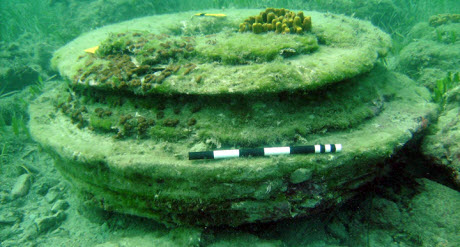 The strange formations which looked a bit like circular column bases, is typical of mineralization at hydrocarbon seeps.Photo courtesy of the University of East AngliaThe bizarre discovery, found close to Alikanas Bay, was carefully examined in situ by the Ephorate of Underwater Antiquities of Greece.
Archaeologist Magda Athanasoula and diver Petros Tsampourakis studied the site, together with professor Michael Stamatakis from the Department of Geology and Geoenvironment at the University of Athens (UoA).
After the preliminary mineralogical and chemical analyses, a scientific research team was formed, composed of UoA and UEA staff.
The research team went on to investigate in detail the mineral content and texture of the underwater formation in minute detail, using microscopy, X-ray, and stable isotope techniques.
Professor Andrews said: “We investigated the site, which is between two and five meters under water, and found that it is actually a natural geologically occurring phenomenon.
“The disk and doughnut morphology, which looked a bit like circular column bases, is typical of mineralization at hydrocarbon seeps—seen both in modern seafloor and palaeo settings.
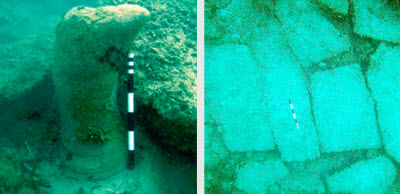 The site was discovered by snorkelers who believed they'd found the remains of columns and paved floors.Photos courtesy of the University of East Anglia“We found that the linear distribution of these doughnut shaped concretions is likely the result of a sub-surface fault which has not fully ruptured the surface of the sea bed. The fault allowed gases, particularly methane, to escape from depth.
“Microbes in the sediment use the carbon in methane as fuel. Microbe-driven oxidation of the methane then changes the chemistry of the sediment forming a kind of natural cement, known to geologists as concretion.
“In this case the cement was an unusual mineral called dolomite which rarely forms in seawater, but can be quite common in microbe-rich sediments.
“These concretions were then exhumed by erosion to be exposed on the seabed today.
“This kind of phenomenon is quite rare in shallow waters. Most similar discoveries tend to be many hundreds and often thousands of meters deep underwater.
“These features are proof of natural methane seeping out of rock from hydrocarbon reservoirs. The same thing happens in the North Sea, and it is also similar to the effects of fracking, when humans essentially speed up or enhance the phenomena.”
"Exhumed hydrocarbon-seep authigenic carbonates from Zakynthos island (Greece): Concretions not archaeological remains" is published in the journal Marine and Petroleum Geology.