Advanced Protocols for Residue Testing of Pesticides and Mycotoxins
This guide examines analytical methodologies, regulatory frameworks, and quality control strategies for effective residue testing in agricultural laboratories.
Craig Bradley BSc (Hons), MSc, has a strong academic background in human biology, cardiovascular sciences, and biomedical engineering, and is a SEO Editor.
Agricultural laboratories function as the primary gatekeepers of food safety, employing rigorous scientific methods to detect contaminants that threaten public health and international trade. Residue testing remains the fundamental process for quantifying chemical traces, specifically pesticides applied during cultivation and mycotoxins resulting from fungal contamination. Regulatory bodies enforce strict Maximum Residue Limits (MRLs) to ensure consumer safety, necessitating high-precision analytical techniques capable of detecting analytes at parts-per-billion (ppb) levels. Laboratory professionals must navigate complex sample matrices, evolving regulatory standards, and the demand for high-throughput analysis. This article explores the technical requirements for effective testing, the distinctions between pesticide and mycotoxin analysis, and the quality assurance frameworks required to maintain data integrity in modern agricultural labs.
Residue testing standards for regulatory compliance and trade
Adherence to established safety thresholds protects public health while facilitating the movement of agricultural commodities across global markets.
Residue testing validates that agricultural products meet the safety standards set by agencies such as the U.S. Environmental Protection Agency (EPA), the Food and Drug Administration (FDA), and the European Food Safety Authority (EFSA). These organizations establish MRLs based on toxicological data, defining the highest level of a pesticide residue that is legally tolerated in or on food or feed. When laboratories detect residues exceeding these limits, or detect banned substances, regulatory actions ensue, ranging from product recalls to import alerts.
The globalization of the food supply chain adds complexity to compliance. A crop compliant with MRLs in the country of origin may violate standards in the destination country. For instance, the European Union typically maintains lower MRLs for neonicotinoids compared to other regions. Consequently, laboratories must tailor residue testing protocols to encompass multi-residue screens that satisfy diverse regulatory frameworks. The Codex Alimentarius Commission, established by FAO and WHO, provides international food standards that serve as a reference point for resolving trade disputes. Accurate data generation allows producers to navigate these regulatory landscapes effectively.
Public Health Protection: Prevents acute and chronic toxicity exposure in consumers.
Trade Facilitation: Ensures commodities meet the import requirements of trading partners.
Legal Defense: Provides documentation of due diligence for growers and distributors.
Analytical techniques for precise pesticide residue detection
Modern chromatography coupled with mass spectrometry offers the sensitivity and selectivity required for trace-level pesticide analysis.
Detecting hundreds of distinct pesticide compounds within complex food matrices requires robust analytical instrumentation. Gas Chromatography-Mass Spectrometry (GC-MS/MS) and Liquid Chromatography-Mass Spectrometry (LC-MS/MS) represent the gold standards in residue testing. GC-MS/MS generally suits volatile and semi-volatile compounds, such as organochlorines and organophosphates. Conversely, LC-MS/MS excels in analyzing polar, non-volatile, and thermally labile compounds, which constitute a significant portion of modern agricultural chemicals.
Advanced Lab Management Certificate
The Advanced Lab Management certificate is more than training—it’s a professional advantage.
Gain critical skills and IACET-approved CEUs that make a measurable difference.
Sample preparation remains a critical step in the analytical workflow. The QuEChERS (Quick, Easy, Cheap, Effective, Rugged, and Safe) method has revolutionized pesticide extraction. This technique involves an initial extraction with acetonitrile followed by a dispersive solid-phase extraction (d-SPE) cleanup to remove interferences like lipids, sugars, and pigments. AOAC Official Method 2007.01 validates this approach for a wide range of pesticide residues. The efficiency of QuEChERS allows laboratories to process high sample volumes while minimizing solvent usage and hazardous waste.
Advantages of tandem mass spectrometry
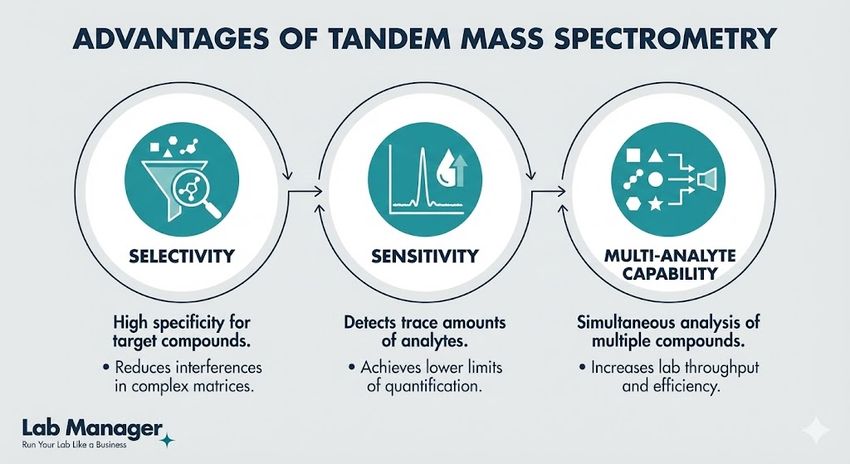
Tandem mass spectrometry (MS/MS) offers more than just precise data; it drives operational efficiency.
GEMINI (2025)
Selectivity: Triple quadrupole systems filter out matrix interferences, ensuring that the detected signal originates from the target analyte.
Sensitivity: capable of detecting residues at trace levels often required by organic certification standards.
Multi-analyte capability: simultaneous screening of hundreds of pesticides in a single run.
Sampling strategies for accurate mycotoxin analysis
Heterogeneous distribution of fungal toxins necessitates rigorous sampling protocols to minimize variance and ensure accurate quantification.
Mycotoxins differ from pesticides in their origin; they are secondary metabolites produced by fungi such as Aspergillus, Penicillium, and Fusarium. Unlike uniformly applied pesticides, mycotoxin contamination often occurs in "hot spots" within a bulk lot of grain or feed. This heterogeneity means that sampling error contributes more to the total measurement uncertainty than the analytical error itself. Laboratory professionals must advocate for and implement statistical sampling plans, such as those outlined by the USDA Grain Inspection, Packers and Stockyards Administration (GIPSA) or European Commission Regulation (EC) No 401/2006, to obtain representative samples.
Interested in lab leadership?
Register for a FREE Lab Manager account to subscribe to our Lab Leadership Digest Newsletter.
Once a representative sample reaches the lab, particle size reduction and homogenization are vital. For analysis, methods vary based on the required throughput and sensitivity. Enzyme-Linked Immunosorbent Assay (ELISA) kits provide rapid screening capabilities, making them suitable for field testing or high-volume intake points. However, for confirmatory analysis and multi-mycotoxin quantification, LC-MS/MS remains the superior choice. It allows for the simultaneous detection of major mycotoxin classes—including Aflatoxins, Ochratoxin A, Deoxynivalenol (DON), and Zearalenone—handling the matrix effects common in commodities like corn, wheat, and peanuts.
Mycotoxin Class
Common Fungal Source
Primary Commodities Affected
Aflatoxins (B1, B2, G1, G2)
Aspergillus flavus
Corn, peanuts, tree nuts
Ochratoxin A
Aspergillus ochraceus
Wheat, coffee, dried fruits
Deoxynivalenol (Vomitoxin)
Fusarium graminearum
Wheat, barley, corn
Fumonisins
Fusarium verticillioides
Corn
Quality control protocols in residue testing laboratories
Robust quality management systems ensure the reliability, reproducibility, and defensibility of analytical data generated by agrilabs.
Quality Assurance (QA) and Quality Control (QC) form the backbone of credible residue testing. For agricultural laboratories, ISO/IEC 17025 accreditation serves as the international benchmark for technical competence. This standard requires laboratories to validate methods, ensuring they fit the intended purpose regarding limits of detection (LOD), limits of quantification (LOQ), linearity, and precision. Routine QC measures must run parallel to sample analysis. These include the analysis of method blanks to monitor for cross-contamination, matrix-matched calibration standards to compensate for matrix effects, and surrogate recovery spikes to verify extraction efficiency.
Proficiency testing (PT) plays a distinct role in QA/QC by providing an external evaluation of a laboratory's performance. Participating in PT schemes allows agrilabs to compare their results against peer laboratories using blind samples. Discrepancies in PT results trigger root cause analyses, helping lab managers identify instrument drift, standard degradation, or analyst error. Furthermore, robust data integrity protocols prevent unauthorized manipulation of results, a critical requirement for regulatory submissions. By maintaining rigorous QA/QC oversight, laboratories protect the agricultural supply chain and maintain the trust of clients and regulators.
Ensuring food safety with residue testing
Advanced testing methodologies remain the essential barrier against contaminated agricultural products entering the market.
As global food trade expands and climate change influences pest pressure and fungal growth, the demand for accurate residue testing will continue to escalate. Laboratories must continuously evolve, adopting more sensitive instrumentation and automated workflows to handle increasing sample loads. By integrating rigorous sampling protocols, advanced mass spectrometry techniques, and unyielding quality control standards, laboratory professionals ensure compliance with MRLs and protect consumer health. The systematic detection of pesticides and mycotoxins ultimately supports a sustainable and safe global food system.
FAQ
What is the difference between pesticide residue and mycotoxin analysis?
Pesticide residue analysis detects synthetic chemicals applied intentionally during farming, whereas mycotoxin analysis detects naturally occurring toxic metabolites produced by fungi. While both often use mass spectrometry, mycotoxin analysis requires more stringent sampling protocols due to the uneven distribution of contamination in bulk commodities.
How does the QuEChERS method improve residue testing efficiency?
The QuEChERS (Quick, Easy, Cheap, Effective, Rugged, and Safe) method streamlines sample preparation by combining extraction and cleanup into a rapid process. This reduces solvent consumption and preparation time, allowing laboratories to process higher sample volumes without sacrificing recovery rates.
Why is matrix effect a concern in liquid chromatography-mass spectrometry?
Matrix effects occur when co-extracted components from the food sample suppress or enhance the ionization of the target analyte in the mass spectrometer. This phenomenon leads to inaccurate quantification, requiring laboratories to use matrix-matched calibration standards or stable isotope dilution to correct the data.
What accreditation is essential for laboratories conducting residue testing?
ISO/IEC 17025 accreditation stands as the primary standard for testing and calibration laboratories. It demonstrates that the laboratory operates a quality management system, possesses technical competence, and generates valid, internationally recognized results.
This article was created with the assistance of Generative AI and has undergone editorial review before publishing.
Add Lab Manager as a preferred Google source to see more of our trusted coverage.
Craig Bradley BSc (Hons), MSc, has a strong academic background in human biology, cardiovascular sciences, and biomedical engineering. Since 2025, he has been working with LabX Media Group as a SEO Editor. Craig can be reached at cbradley@labx.com.