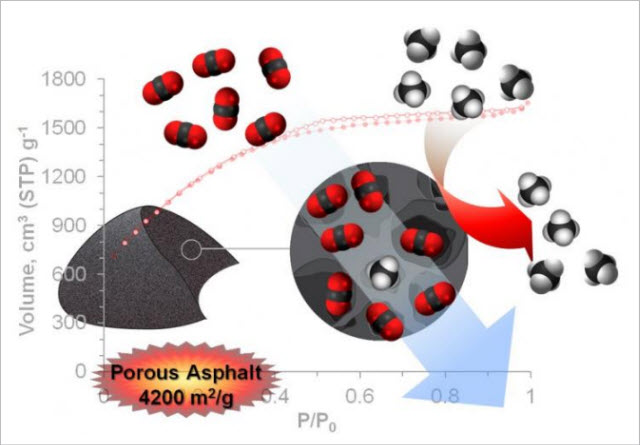
 Rice University scientists have improved their asphalt-derived porous carbon's ability to capture carbon dioxide, a greenhouse gas, from natural gas. The capture material derived from untreated Gilsonite asphalt has a surface area of 4,200 square meters per gram.Image Courtesy of: Almaz Jalilov/Rice University
(Houston, TX)—A Rice University laboratory has improved its method to turn plain asphalt into a porous material that can capture greenhouse gases from natural gas.
In research detailed this month in Advanced Energy Materials, Rice researchers showed that a new form of the material can sequester 154 percent of its weight in carbon dioxide at high pressures that are common at gas wellheads.
Related Article: Chemists Lead Breakthrough in Carbon Capture
Raw natural gas typically contains between 2 and 10 percent carbon dioxide and other impurities, which must be removed before the gas can be sold. The cleanup process is complicated and expensive and most often involves flowing the gas through fluids called amines that can soak up and remove about 15 percent of their own weight in carbon dioxide. The amine process also requires a great deal of energy to recycle the fluids for further use.
"It's a big energy sink," said Rice chemist James Tour, whose lab developed a technique last year to turn asphalt into a tough, sponge-like substance that could be used in place of amines to remove carbon dioxide from natural gas as it was pumped from ocean wellheads.
Initial field tests in 2015 found that pressure at the wellhead made it possible for that asphalt material to adsorb, or soak up, 114 percent of its weight in carbon at ambient temperatures.
Tour said the new, improved asphalt sorbent is made in two steps from a less expensive form of asphalt, which makes it more practical for industry.
"This shows we can take the least expensive form of asphalt and make it into this very high surface area material to capture carbon dioxide," Tour said. "Before, we could only use a very expensive form of asphalt that was not readily available."
The lab heated a common type asphalt known as Gilsonite at ambient pressure to eliminate unneeded organic molecules, and then heated it again in the presence of potassium hydroxide for about 20 minutes to synthesize oxygen-enhanced porous carbon with a surface area of 4,200 square meters per gram, much higher than that of the previous material.
The Rice lab's initial asphalt-based porous carbon collected carbon dioxide from gas streams under pressure at the wellhead and released it when the pressure was released. The carbon dioxide could then be repurposed or pumped back underground while the porous carbon could be reused immediately.
Related Article: Geologists Probe Geological Carbon Storage
In the latest tests with its new material, Tours group showed its new sorbent could remove carbon dioxide at 54 bar pressure. One bar is roughly equal to atmospheric pressure at sea level, and the 54 bar measure in the latest experiments is characteristic of the pressure levels typically found at natural gas wellheads, Tour said.
###
Rice postdoctoral researcher Almaz Jalilov is lead author of the study. Co-authors are Rice graduate student Yilun Li and former Rice research scientist Jian Tian, now at Wuhan University, China. Tour is the T.T. and W.F. Chao Professor of Chemistry as well as a professor of computer science and of materials science and nanoengineering.
The Apache Corp., Prince Energy and MI-SWACO supported the research.
Read the abstract at https://onlinelibrary.wiley.com/doi/10.1002/aenm.201600693/full
This news release can be found online at https://news.rice.edu/2016/09/12/asphalt-based-carbon-capture-material-advances/
Follow Rice News and Media Relations via Twitter @RiceUNews
Related materials:
Cheap asphalt provides 'green' carbon capture: https://news.rice.edu/2015/01/07/cheap-asphalt-provides-green-carbon-capture-2/
Tour Group: https://www.jmtour.com
Wiess School of Natural Sciences: https://natsci.rice.edu
Images for download:
https://news.rice.edu/files/2016/09/0912_ASPHALT-1-WEB-2fv3h99.jpg
Rice University scientists have improved their asphalt-derived porous carbon's ability to capture carbon dioxide, a greenhouse gas, from natural gas. The capture material derived from untreated Gilsonite asphalt has a surface area of 4,200 square meters per gram. (Credit: Almaz Jalilov/Rice University)
https://news.rice.edu/files/2016/09/0912_ASPHALT-2-WEB-2dsaewd.jpg
A transmission electron microscope image of Gilsonite-derived asphalt shows a micropore in the structure. The pores sequester carbon dioxide under common pressures at natural gas wellheads. (Credit: Tour Group/Rice University)
https://news.rice.edu/files/2016/09/0912_ASPHALT-3-WEB-28ga65v.jpg
A scanning electron microscope image shows micropores in carbon capture material derived from common asphalt. The material created at Rice University sequesters 154 percent of its weight in carbon dioxide at 54 bar pressure, a common pressure at wellheads. (Credit: Tour Group/Rice University)
Located on a 300-acre forested campus in Houston, Rice University is consistently ranked among the nation's top 20 universities by U.S. News & World Report. Rice has highly respected schools of Architecture, Business, Continuing Studies, Engineering, Humanities, Music, Natural Sciences and Social Sciences and is home to the Baker Institute for Public Policy. With 3,910 undergraduates and 2,809 graduate students, Rice's undergraduate student-to-faculty ratio is 6-to-1. Its residential college system builds close-knit communities and lifelong friendships, just one reason why Rice is ranked No. 1 for best quality of life and for lots of race/class interaction by the Princeton Review. Rice is also rated as a best value among private universities by Kiplinger's Personal Finance. To read "What they're saying about Rice," go to https://tinyurl.com/RiceUniversityoverview.














