Ensuring thorough chemical storage and handling protocols is indispensable for maintaining the integrity of food testing operations and securing comprehensive lab safety.
A comprehensive guide for laboratory professionals on managing, segregating, and storing reagents to prevent chemical hazards, ensuring compliance, and protecting food testing integrity.
Craig Bradley BSc (Hons), MSc, has a strong academic background in human biology, cardiovascular sciences, and biomedical engineering, and is a SEO Editor.
The management of hazardous materials is a foundational pillar of operational excellence in any scientific setting, and effective chemical storage is particularly critical for maintaining accreditation and reliability in food labs. Improperly handled or stored materials pose serious risks, ranging from fire and explosion to the degradation of reference standards and reagents, which directly compromises the accuracy of food testing results. Establishing robust protocols ensures personnel protection and preserves the integrity of the sample matrices essential for public health safety.
Hazard classification and incompatibility segregation
Understanding the inherent risks of materials is the first step in constructing a secure and compliant chemical storage system. The Global Harmonized System (GHS) provides a universal framework for classifying chemicals, which must be strictly applied in food labs to dictate appropriate handling and segregation.
The foundation of safe storage
All laboratory materials must be classified according to their primary and secondary hazards (e.g., flammability, corrosivity, reactivity). This rigorous classification is non-negotiable for mitigating chemical incompatibility risks—the primary cause of unintended reactions, toxic gas generation, or thermal events in storage areas.
Proper segregation involves physically separating incompatible chemical classes by distance, use of dedicated secondary containment, or storage in approved cabinets. This prevents accidental mixing, particularly if a container is breached. For example, acids and bases, while both corrosive, must be isolated from one another and from water-reactive substances. Similarly, highly flammable liquids, critical for many extraction and analysis methods in food testing, must be stored away from oxidizers, which can fuel or initiate combustion.
Chemical Class
Example (Food Lab Context)
Segregation Requirement
Flammable Liquids
Hexane, Ethanol (for extractions)
Store in fire-rated cabinet; separate from oxidizers and ignition sources.
Corrosive Acids
Hydrochloric Acid, Nitric Acid
Store below eye level in non-metallic trays; separate from bases and flammables.
Corrosive Bases
Sodium Hydroxide
Store in designated cabinet; separate from acids and halogens.
Oxidizers
Peroxides, Strong Acids (Nitric)
Store separately from organic compounds, flammables, and reducing agents.
Adherence to the standards set forth by the Occupational Safety and Health Administration (OSHA) in the Hazard Communication Standard (HCS), which incorporates GHS principles, is essential for every food lab. These guidelines inform both labeling requirements and the necessary physical segregation requirements.
Optimizing engineering and infrastructure controls
Physical infrastructure plays a pivotal role in ensuring effective chemical storage and overall lab safety. Engineering controls must be specifically tailored to the hazards present in a food lab environment, providing passive protection against accidents and environmental factors.
Lab Management Certificate
The Lab Management certificate is more than training—it’s a professional advantage.
Gain critical skills and IACET-approved CEUs that make a measurable difference.
Selecting compliant storage units
Approved storage units are not merely shelving; they are engineered safety barriers. Flammable liquids, integral to many chromatographic preparations and organic compound analysis in food testing, must be housed exclusively within flammable liquid storage cabinets compliant with NFPA 30 and NFPA 45 standards. These cabinets feature double-walled construction, leak-tight sumps, and self-closing, self-latching doors, providing a crucial 10-minute fire resistance rating. The cabinet capacity must strictly adhere to regulatory limits, preventing over-accumulation of hazardous materials.
For corrosive materials, such as the concentrated acids and bases used in digestion processes, dedicated polypropylene or polyethylene-lined cabinets are necessary. These non-metallic linings resist degradation from corrosive vapors, preventing cabinet failure and protecting the laboratory structure. Furthermore, volatile or highly odorous materials require storage within ventilated enclosures or dedicated chemical fume hoods, ensuring that harmful vapors are captured at the source and preventing atmospheric accumulation.
Temperature control is another critical infrastructure consideration. Certain reagents and standards used in quantitative food testing, particularly those prone to decomposition or phase separation, require cold storage. Explosion-proof or spark-free refrigerators must be utilized for storing flammable chemicals (e.g., diethyl ether) below their flash point, as standard refrigerators contain ignition sources (such as internal lights or fan motors) that could trigger a fire or explosion.
Interested in lab health and safety?
Register for a FREE Lab Manager account to subscribe to our Lab Health & Safety Newsletter.
Digital inventory management and documentation compliance
Effective chemical storage relies heavily on comprehensive and auditable documentation. Modern inventory systems move beyond simple logs to provide real-time data, enhancing both compliance and operational efficiency in the food labs.
Maintaining an accurate chemical lifecycle record
Every hazardous material must be documented from the moment it enters the facility until its disposal. This record, which is vital for both proactive lab safety measures and regulatory scrutiny, includes the chemical name, quantity, concentration, received date, assigned storage location, primary hazard class, and expiration date.
Digital inventory systems (often incorporating barcoding or QR codes) significantly streamline this process. Such systems enforce the 'First-In, First-Out' (FIFO) principle for time-sensitive reagents, minimizing the risk of using degraded standards that could lead to inaccurate food testing results. Regular inventory audits are essential to ensure the physical stock matches the digital record and to identify any expired or near-expired chemicals for timely disposal or re-qualification.
Digital tracking systems allow personnel to instantly access the full Safety Data Sheet (SDS) for any chemical on site, ensuring immediate reference to handling, spill response, and necessary personal protective equipment (PPE).
A robust inventory system provides an immediate list of all materials present, which is mandatory information for emergency responders in the event of an incident.
The complete record of material data and its location serves as the foundation for the facility’s overall hazard communication program and demonstrates due diligence in compliance with environmental and occupational health regulations.
Container integrity and transfer protocols
The physical condition of the containers holding hazardous materials is as important as the location where they are stored. Maintaining container integrity and following strict transfer protocols are essential practices in every food lab.
Preserving material purity and safety
Chemical containers must be routinely inspected for signs of degradation, such as corrosion, cracking, or compromise of the cap seal. Material transfer, often necessary for preparing working solutions or aliquots for food testing samples, must be performed only in designated areas, typically within a certified chemical fume hood. This minimizes exposure to personnel and contains any potential spills or vapor releases.
Secondary containment is mandatory for nearly all stored liquids, especially corrosives and highly toxic materials. Secondary containment devices (e.g., trays, tubs, or overpacks) are designed to hold 110% of the volume of the largest primary container, preventing spilled material from spreading across the bench or floor and migrating to incompatible neighbors.
Furthermore, proper labeling is a core requirement of lab safety. Every container, including secondary and tertiary working containers generated within the food lab, must bear a clear label that identifies the chemical contents, relevant GHS pictograms, and a cautionary statement. Labels must be durable and resistant to the chemical they contain; for instance, labels on acid bottles should withstand acid spills. Diligence in maintaining accurate labels prevents confusion and ensures that the correct handling and storage procedures are always observed.
Recurrent training and emergency preparedness
Even the most technologically advanced chemical storage infrastructure is vulnerable without consistently high standards of human performance. Comprehensive training and robust emergency planning are the final, essential components of a complete lab safety program.
Cultivating a culture of compliance
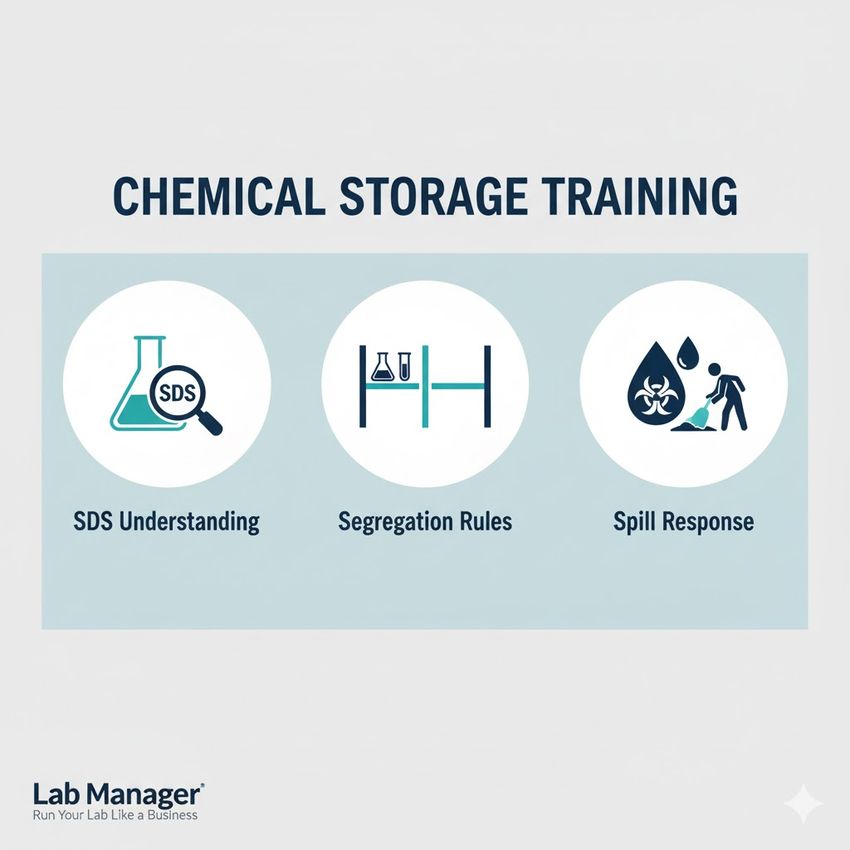
All laboratory personnel must receive recurrent training on the proper procedures for chemical storage, handling, and disposal. Training must cover:
SDS comprehension:
Training staff to store chemicals safely is paramount to the overall safety of the lab.
GEMINI (2025)
The ability to read, interpret, and apply information from Safety Data Sheets.
Segregation rules: Detailed knowledge of chemical incompatibility groups specific to the materials used in the food lab.
Spill response: Practical training on using spill kits, neutralizing agents, and enacting the facility’s emergency response plan for various chemical types.
Drills for chemical spills and facility evacuation must be conducted regularly to ensure personnel can react efficiently and calmly during a crisis. The emergency plan must clearly delineate communication pathways, contact information for internal safety officers, and external responders. Crucially, the plan must include designated safe havens and decontamination zones.
For materials requiring specialized disposal—a common consideration in food labs due to mixed chemical/biological waste streams—personnel must be trained on preparing waste containers, accurate labeling, and scheduling pickups with licensed waste handlers. Failing to follow disposal protocols can lead to non-compliance fines and environmental hazards, demonstrating the final link between rigorous chemical storage procedures and broader operational responsibility.
Securing integrity through compliant chemical management
Ensuring thorough chemical storage and handling protocols is indispensable for maintaining the integrity of food testing operations and securing comprehensive lab safety. By implementing stringent hazard classification, investing in appropriate engineering controls, utilizing digital inventory systems, and prioritizing recurrent personnel training, food labs minimize risk, assure regulatory compliance, and uphold the highest standards of analytical reliability. These practices collectively protect laboratory personnel, prevent cross-contamination of samples, and ultimately safeguard public health.
Frequently Asked Questions (FAQ)
What is the primary risk associated with chemical storage in food labs?
The primary risk is chemical incompatibility, where accidental mixing of segregated substances (like acids and bases, or flammables and oxidizers) leads to uncontrolled reactions, fire, explosion, or the release of toxic gases, severely compromising lab safety.
How does proper chemical storage directly impact food testing accuracy?
Proper chemical storage prevents the degradation or contamination of analytical reagents and standards (e.g., due to heat, light, or incompatible vapors). Using degraded materials directly introduces error into analytical measurements, potentially leading to inaccurate food testing results.
Where should flammable liquids essential for food analysis be stored?
All flammable liquids, such as those used in solvent extractions for food testing, must be stored exclusively in fire-rated flammable liquid storage cabinets compliant with NFPA 30 and NFPA 45 standards and must be segregated from ignition sources and oxidizers.
What regulatory guidelines are most relevant for chemical storage safety in food labs?
Key relevant guidelines include the OSHA Hazard Communication Standard (HCS) based on GHS, which mandates classification and labeling, and standards like NFPA 45 (Standard on Fire Protection for Laboratories), which dictates requirements for storage infrastructure and lab safety.
This article was created with the assistance of Generative AI and has undergone editorial review before publishing.
Add Lab Manager as a preferred Google source to see more of our trusted coverage.
Craig Bradley BSc (Hons), MSc, has a strong academic background in human biology, cardiovascular sciences, and biomedical engineering. Since 2025, he has been working with LabX Media Group as a SEO Editor. Craig can be reached at cbradley@labx.com.