Don't Get Ghosted by Your Vendor: The Critical Importance of After-Sales Support
With brand loyalty at an all-time low, the success of modern lab procurement hinges not on flashy marketing, but on what happens after the installation—here is how to hold your vendors accountable.
Trevor Henderson BSc (HK), MSc, PhD (c), has more than two decades of experience in the fields of scientific and technical writing, editing, and creative content creation.
The "new car smell" of a high-end analytical instrument is intoxicating. There is the sleek chassis, the promise of higher sensitivity, and the glossy marketing brochures that suggest your lab is entering a new era of effortless discovery. But in the high-stakes environment of 2026, lab managers are increasingly realizing that the most beautiful piece of hardware is nothing more than an expensive paperweight if the vendor disappears the moment the installation check clears.
We are witnessing a fundamental shift in the psychology of lab procurement. The era of the "flashy pitch" is over, replaced by a hyper-pragmatic focus on long-term survivability. If you want to ensure your lab remains operational in the coming year, you need to stop falling in love with the brand and start falling in love with the service contract.
The Death of the Brand: Service Loyalty is the New King
For decades, certain brands held a "moat" around their market share based on legacy and name recognition. That moat is currently evaporating. According to the Fall 2025 Purchasing Trends Survey, an overwhelming 81.9% of laboratory professionals are now "brand agnostic." This isn't a sign of indecision; it’s a sign of empowerment. Modern lab managers prioritize their specific technical and operational needs over a logo. In fact, a mere 29.2% of respondents care about a vendor's online presence or digital marketing footprint. The data tells a clear story: buyers are no longer influenced by who has the best social media strategy; they are influenced by who has a service technician stationed within a two-hour drive of their facility.
Flow (2026)
When the survey asked what factors were "Very Important" in a purchasing decision, After-sale support/maintenance was the highest-rated factor at 72.0%. It beat out initial price, technical specs, and even ease of use. In 2026, service loyalty has officially replaced brand loyalty.
The Aging Fleet: Why Support is Non-Negotiable
This pivot toward service is driven by a harsh reality: the global lab fleet is aging. The #1 open-ended reason cited by survey respondents for upcoming purchases is replacing aging or broken equipment (16.5%). As labs struggle to keep older systems running in the face of budget freezes and supply chain delays, maintenance has become the primary operational focus. The survey found that 61.3% of laboratories plan to purchase Equipment Calibration, Inspection, and Maintenance Services in the next 6-12 months. We are no longer in a "disposable" economy. Lab managers are looking for partners who will help them extend the lifecycle of their assets. A vendor who provides robust, reliable support for a seven-year-old system is far more likely to win the contract for the replacement than a vendor who pushes for a "forced upgrade" by sunsetting support for older models.
Negotiating the SLA: Don't Sign Until You're Protected
If 72% of your peers view after-sales support as a top priority, the Service Level Agreement (SLA) should be the most scrutinized document in your procurement process. Too often, lab managers treat the SLA as "boilerplate" text to be filed away. In 2026, the SLA is your primary tool for accountability.
Before signing a purchase order, you must aggressively negotiate the following points in writing:
Flow (2026)
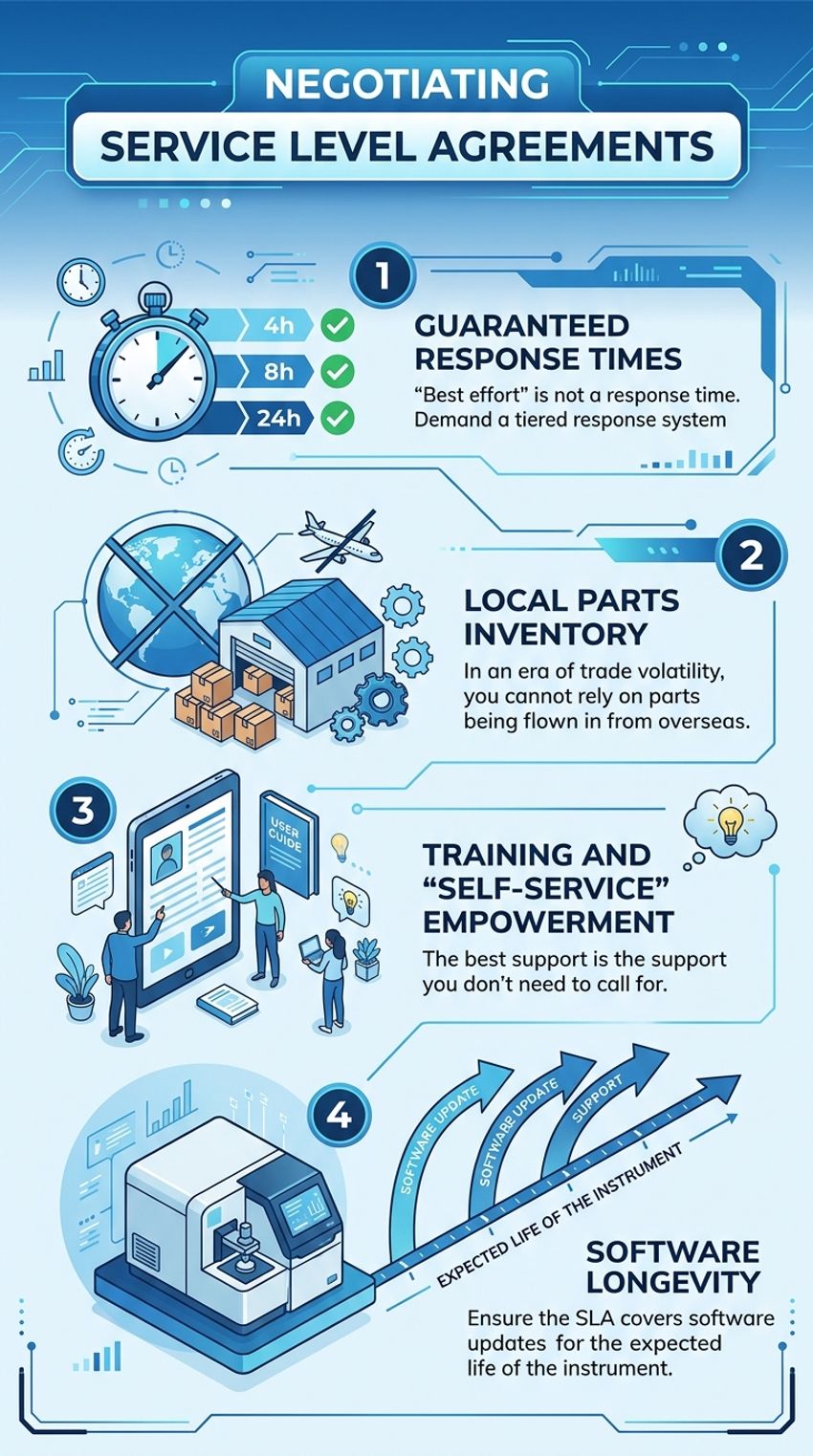
1. Guaranteed Response Times
"Best effort" is not a response time. Demand a tiered response system:
Critical Failures: On-site service within 24–48 hours.
Minor Issues: Phone or remote support within 4 hours. If the vendor misses these windows, there should be clear financial penalties or credits toward future consumables.
2. Local Parts Inventory
In an era of trade volatility, you cannot rely on parts being flown in from overseas. Ask the vendor: "Where is the nearest parts depot for this specific model?" If the answer is "another continent," you are looking at a potential three-month downtime event. Insist on a domestic parts guarantee for "wear-and-tear" items.
3. Training and "Self-Service" Empowerment
The best support is the support you don't need to call for. Negotiate for "Level 1" training for your internal staff so they can perform basic troubleshooting and preventative maintenance without voiding the warranty.
4. Software Longevity
Ensure the SLA covers software updates for the expected life of the instrument. You don't want to find yourself with a perfectly functional mass spec that cannot communicate with your network because the vendor stopped updating the drivers for a new OS.
The New Vendor Relationship
The dynamic has changed. You are not a "customer" of a vendor; you are a "client" of their service department.
When 81.9% of the market is willing to jump ship for better support, the power dynamic shifts in favor of the lab. Use this leverage. If your current vendor has "ghosted" you on a service call or left a machine down for weeks, the data says you should not hesitate to move to a competitor who treats service as a product, not an afterthought.
In 2026, the labs that thrive will be those that prioritize the "after" in after-sales. By focusing on maintenance, demanding robust SLAs, and remaining brand-agnostic, you ensure that your lab's productivity is never at the mercy of a vendor's silence.
Add Lab Manager as a preferred Google source to see more of our trusted coverage.
Trevor Henderson BSc (HK), MSc, PhD (c), has more than two decades of experience in the fields of scientific and technical writing, editing, and creative content creation. With academic training in the areas of human biology, physical anthropology, and community health, he has a broad skill set of both laboratory and analytical skills. Since 2013, he has been working with LabX Media Group developing content solutions that engage and inform scientists and laboratorians. He can be reached at thenderson@labmanager.com.