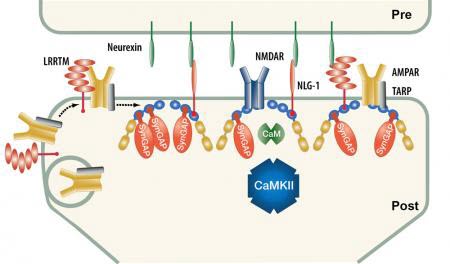
 When a synapse has not been strongly activated, addition and removal of receptors (AMPARs) from the membrane are in equilibrium. Receptors diffuse toward the synaptic junction where they can be captured by binding to scaffold molecules in the postsynaptic density.Image Courtesy of M. KennedyMany people remember exactly what they were doing on September 11, 2001, and some even easily remember exactly what they ate for lunch yesterday. Memories are formed when the neural networks that are active during an event become hard-wired into the cellular machinery of our brain. A group of scientists at Caltech, led by Allen and Lenabelle Davis Professor of Biology Mary Kennedy and postdoctoral fellow Ward Walkup have now discovered how one protein helps to create memories in the brain. A paper describing the findings appears in the September 29 issue of the journal eLife.
Memories are formed when an event or perception triggers the transfer of small chemicals called neurotransmitters between brain cells across junctions called synapses. Every time the same set of synapses connecting a particular group of neurons is activated together, the synapses get stronger, forming a memory.
Related Article: How Neurons Lose Their Connections
"When a memory is strong, if any one of the neurons that was involved gets activated, there's a much greater tendency for the whole memory to come back," says Kennedy. "Sometimes certain smells or a certain location can trigger an entire memory."
The synapse has two sides: the presynaptic side, from which neurotransmitters originate, and the postsynaptic side. At the postsynaptic side, there is a scaffold of proteins called the postsynaptic density (PSD) that is attached to the postsynaptic membrane. Receptors for the neurotransmitters are embedded into the PSD. "Strengthening" of the synapse to form a memory requires addition of more receptors to the synaptic membrane, and then direct attachment of the receptors to specific locations on a scaffold protein in the PSD. More receptors in the PSD result in a larger electrical response when the neurotransmitters reach the postsynaptic side. This leads to a more complete recollection of the memory.
"We wanted to know what triggers an increase in receptors, and how they are stabilized so that they stay embedded within the PSD," says Kennedy.
The addition of receptors is regulated by a set of enzymes near the postsynaptic membrane. The group focused on one particular protein called synGAP. In a previous paper, the Kennedy group discovered that when a phosphate molecule is added to synGAP in a process called phosphorylation, the modified protein begins to modulate the balance of two other proteins, called Ras and Rap. More activated Ras produces addition of more receptors to the postsynaptic membrane; whereas, more activated Rap has the opposite effect, causing receptors to be removed from the membrane. By causing synGAP to inactivate more Rap proteins than Ras proteins, phosphorylation of synGAP potentiates—or initiates—the addition of more receptors to the membrane.
Related Article: Remembering Past Events Might Take Place Quicker Than We Thought, Research Shows
Now, the group has discovered a completely separate function of synGAP—as a placeholder within the PSD that competes with and reduces the number of receptors that can be bound there.
"We found that when synGAP becomes phosphorylated, it is released from particular protein binding sites within the PSD, which frees up space for receptors to bind," says Kennedy. "So in summary, synGAP both ushers more receptors into the membrane, and makes room for them to bind directly to the PSD."
A few years ago, geneticists found that humans who are missing one copy of the synGAP gene—a condition called synGAP haploinsufficiency—have cognitive disabilities that are usually accompanied by autism and epilepsy. The loss of one copy of the gene causes them to have about half as much synGAP in their brain as is normal.
"Our work takes steps towards understanding why synGAP haploinsufficiency leads to such serious neurological disorders," says Kennedy. "Understanding this complex process at the molecular level allows for the possibility of developing much better pharmaceutical agents."
Funding for the work came from the National Science Foundation, the National Institutes of Health, the Gordon and Betty Moore Foundation, the Hicks Foundation, the Allen and Lenabelle Davis Foundation, and the Beckman Institute. In addition to Kennedy and Walkup, other authors on the paper are postdoctoral scholar Tara Mastro; former scientific researcher Leslie Schenker; Jost Vielmetter, the director of the Protein Expression Center; former undergraduates Rebecca Hu (BS '15) and Meera Reghunathan (BS '15); former Amgen Scholar Ariella Iancu; and assistant scientific analyst Barry Dylan Bannon.













