Thermo Fisher’s Eric Phillips, describes the adoption of MS detectors in GC as a “technology shift” that began with single-quad MS as an alternative to standard GC detection modes. “Now a lot of single-quad work is yielding to GC triple quad because of the latter’s capabilities and dramatic price reductions,” Phillips explains.  BiPolar MALDI TOF Detector PHOTONIS USA | www.photonis.com Phillips concedes that detectors using flame ionization, electron capture, and nitrogen/phosphorous detection “do fantastic work” and still constitute approximately three-fourths of all GC detector sales. But conventional GC detectors fall short of MS’s confirmation of molecular identity through precise mass measurement.
High performance comes at a cost, however. A GC with a single conventional detector, autosampler, and data system costs between $20,000 and $25,000. With a single-quad or ion trap, the price reaches the low $70,000s, and the price runs $120,000 for an entry-level triple quad and $150,000 for a top-of-the-line configuration.
The business case for MS detection matters less about the industry than it does the specificity required to get the job done. “Switching from a non-MS detector to a single quad comes down to how specific you need to be, and how much time you have available for sample prep,” Phillips explains. As MS detectors increase in sophistication, so does their ability to resolve co-eluting peaks and analytes from matrix within the ionization chamber, a process known as infusion.
Phillips describes MS as a “universal detector” that is simultaneously highly specific. “There are times you don’t need it, which is why labs still use non-MS detectors. But when you need it, you need it.”
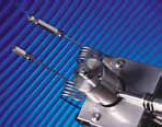 Pulsed Discharge Detector | VICI D-3-1-HP / Valco Instruments www.vici.com According to Phillips, MS paradoxically requires less experience to run expertly despite higher instrument complexity. “Someone new to the field can be trained on GC-MS and be positive they’re locating their target compounds. Conventional GC detectors require more experience to understand when problems arise or when matching peaks to known retention times. MS avoids a lot of those problems.”
Workflows are similarly enhanced by MS’s higher efficiency, at least for some applications. “The more specificity you obtain for your list of compounds, the easier the analysis. That, combined with software that points out areas failing a QC specification or known problem areas, can speed things up. Not the chromatography, but the ability to analyze or view data and confirm results.”
According to Erik Hansen, VP of commercial operations at IONICS Mass Spectrometry (Ontario, Canada), upgrading to MS detection will increase the instrument’s sensitivity and selectivity and thereby, at least in the case of triple quads, improve the lowest level of quantitation. “Sensitivity improvements allow labs to refine assays that detect at levels unavailable by other means.”
“MS is the standard way to attack complex mixtures that include unknowns,” comments Jack Driscoll, technology and marketing manager at PID Analyzers (Sandwich, MA), adding, “particularly if you have $60,000. But MS is overkill for many applications like QA/QC labs that repeatedly target a limited number of analytes.”
 MS Detector | Flexar SQ 300 PerkinElmer www.perkinelmer.com “You can spend between $4,000 and $7,000 on a non-MS detector and get the job done, often at higher sensitivity.”
According to Driscoll, a photoionization detector is “much more sensitive” than MS is for aromatic compounds, achieving lower ppb detection limits.
Lower-cost non-MS detectors more readily (and cheaply) allow dual detection, such as photoionization plus flame ionization. This particular combination detects unsaturation (PID) and “everything” (FID). The PID/FID ratio quantifies a sample’s olefinic content and is prescribed by many state environmental and EPA methods for hydrocarbon analysis. “The combined detectors, which cost about $8,000, give the same results as running two separate columns in series.”