Before embarking on a transcontinental journey, jet airplanes fill up with tens of thousands of gallons of fuel. In the event of a crash, such large quantities of fuel increase the severity of an explosion upon impact. Researchers at Caltech and JPL have discovered a polymeric fuel additive that can reduce the intensity of postimpact explosions that occur during accidents and terrorist acts. Furthermore, preliminary results show that the additive can provide this benefit without adversely affecting fuel performance.
The work is published in the October 2 issue of the journal Science.
Jet engines compress air and combine it with a fine spray of jet fuel. Ignition of the mixture of air and jet fuel by an electric spark triggers a controlled explosion that thrusts the plane forward. Jet airplanes are powered by thousands of these tiny explosions. However, the process that distributes the spray of fuel for ignition—known as misting—also causes fuel to rapidly disperse and easily catch fire in the event of an impact.
The additive, created in the laboratory of Julia Kornfield (BS '83), professor of chemical engineering, is a type of polymer—a long molecule made up of many repeating subunits—capped at each end by units that act like Velcro. The individual polymers spontaneously link into ultralong chains called "megasupramolecules."
When added to fuel, megasupramolecules dramatically affect the flow behavior even when the polymer concentration is too low to influence other properties of the liquid. For example, the additive does not change the energy content, surface tension, or density of the fuel. In addition, the power and efficiency of engines that use fuel with the additive is unchanged—at least in the diesel engines that have been tested so far.
To continue reading this article, sign up for FREE to
Membership is FREE and provides you with instant access to eNewsletters, digital publications, article archives, and more.
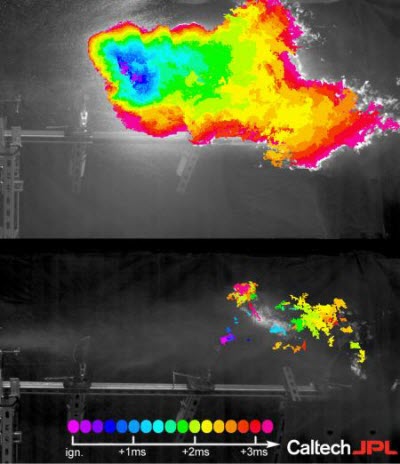
The progress of the flame after ignition in a post-impact mist of Jet-A fuel treated with prior ultra-long polymers (upper) and the Caltech polymer (lower) after the samples have passed through a fuel pump 50 times. The efficacy of prior polymers is lost, and a large, hot fireball ensues. The Caltech polymer retains its ability to mitigate post-impact fire. The color scale shows the progression of the flame with time.Image Credit: Caltech/JPLBefore embarking on a transcontinental journey, jet airplanes fill up with tens of thousands of gallons of fuel. In the event of a crash, such large quantities of fuel increase the severity of an explosion upon impact. Researchers at Caltech and JPL have discovered a polymeric fuel additive that can reduce the intensity of postimpact explosions that occur during accidents and terrorist acts. Furthermore, preliminary results show that the additive can provide this benefit without adversely affecting fuel performance.
The work is published in the October 2 issue of the journal Science.
Jet engines compress air and combine it with a fine spray of jet fuel. Ignition of the mixture of air and jet fuel by an electric spark triggers a controlled explosion that thrusts the plane forward. Jet airplanes are powered by thousands of these tiny explosions. However, the process that distributes the spray of fuel for ignition—known as misting—also causes fuel to rapidly disperse and easily catch fire in the event of an impact.
The additive, created in the laboratory of Julia Kornfield (BS '83), professor of chemical engineering, is a type of polymer—a long molecule made up of many repeating subunits—capped at each end by units that act like Velcro. The individual polymers spontaneously link into ultralong chains called "megasupramolecules."
Megasupramolecules, Kornfield says, have an unprecedented combination of properties that allows them to control fuel misting, improve the flow of fuel through pipelines, and reduce soot formation. Megasupramolecules inhibit misting under crash conditions and permit misting during fuel injection in the engine.
Other polymers have shown these benefits, but have deficiencies that limit their usefulness. For example, ultralong polymers tend to break irreversibly when passing through pumps, pipelines, and filters. As a result, they lose their useful properties. This is not an issue with megasupramolecules, however. Although supramolecules also detach into smaller parts as they pass through a pump, the process is reversible. The Velcro-like units at the ends of the individual chains simply reconnect when they meet, effectively "healing" the megasupramolecules.
When added to fuel, megasupramolecules dramatically affect the flow behavior even when the polymer concentration is too low to influence other properties of the liquid. For example, the additive does not change the energy content, surface tension, or density of the fuel. In addition, the power and efficiency of engines that use fuel with the additive is unchanged—at least in the diesel engines that have been tested so far.
When an impact occurs, the supramolecules spring into action. The supramolecules spend most of their time coiled up in a compact conformation. When there is a sudden elongation of the fluid, however, the polymer molecules stretch out and resist further elongation. This stretching allows them to inhibit the breakup of droplets under impact conditions—thus reducing the size of explosions—as well as to reduce turbulence in pipelines.
"The idea of megasupramolecules grew out of ultralong polymers," says research scientist and co–first author Ming-Hsin "Jeremy" Wei (PhD '14). "In the late 1970s and early 1980s, polymer scientists were very enthusiastic about adding ultralong polymers to fuel in order to make postimpact explosions of aircrafts less intense." The concept was tested in a full-scale crash test of an airplane in 1984. The plane was briefly engulfed in a fireball, generating negative headlines and causing ultralong polymers to quickly fall out of favor, Wei says.
In 2002, Virendra Sarohia (PhD '75) at JPL sought to revive research on mist control in hopes of preventing another attack like that of 9-11. "He reached out to me and convinced me to design a new polymer for mist control of jet fuel," says Kornfield, the corresponding author on the new paper. The first breakthrough came in 2006 with the theoretical prediction of megasupramolecules by Ameri David (PhD '08), then a graduate student in her lab. David designed individual chains that are small enough to eliminate prior problems and that dynamically associate together into megasupramolecules, even at low concentrations. He suggested that these assemblies might provide the benefits of ultralong polymers, with the new feature that they could pass through pumps and filters unharmed.
When Wei joined the project in 2007, he set out to create these theoretical molecules. Producing polymers of the desired length with sufficiently strong "molecular Velcro" on both ends proved to be a challenge. With the help of a catalyst developed by Robert Grubbs, the Victor and Elizabeth Atkins Professor of Chemistry and winner of the 2005 Nobel Prize in Chemistry, Wei developed a method to precisely control the structure of the molecular Velcro and put it in the right place on the polymer chains.
Integration of science and engineering was the key to success. Simon Jones, an industrial chemist now at JPL, helped Wei develop practical methods to produce longer and longer chains with the Velcro-like end groups. Co–first author and Caltech graduate student Boyu Li helped Wei explore the physics behind the exciting behavior of these new polymers. Joel Schmitigal, a scientist at the U.S. Army Tank Automotive Research Development and Engineering Center (TARDEC) in Warren, Michigan, performed essential tests that put the polymer on the path toward approval as a new fuel additive.
"Looking to the future, if you want to use this additive in thousands of gallons of jet fuel, diesel, or oil, you need a process to mass-produce it," Wei says. "That is why my goal is to develop a reactor that will continuously produce the polymer—and I plan to achieve it less than a year from now."
"Above all," Kornfield says, "we hope these new polymers will save lives and minimize burns that result from postimpact fuel fires."