BOULDER -- The formation of a distinct pattern of sea surface temperatures in the middle of the North Pacific Ocean can predict an increased chance of summertime heat waves in the eastern half of the United States up to 50 days in advance, according to a new study led by a scientist at the National Center for Atmospheric Research (NCAR).
The pattern is a contrast of warmer-than-average water butting up against cooler-than-average seas. When it appears, the odds that extreme heat will strike during a particular week—or even on a particular day—can more than triple, depending on how well-formed the pattern is.
The research is being published in the journal Nature Geoscience.
Related Article: Scientists Suggest Ocean Warming in Southern Hemisphere Underestimated
"Summertime heat waves are among the deadliest weather events, and they can have big impacts on farming, energy use, and other critical aspects of society," said Karen McKinnon, a postdoctoral researcher at NCAR and the lead author of the study. "If we can give city planners and farmers a heads up that extreme heat is on the way, we might be able to avoid some of the worst consequences."


The research was largely funded by the National Science Foundation, NCAR's sponsor. In addition to McKinnon, the research team includes Andrew Rhines, of the University of Washington; Martin Tingley, of Pennsylvania State University; and Peter Huybers, of Harvard University.
A fingerprint on the ocean
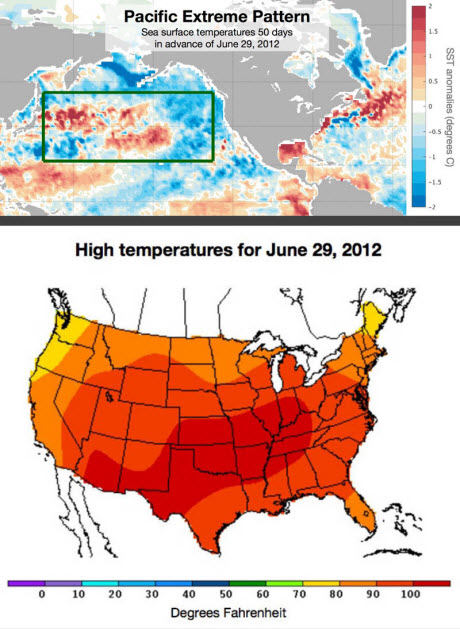 Top: Sea surface temperature anomalies in the mid-latitude Pacific 50 days in advance of June 29, 2012. The pattern inside the green box resembled the Pacific Extreme Pattern, indicating that there would be an increase in the odds of a heat wave in the eastern half of the United States at the end of June. Bottom: June 29, 2012, was the hottest day of the year in the eastern United States. The hot temperatures in late June and early July were part of an extraordinarily hot summer that saw three heat waves strike the country.Top image courtesy of Karen McKinnon, NCAR. Bottom Map courtesy of the National Weather Service's Weather Prediction CenterFor the study, the scientists divided the country into regions that tend to experience extreme heat at the same time. The scientists then focused on the largest of the resulting blocks: a swath that stretches across much of the Midwest and up the East Coast, encompassing both important agricultural areas and heavily populated cities.
The research team looked to see if there was a relationship between global sea surface temperature anomalies—waters that are warmer or cooler than average—and extreme heat in the eastern half of the U.S.
Right away, a pattern popped out in the middle of the Pacific, above about 20 degrees North latitude. The scientists found that the particular configuration of ocean water temperatures, which they named the Pacific Extreme Pattern, was not only found when it was already hot in the eastern U.S., but that it tended to form in advance of that heat.
"Whatever mechanisms ultimately leads to the heat wave also leaves a fingerprint of sea surface temperature anomalies behind," McKinnon said.
Improving seasonal forecasts
To test how well that fingerprint could predict future heat, the scientists used data collected from 1,613 weather stations across the eastern U.S. between 1982 and 2015, as well as daily sea surface temperatures for the same time period.
The scientists defined extreme heat in the eastern U.S. as a summertime day when the temperature readings from the warmest 5 percent of weather stations in the region were at least 6.5 degrees Celsius (11.7 degrees Fahrenheit) hotter than average. The scientists only looked at extreme heat during that region’s 60 hottest days of the year: June 24 through Aug. 22.
The researchers "hindcasted" each year in the dataset to see if they could retrospectively predict extreme heat events—or lack of those events—during that year's summer, using only data collected during the other years as a guide.
Related Article: New Study Puts Temperature Increases Caused by CO2 Emissions on the Map
At 50 days out, the scientists were able to predict an increase in the odds—from about 1 in 6 to about 1 in 4—that a heat wave would strike somewhere in the eastern U.S. during a given week. At 30 days out or closer, the scientists were able to predict an increase in the odds—to better than 1 in 2 for a particularly well-formed pattern—that a heat wave would strike on a particular day.


Advanced Lab Management Certificate
The Advanced Lab Management certificate is more than training—it’s a professional advantage.
Gain critical skills and IACET-approved CEUs that make a measurable difference.
This new technique could improve existing seasonal forecasts, which do not focus on predicting daily extremes. Seasonal forecasts typically predict whether an entire summer is expected to be warmer than normal, normal, or cooler than normal.
For example, the seasonal forecast issued for the summer of 2012 predicted normal heat for the Northeast and Midwest. But, the summer ended up being especially hot, thanks to three major heat waves that struck in late June, mid-July, and late July.
When the science team used the Pacific Extreme Pattern to hindcast 2012, they were able to determine as early as mid-May that there were increased odds of extremely hot days occurring in late June. The hottest day of the summer of 2012, as measured by the technique used for this study, was June 29, when the warmest 5 percent of weather stations recorded temperatures that were 10.4 degrees Celsius (18.7 degrees Fahrenheit) above average.
Interested in chemistry and materials science?

"We found that we could go back as far as seven weeks and still predict an increase in the odds of future heat waves," McKinnon said. “What’s exciting about this is the potential for long-range predictions of individual heat waves that gives society far more notice than current forecasts.”
Looking ahead
Scientists do not yet know why the fingerprint on sea surface temperatures in the Pacific predicts heat in the eastern U.S. It could be that the sea surface temperatures themselves kick off weather patterns that cause the heat. Or it could be that they are both different results of the same phenomenon, but one does not cause the other.
To learn more about how the two are connected, McKinnon is working with colleagues at NCAR to use sophisticated computer models to try and tease apart what is really happening.
The study's findings also point toward the possibility that the Pacific Extreme Pattern, or a different oceanic fingerprint, could be used to forecast other weather events far in advance, including cooler-than-average days and extreme rainfall events.
“The results suggest that the state of the mid-latitude ocean may be a previously overlooked source of predictability for summer weather,” McKinnon said.