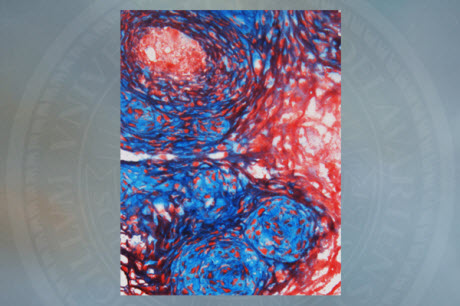
 This image shows interactions between fibrous tissue (red) and nonfibrous microdomains (blue) at week one of culture in tissue-engineered constructs that reproduce the microstructural, micromechanical, and mechanobiological features of native fibrocartilage.Image courtesy of the University of DelawareJan. 4, 2016--Injury and degeneration of fibro-cartilaginous tissues, such as the knee meniscus and the intervertebral disc, have significant socioeconomic and quality-of-life costs. But the development of effective treatment strategies to address pathologies in these load-bearing tissues has been hindered by a lack of understanding of the relationships between their structure and their function.
Now, a team of researchers from the University of Delaware and the University of Pennsylvania has shed new light on this issue, laying the foundation for better treatment of injuries such as meniscus tears as well as new therapies for osteoarthritis and age-related degeneration.
Related article: Engineer Developing Materials for Tissue Engineering, Vaccines
Their findings are reported in a paper, “Microstructural Heterogeneity Directs Micromechanics and Mechanobiology in Native and Engineered Fibrocartilage,” published online inNature Materials on Jan. 4.
Dawn Elliott, professor and chair of UD’s Department of Biomedical Engineering, explains that fibro-cartilaginous tissues are primarily made up of long, aligned fibers that confer strength and stiffness. It turns out, however, that they also have small non-fibrous regions, known as microdomains, that behave very differently from the fibrous areas.
“Our first question when we saw these microdomains was ‘Are they normal, or are they associated with pathology?’” Elliott says.
Studies done in her lab on bovine and donated human tissue showed that the microdomains were present beginning in the fetal stage but grew larger with age, injury, and disease, suggesting that increased microdomain size was related to loss of function.
Related article: Scientists Identify a Critical Pathway to Improve Muscle Repair
So she and her team began to look at the mechanics of the system, and they found that while the aligned fibrous tissues were very elastic, behaving like a rubber band when stretched, the microdomains did not stretch.
“This told us that they were not receiving the same mechanical signals as the aligned tissues,” Elliott says.
She then turned to Randall Duncan, professor in UD’s Department of Biological Sciences, for help in addressing the issue of cell signaling. With Duncan, the team found that the cells in the microdomains evidenced very high calcium signaling, while calcium signals switched on and off under mechanical loading in the fibrous regions.
 Woojin Han, who completed his doctorate in May 2015, works in the lab.Photo courtesy of the University of Delaware“This told us that cells in these two regions behave very differently when the tissue is stretched, which is critical information in the development of therapies to treat disease,” Elliott says.
Further study required a model system with better ability to control variables than in native tissue. This system was developed by Elliott’s long-time collaborator and co-principal investigator of the National Institutes of Health grant funding this research, Robert Mauck, who is associate professor of orthopedic surgery and bioengineering in the Perelman School of Medicine at the University of Pennsylvania.
Mauck and his team created a platform to study microdomain effects under normal and pathological conditions, enabling the researchers to investigate physical structure, mechanical loading and cell signaling under both actual and engineered conditions.
Related article: Turning Back the Clock on Aging Muscles?
“This tissue-engineered platform will facilitate study of the mechanobiology of developing, homeostatic, degenerating and regenerating fibrous tissues, paving the way to the development of therapeutic strategies that can halt or reverse the progression of tissue degeneration,” Elliott says.
In addition to Elliott, Duncan, and Mauck, the paper was co-authored by Woojin Han, Su-Jin Heo, Tristan Driscoll, John Delucca, Claire McLeod, and Lachlan Smith.
The research was financially supported by the National Institutes of Health grant R01 EB02425 and the Penn Center of Musculoskeletal Disorders grant P30AR050950.