LA JOLLA, CA – A new study led by scientists at The Scripps Research Institute (TSRI) and the J. Craig Venter Institute (JCVI) shows that the act of creating pluripotent stem cells for clinical use is unlikely to pass on cancer-causing mutations to patients.
The research, published February 19, 2016 in the journal Nature Communications, is an important step in assessing patient safety in the rapidly developing field of stem cell therapies.
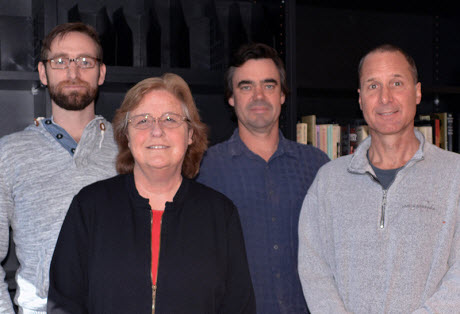 Key authors of the new study included (left to right) TSRI’s Kit Nazor, Jeanne Loring, and Roy Williams, and JCVI’s Nicholas Schork.Photo courtesy of The Scripps Research InstituteThe new study focused on the safety of using induced pluripotent stem cells (iPSCs) in human patients. Because iPSCs can differentiate into any kind of cell in the body, they hold potential for repairing damage from injuries or diseases such as Parkinson’s and multiple sclerosis.
“We wanted to know whether reprogramming cells would make the cells prone to mutations,” said Jeanne Loring, professor of developmental neurobiology at TSRI and co-leader of the new study with Nicholas J. Schork, professor and director of human biology at JCVI. “The answer is ‘no.’”
"The safety of patients comes first, and our study is one of the first to address the safety concerns about iPSC-based cell replacement strategies and hopefully will spark further interest,” added Schork.
Related Article: Scientists Report Reliable and Highly Efficient Method for Making Stem Cells
To make an iPSC, scientists must reprogram an adult cell, such as a skin cell, to express a different set of genes, which can be accomplished using viruses as delivery vehicles or with molecules called messenger RNAs (mRNAs).
The researchers looked at three popular methods of iPSC production (integrating retroviral vectors, non-integrating Sendai virus and synthetic mRNAs), assessing each for the potential to trigger cancer-causing mutations. While the researchers noted some minor alterations in the iPSCs, none of the methods led to significant mutations. The researchers repeated the experiments two more times and again found no significant risk.
“The methods we’re using to make pluripotent stem cells are safe,” said Loring.
The scientists do warn that even though iPSCs don’t gain cancer-causing mutations during reprogramming, potentially harmful mutations can accumulate later on as iPSCs multiply in lab cultures. Loring said scientists must analyze their cells for these mutations before using them in therapies.
“We need to move on to developing these cells for clinical applications,” said Loring. “The quality control we’re recommending is to use genomic methods to thoroughly characterize the cells before you put them into people.”
In addition to Loring and Schork, authors of the study, “Whole Genome Mutational Burden Analysis of Three Pluripotency Induction Methods,” were first author Kunal Bhutani, formerly at TSRI, now at JCVI; Kristopher L. Nazor, Roy Williams and Ha Tran of TSRI; Heng Dai, formerly at BioNano Genomics, now at WuXi NextCODE Genomics; Željko Džakula, Edward H. Cho, Andy W.C. Pang and Han Cao of BioNano Genomics; and Mahendra Rao, formerly at the National Institutes of Health (NIH), now at the New York Stem Cell Foundation.
This study was supported a National Science Foundation Graduate Research Fellowship (grant DGE-1144086), an Autism Speaks Fellowship, the NIH (grants U19 AG023122, R21 AG045789 and R33 MH087925), the Tanner Foundation, the California Institute for Regenerative Medicine (grants RT1-01108, RT3-07655, TR1-01250, TR3-05603, and CL1-00502), the NIH Center for Regenerative Medicine, the New York Stem Cell Foundation and BioNano Genomics, Inc.