Spectrophotometry: From UV-Vis to Atomic Absorption
An essential guide for laboratory professionals on the foundational principles, diverse applications, and modern advancements of spectrophotometry, from UV-Vis to atomic absorption.
Craig Bradley BSc (Hons), MSc, has a strong academic background in human biology, cardiovascular sciences, and biomedical engineering, and is a SEO Editor.
In the fast-paced, precision-driven world of the modern laboratory, reliable data is the cornerstone of every breakthrough and every quality control check. Among the myriad of analytical techniques at your disposal, few are as fundamental and versatile as spectrophotometry. It is a principle you likely use daily, whether you are quantifying protein concentrations in a biochemistry lab, analyzing water purity for environmental science, or determining the concentration of trace metals in a manufacturing process. While the term might evoke images of a simple cuvette and a single-beam instrument, the field of spectrophotometry is vast, encompassing a range of techniques that leverage the interaction of light and matter to deliver critical insights.
This comprehensive guide delves into the core principles of spectrophotometry and explores its most common applications. We will examine the workhorse of many labs—UV-Vis spectroscopy—before expanding our view to the high-sensitivity realm of fluorescence and the element-specific power of atomic absorption spectroscopy. By understanding the nuances of each method, you can enhance your analytical capabilities, troubleshoot more effectively, and ensure the integrity of your results.
What is Spectrophotometry? The Foundational Principle of Light and Matter
At its most basic, spectrophotometry is the quantitative study of how a substance interacts with light. This interaction can involve absorption, transmission, reflection, or even emission of light. The core principle hinges on the fact that every substance, based on its molecular or atomic structure, has a unique "fingerprint" of wavelengths it will absorb. A spectrophotometer is the instrument that measures this interaction, providing a powerful tool for identifying substances and determining their concentration.
The fundamental law governing this process is the Beer-Lambert Law. This principle states that the amount of light absorbed by a sample is directly proportional to the concentration of the substance and the path length of the light through the sample. In its simplest form, it is expressed as:
A=ϵbc
Where:
A is the absorbance (unitless)
ϵ is the molar absorptivity (a constant specific to the substance at a given wavelength, with units of L⋅mol−1⋅cm−1)
b is the path length of the sample cell (typically 1 cm)
c is the concentration of the absorbing substance (mol/L)
This elegant relationship allows us to use the measured absorbance of a solution to calculate its concentration, provided we know the other variables. It is the bedrock of nearly all quantitative spectrophotometry.
Lab Management Certificate
The Lab Management certificate is more than training—it’s a professional advantage.
Gain critical skills and IACET-approved CEUs that make a measurable difference.
A typical spectrophotometer consists of several key components:
Light Source: Provides a stable beam of light over a range of wavelengths (e.g., a deuterium lamp for UV, a tungsten lamp for visible light).
Monochromator: Selects a specific wavelength of light to pass through the sample.
Sample Compartment: Holds the sample (often in a cuvette).
Detector: Measures the intensity of the light that passes through the sample.
These components work in concert to measure the light before it enters the sample (I0) and the light that exits the sample (I), which allows the instrument to calculate absorbance.
UV-Vis Spectrophotometry: The Lab Workhorse
Ultraviolet-Visible, or UV-Vis spectrophotometry, is arguably the most widespread form of spectrophotometry in modern labs. It measures the absorbance of light in the UV (180–400 nm) and visible (400–800 nm) regions of the electromagnetic spectrum. This technique is invaluable for analyzing compounds that absorb light in these regions, which includes many organic molecules, proteins, and DNA.
The versatility of UV-Vis spectrophotometry makes it applicable across a vast range of disciplines:
Biochemistry: Quantifying DNA and protein concentration. The nucleic acid concentration can be determined at 260 nm, and protein concentration at 280 nm.
Environmental Science: Analyzing water samples for pollutants or nutrient levels by using colorimetric assays.
Pharmaceutical Industry: Measuring the concentration of active ingredients in drug formulations.
Material Science: Characterizing the optical properties of materials and thin films.
While incredibly useful, it is essential to be aware of the limitations of UV-Vis spectrophotometry, such as its sensitivity to interference from other absorbing substances in the sample and the need for a chromophore—a part of the molecule that absorbs light—to be present.
Interested in chemistry and materials science?
Register for a FREE Lab Manager account to subscribe to our Chemistry & Materials Science Newsletter.
Beyond Absorption: Fluorescence and Luminescence Spectroscopy
While UV-Vis spectrophotometry relies on measuring absorbed light, other techniques leverage the emission of light. Fluorescence spectroscopy and luminescence are highly sensitive analytical methods that measure the light emitted by a substance after it has absorbed energy. In fluorescence, a molecule (the fluorophore) is excited by a photon of light to a higher energy state. This molecule then rapidly de-excites, emitting a photon of light at a longer, lower-energy wavelength.
The key advantage of fluorescence spectrophotometry is its exceptional sensitivity. Because the detector measures emitted light against a dark background, even a very low concentration of a fluorophore can produce a strong signal. This makes it ideal for applications where the analyte is present in minute quantities.
Common applications of fluorescence and luminescence include:
Cell Biology: Staining and tracking specific molecules or processes within living cells.
Biotechnology: High-throughput screening of drug candidates.
Clinical Diagnostics: Quantifying biomarkers in patient samples.
Forensic Science: Detecting and analyzing trace evidence, such as blood or certain drug residues.
Understanding the difference between absorbance and emission-based techniques is crucial for selecting the right analytical tool for the job. While absorbance measures what is taken in, fluorescence measures what is given off, providing a complementary and often more sensitive approach.
Atomic Absorption Spectrophotometry (AAS): Quantifying Trace Elements
When your analytical needs turn to quantifying trace metal concentrations, Atomic Absorption Spectrophotometry (AAS) is the instrument of choice. Unlike the other forms of spectrophotometry that measure molecular absorption, AAS measures the absorption of light by atoms in a gaseous state. This makes the technique highly specific and precise for quantifying a single element at a time.
The process of AAS involves several key steps:
Atomization: The liquid sample is introduced into a high-temperature environment (either a flame or a graphite furnace) where the analyte is converted into a cloud of ground-state atoms.
Light Source: A hollow cathode lamp specific to the element being analyzed emits a narrow beam of light at that element’s characteristic absorption wavelength. For example, a zinc lamp is used to analyze zinc concentration.
Measurement: The light from the lamp passes through the atomic cloud. Atoms of the target element in the cloud absorb some of this light.
Detection: A detector measures the amount of light that was not absorbed. The Beer-Lambert Law is then applied to determine the concentration of the element.
AAS is particularly indispensable in fields such as:
Environmental Monitoring: Analyzing heavy metals like lead and cadmium in water and soil.
Geology and Mining: Quantifying precious metals in ore samples.
Food and Beverage Industry: Ensuring safe levels of trace elements in food products and beverages.
Clinical and Toxicology: Measuring concentrations of metals in biological fluids.
The specificity of AAS is its greatest strength, as it effectively eliminates interference from other elements and allows for highly accurate, parts-per-billion level detection.
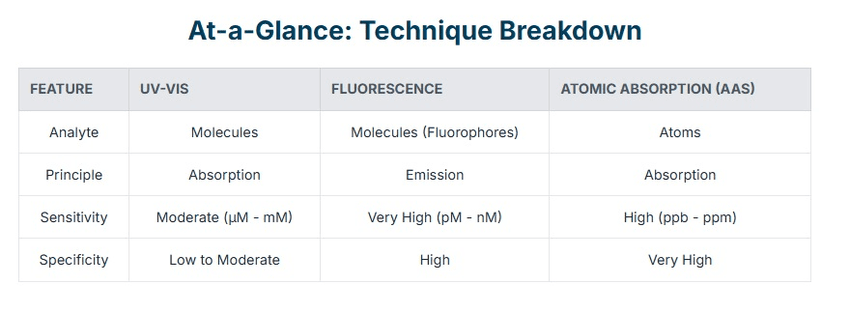
A breakdown of the common spectrophotometric techniques used.
GEMINI (2025)
Mastering Spectrophotometry for Precision and Progress
The principles of spectrophotometry, from the fundamental Beer-Lambert Law to the specialized applications of UV-Vis, fluorescence, and atomic absorption, form a cornerstone of analytical chemistry. For laboratory professionals, a deep understanding of these techniques is not just a skill—it's a critical competency that ensures the accuracy and reliability of your work. By continuously honing your knowledge of these instruments, recognizing their strengths and limitations, and embracing the latest advancements, you empower your lab to produce the high-quality data that drives discovery, innovation, and safety.
Whether you are performing a routine assay or developing a novel method, a strong grasp of the science behind light-matter interactions will allow you to select the right instrument, optimize your protocols, and troubleshoot with confidence. The field of spectrophotometry is ever-evolving, but its core principles remain constant, serving as a powerful reminder that sometimes, the simplest interactions can yield the most profound insights.
Spectrophotometry FAQ
What is the primary difference between UV-Vis and Atomic Absorption Spectrophotometry?
UV-Vis spectrophotometry measures the absorption of light by molecules in a solution, while Atomic Absorption Spectrophotometry (AAS) measures the absorption of light by individual, free-floating atoms in a gaseous state, making it specific for elemental analysis.
How do you choose the correct wavelength for a UV-Vis analysis?
The optimal wavelength, or λmax, for a substance is the wavelength at which it absorbs the most light. This is typically determined by running a full absorbance spectrum of the substance and identifying the peak absorbance value. Using the λmax provides the highest sensitivity and most accurate results.
Why is it important to use a blank sample in spectrophotometry?
A blank sample contains all the components of the sample matrix—such as the solvent, reagents, and buffer—but without the analyte. Measuring the absorbance of the blank allows you to subtract any background signal or interference from these components, ensuring that your absorbance reading is due solely to the substance you are trying to measure.
What are the most common sources of error in spectrophotometry?
Common errors include using scratched or dirty cuvettes, which can scatter light; bubbles in the sample, which can interfere with the light path; using a non-matched blank; and incorrect sample preparation, such as incomplete dissolution or degradation of the analyte. Adhering to strict lab protocols is essential to minimize these errors.
Add Lab Manager as a preferred Google source to see more of our trusted coverage.
Craig Bradley BSc (Hons), MSc, has a strong academic background in human biology, cardiovascular sciences, and biomedical engineering. Since 2025, he has been working with LabX Media Group as a SEO Editor. Craig can be reached at cbradley@labx.com.