



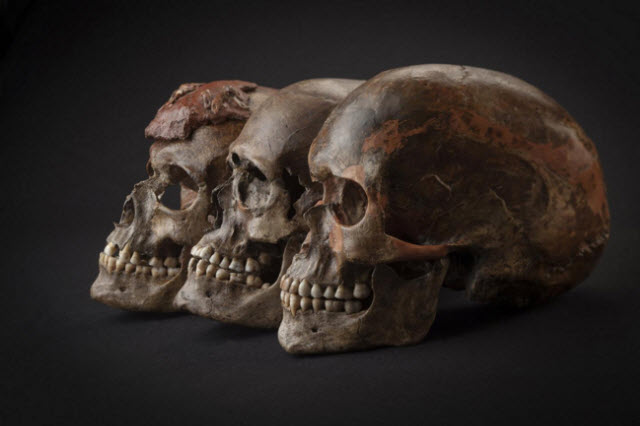
 Three ~31,000-year-old skulls from Dolni Vestonice in the Czech Republic. For the next five thousand years, all samples analyzed in this study—whether from Belgium, the Czech Republic, Austria, or Italy—are closely related, reflecting a population expansion associated with the Gravettian archaeological culture.Photo Courtesy of: Martin Frouz and Jijí Svoboda
Analyses of ancient DNA from prehistoric humans paint a picture of dramatic population change in Europe from 45,000 to 7,000 years ago, according to a new study led by Howard Hughes Medical Institute Investigator David Reich at Harvard Medical School.
The new genetic data, published May 2, 2016 in Nature, reveal two big changes in prehistoric human populations that are closely linked to the end of the last Ice Age around 19,000 years ago. As the ice sheet retreated, Europe was repopulated by prehistoric humans from southwest Europe (e.g., Spain). Then, in a second event about 14,000 years ago, populations from the southeast (e.g., Turkey, Greece) spread into Europe, displacing the first group of humans.
Related Article: Ancient DNA Preserved in Humans, Study Finds
Archeological studies have shown that modern humans swept into Europe about 45,000 years ago and caused the demise of the Neanderthals, indicated by the disappearance of Neanderthal tools in the archaeological record, explained Reich. The researchers also knew that during the Ice Age—a long period of time that ended about 12,000 years ago, with its peak intensity between 25,000 and 19,000 years ago—glaciers covered Scandinavia and northern Europe all the way to northern France. As the ice sheets retreated beginning 19,000 years ago, prehistoric humans spread back into northern Europe.


But prior to this study, there were only four samples of prehistoric European modern humans 45,000 to 7,000 years old for which genomic data were available, which made it all but impossible to understand how human populations migrated or evolved during this period. "Trying to represent this vast period of European history with just four samples is like trying to summarize a movie with four still images. With 51 samples, everything changes; we can follow the narrative arc; we get a vivid sense of the dynamic changes over time," said Reich. "And what we see is a population history that is no less complicated than that in the last 7,000 years, with multiple episodes of population replacement and immigration on a vast and dramatic scale, at a time when the climate was changing dramatically."
The genetic data show that, beginning 37,000 years ago, all Europeans come from a single founding population that persisted through the Ice Age, said Reich. The founding population has some deep branches in different parts of Europe, one of which is represented by a specimen from Belgium. This branch seems to have been displaced in most parts of Europe 33,000 years ago, but around 19,000 years ago, a population related to it re-expanded across Europe, Reich explained. Based on the earliest sample in which this ancestry is observed, it is plausible that this population expanded from the southwest, present-day Spain, after the Ice Age peaked.
The second event that the researchers detected happened 14,000 years ago. "We see a new population turnover in Europe, and this time it seems to be from the east, not the west," said Reich. "We see very different genetics spreading across Europe that displaces the people from the southwest who were there before. These people persisted for many thousands of years until the arrival of farming."
The researchers also detected some mixture with Neanderthals, around 45,000 years ago, as modern humans spread across Europe. The prehistoric human populations contained three to six percent of Neanderthal DNA, but today most humans only have about two percent. "Neanderthal DNA is slightly toxic to modern humans," explained Reich, and this study provides evidence that natural selection is removing Neanderthal ancestry.
###
The study was an equal collaboration of David Reich's laboratory with the laboratories of Svante Pääbo and Johannes Krause, which worked together to extract and analyze the DNA from these ancient bones. Ancient specimens are frequently contaminated with microbial DNA, as well as DNA from archaeologists or lab technicians who have handled the specimens.
Related Article: Fossil Analysis Pushes Back Human Split from Other Primates by Two Million Years
To get around these problems, the research team used a technique called in-solution hybrid capture enrichment. The team used about 1.2 million 52-base-pair DNA sequences corresponding to positions in the human genome that they were interested in as bait to target specific segments of DNA. After they washed the ancient DNA over the 1.2 million probe sequences, the researchers sequenced the ancient DNA that was captured by the probes.


Lab Quality Management Certificate
The Lab Quality Management certificate is more than training—it’s a professional advantage.
Gain critical skills and IACET-approved CEUs that make a measurable difference.
To eliminate contamination that may have been introduced from handling the specimens, the researchers restricted analysis of many of the samples to sequences that had characteristic lesions of ancient DNA—a cytosine to uracil error at the beginning of the sequence. Modern DNA typically does not have these errors, so contamination can be avoided by restricting the analysis to the sequences that do have them, said Reich.
"The ability to obtain genome-scale data from ancient bones is a new technology that's only been around for the last five or six years," Reich emphasized. "It's a new scientific instrument that makes it possible to look at things that have not been looked at before."





