

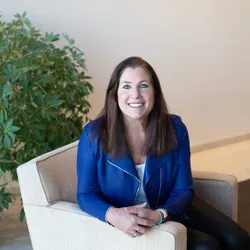
Science thrives when leadership reflects the breadth of talent entering the field. As access to scientific careers has expanded, so too has attention to how careers are built, supported, and sustained.
To help recognize International Women’s Day on March 8, we spoke with three women we spoke with three leaders shaping the future of life sciences about the challenges they faced, the assumptions they’ve challenged, and the leadership lessons they’ve learned: Lucy Foley (LF), CEO of eXmoor Pharma, Claudia Zylberberg (CK), co-founder of Akron Bio, board chair of Arscience Bio, and board chair of Kosten Digital, and Jackie Kunzler (JK), SVP and global head of R&D for Terumo BCT.
Q: What was the biggest challenge in establishing your career in life sciences?
LF: I did not come from a background where university or careers in life sciences were familiar. Understanding what career paths even existed was difficult. There was no blueprint. Navigating options without that context took time and confidence.
CZ: Credibility. As a woman and a founder, building in highly technical spaces like CGT manufacturing and AI, I often had to prove expertise before being heard. But challenge builds muscle. And muscle builds resilience. Over time, I learned that consistency and results shift the narrative—not by asking for space, but by creating undeniable value.
JK: The biggest challenge was balancing everything simultaneously: Family, career, commuting long distance, and furthering my education. Those years were demanding, but they taught me resilience and reinforced how important strong support systems are.
Q: What is the biggest lie girls are told about science careers?
LF: I think one of the biggest misconceptions is that there is a fixed glass ceiling.
Barriers can exist, and representation still varies by level and organization. But I have never entered a room assuming I did not belong there. I have sometimes been the only woman at the table, but I did not see that as disqualifying. In fact, the narrative that there is an inevitable ceiling can become limiting in itself. If you expect an invisible barrier, it can shape how you interpret every setback. The more important message is this: if you have earned your seat, your voice is equal. You are not there as a token. You are there because you bring expertise.


Lab Management Certificate
The Lab Management certificate is more than training—it’s a professional advantage.
Gain critical skills and IACET-approved CEUs that make a measurable difference.
CZ: That you have to choose.
- Choose between being technical or visionary.
- Choose between family or ambition.
- Choose between being respected or being warm.
JK: Girls are often made to feel that being a “science geek” isn’t attractive or popular, and that can be intimidating in grade school or high school.
Early in their careers, women may still face hesitation around being put in leadership roles, sometimes driven by assumptions about family commitments, or a desire for a certain type of “camaraderie” that comes from a comfort level with all-male teams. Those biases, subtle or not, are the real lie. The truth is that women bring critical perspectives and innovation to science, and the industry is stronger when we challenge those outdated expectations.
Q: If you could redesign the industry for the next generation of girls, what would you break first?
LF: I am not convinced the industry needs radical redesign for girls specifically. The opportunity is there. If anything, I would focus on reinforcing confidence and resilience early on. The next generation does not need to be told that there is a structural problem waiting for them. They need to be shown that leadership is attainable and normal. Culture evolves over time. I think we are already seeing that evolution. The task now is to sustain it.
Interested in lab leadership?

CZ: I would break the silent hierarchy. The invisible rules. The old networks. The assumption that leadership looks one way. Too often, access to opportunity is hidden behind systems that were never designed for inclusivity. We need cultural redesign, transparency, access, meritocracy based on impact, not proximity.
JK: I’d start by building a supportive ecosystem, because real progress for women in STEM requires more than individual efforts. We need work environments that make it easier to balance life while still being able to dive deeply into work that inspires you.
Some of my most rewarding career moments came from being fully immersed in solving big problems (this meant I worked 60-80 hours a week at times!) The gratification did not come from the long hours behind it, but because the work felt meaningful. I wish more people could experience that sense of passion and purpose in life. I’m a big believer that the work environment needs to be desirable, flexible, and sustainable for people to thrive. We must remove barriers that women in the industry still face, such as representation gaps and outdated expectations of how and when work gets done.
Q: Ambition in women is often labelled differently than in men. When have you felt that, and how did you respond?
LF: Ambition can be interpreted in different ways, but in my own career, it has largely been supported. Where I experienced friction, it tended to come from competitive dynamics rather than from overt bias. That reflects a broader issue across many sectors: when environments feel scarce or hierarchical, competition can overshadow support.
I also found that stepping away briefly for maternity leave did not stall my ambition. If anything, it clarified it. When I returned, I was promoted quickly into a more senior role. The experience reinforced that you can prioritize family and still pursue leadership with intent. When I am at work, I want to be challenged and to contribute fully. Ambition is not something to apologize for. It is about wanting to add value and take responsibility.
CZ: Ambition in men is called “visionary.” In women, it is often called “intense.” I’ve felt it. Sometimes the discomfort others feel is simply the presence of change arriving earlier than expected. My response? Deliver results. Build companies. Create jobs. Advance patients. When outcomes speak, labels fade. And eventually, intensity becomes reframed as leadership—once people understand the purpose behind it.
JK: I’ve experienced that earlier in my career, when I felt hurdle after hurdle thrown at me. It was frustrating and deeply discouraging. But I responded by hurdling higher, channelling that frustration into determination. It wasn’t always fair, and it was personally very taxing, but I’m proud of how I navigated it. Eventually, the hurdles no longer intimidated me as I grew more confident. That experience taught me that anger and frustration, when directed with purpose, can be a very powerful motivator.
Q: What part of your job still feels like rebellion against expectations of what a “scientist” should be?
LF: Perhaps the most rebellious thing is simply being yourself. I have never felt the need to adopt a uniform persona. I speak in my own voice. I dress in a way that feels natural to me. I value humor and human connection in the workplace. We spend a significant portion of our lives at work. It should not feel like a performance. Being authentic does not diminish professionalism. In my experience, it strengthens it.
CZ: Building companies. Designing strategy. Talking about capital markets and AI infrastructure in the same breath as cytokines and cell expansion. Wearing pearls while discussing manufacturing scale-out models. A scientist is not just someone at a bench. A scientist is someone who translates knowledge into impact. To me, science is a living discipline—it evolves through entrepreneurship, collaboration, and systems thinking as much as through experiments. And that, to me, is the most powerful form of rebellion.
JK: Pretty much every day. I often find myself defending the discipline and methodology of doing things the “right way”, while fighting over the desire for speed and instant answers. A scientist’s work is about seeking the truth, finding the right answer, and ensuring a safe solution to a problem. In a world that often rewards speed over accuracy, standing up for that process can feel like an act of rebellion. Science is a marathon, not always a sprint.