The average daily air temperature in the Antarctic summer of 2013, when Goordial collected the permafrost samples which she tested both on the spot and later in the lab, was − 14 °C and it never rose above 0 °C, making the permafrost difficult to drill.Photo credit: Jackie GoordialIt took Jackie Goordial over 1,000 petri dishes before she was ready to accept what she was seeing. Or not seeing. Goordial, a post-doctoral fellow in the Department of Natural Resource Sciences at McGill University has spent the past four years looking for signs of active microbial life in permafrost soil taken from one of the coldest, oldest, and driest places on Earth: in University Valley, located in the high elevation McMurdo Dry Valleys of Antarctica, where extremely cold and dry conditions have persisted for over 150,000 years. The reason that scientists are looking for life in this area is that it is thought to be the place on Earth that most closely resembles the permafrost found in the northern polar region of Mars at the Phoenix landing site.
Related article: Permafrost's Turn of the Microbes
“I’ve been trying to cheer her up by telling her that not finding life is important too,” says Lyle Whyte, Goordial’s supervisor. “Going into the study, we were sure that we would detect a functioning and viable microbial ecosystem in the permafrost soils of University Valley as we and others have done in Arctic and Antarctic permafrost, including in other sites at lower elevations in Antarctica. It is hard for both of us to believe that we may have reached a cold and arid threshold where even microbial life cannot actively exist.”
Drilling for microbes in Antarctica
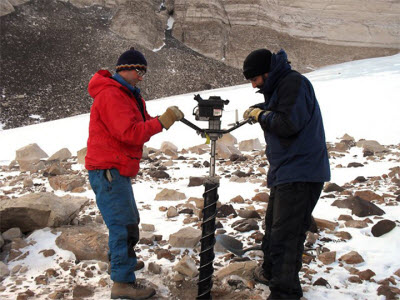 Denis Lacelle of University of Ottawa (left) and Alfonso Davila of NASA/SETI (right) operate a motorized ice drill to obtain cores in ice-cemented ground in University Valley.Photo credit: NASA/Chris McKayWhat brought the researchers to University Valley was a NASA ASTEP (astrobiology science and technology for exploring planets) project to test the IceBite auger, a permafrost drill designed to drill into Martian permafrost. The McGill team analyzed samples from two permafrost boreholes which reached a depth of just 42 cm and 55 cms below the surface. This may not sound like a lot, but drilling into permafrost to get soil samples for testing is very difficult.
“Anytime you drill into frozen ground and it has some ice in it the drilling process creates friction which melts the ice. The hole will refreeze within seconds if the drilling is interrupted, freezing the drill bit into the hole” says Whyte.” I remember drilling in the Arctic and losing a drill bit in one of the holes we had made, just because it froze into the ice before we could get it out.”
Related article: Farming on Mars? The Martian Raises Questions About Soil
"Previous studies in the lower dry valleys of Antarctica and in subglacial lakes were giving us the impression that microbial life was rich in the cold regions. But this is finally Mars!” says Chris McKay of NASA’s Ames Research Center. “University Valley has the coldest driest soil we can find on Earth. And life is really having a hard time of it there. This is certainly the training ground for the search for evidence of life on Mars and an extremely important result for NASA's astrobiology effort."
All the tests came out negative
The research team carried out a variety of tests, both in the field (where they failed to find evidence of carbon dioxide or methane–a gas used by all living things–in the soil) and then back in the lab at McGill in Montreal. They sent soil samples for DNA testing, looking for matches with particular genes known to be found in microbes and fungi; they tried to stimulate microbial growth on a wide variety of substances and then count the cells produced; and they used highly sensitive radiorespiration activity assays, which involve feeding the soil microorganisms a food source which has been labelled with radioactive carbon, which can then be used to detect if the microorganisms are active.
Implications for the search for life on Mars
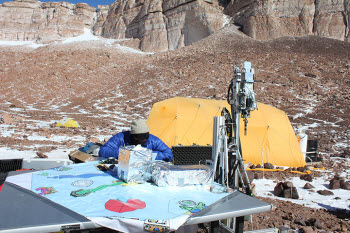 Working in the Arctic is very challenging for researchers. Everything that comes in needs to be transported by helicopter.Photo credit: Jackie Goordial “If conditions are too cold and dry to support active microbial life on an analogous climate on Earth, then the colder dryer conditions in the near surface permafrost on Mars are unlikely to contain life.” Says Whyte. “Additionally, if we cannot detect activity on Earth, in an environment which is teeming with microorganisms, it will be extremely unlikely and difficult to detect such activity on Mars.”
On a positive note however, the researchers add that this suggests that any microorganisms that may be transported to Mars from Earth by mistake are unlikely to be able to survive on the Martian surface, something that is of current concern for planetary protection.
Related article: A New Way to Study Permafrost Soil, Above and Below Ground
The research was funded by NASA ASTEP program, the Natural Sciences and Engineering Research Council (NSERC) Discovery Grant Program, and NSERC and CREATE Canadian Astrobiology Training Program (CATP).
To read “Nearing the cold-arid limits of microbial life in permafrost of an upper dry valley, Antarctica” by Jacqueline Goordial et al in The ISME Journal: 10.1038/ismej.2015.239
The tests failed to show any signs of active life.
“We couldn’t detect any microbial activity within these samples,” says Whyte. “Any, very limited traces we were able to find of microbial life in these samples are most likely the remnants of microbes that are dormant or are slowly dying off. Given the continuous dryness and subfreezing temperatures, and the lack of available water, even in summer, it is unlikely that any microbial communities can grow in these soils.”
Goordial adds, “We don’t know if there is activity beyond our limits of detection. All we can say for sure is that after using all the current methods of testing available to us, the samples are unlike any other permafrost we have encountered to date on Earth”