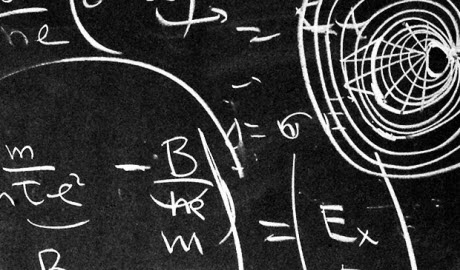
 Image courtesy of Concordia UniversityA feather is dropped on the moon from a height of 1.40 meters. The acceleration of gravity on the moon is 1.67 m/s2. Determine the time it takes for the feather to fall to the surface of the moon.
If this physics problem makes you break out in a cold sweat, you are not alone. And yet thousands of students enroll yearly in university classes to undertake the daunting task of solving questions far more complex than that.
Many of them have difficulty overcoming their physics-induced anxiety.
One Concordia University researcher has a solution: flip the traditional classroom on its head.
In a paper recently published in the journal Physical Review, Calvin Kalman, a professor in the Department of Physics, and his research team undertook a five-year study involving close to 1,000 students enrolled in four physics courses at two universities.
Using data gathered during student interviews, writing assessments, and a special questionnaire, the researchers found that students can actually improve their thinking and learning by engaging in “reflective writing” and interactive activities.
“It has been shown that in typical physics classes, students’ beliefs about their own learning deteriorate or at best stay the same. I want to reverse that result,” says Kalman, who is also the principal of Concordia’s Science College.
“This study shows that if you combine a meta-cognitive activity with an interactive activity, students can better hone their thinking abilities for that course.”
Meta-what?
Simply put, meta-cognition is thinking about your thinking.
“When students engage in 'reflective writing,' which is a meta-cognitive activity, they express in their own words what the concepts found in the textbook mean, how they connect to concepts in other chapters and how they connect to personal life experience,” Kalman says.
“That’s far more involved than a simple cognitive exercise like summary writing, where you just write a précis of the ideas in the textbook, using the same vocabulary,”
The importance of collaboration
Kalman’s study shows that students really see rewards when they follow “reflective writing” with a collaborative activity like working with their peers and professors in the lab.
“That combination of activities produces what is referred to as cognitive dissonance—that feeling of discomfort when the new information you’re confronted with conflicts with what you already believe,” Kalman says.
When students first grapple with a problem on their own, they may come to the wrong conclusion. Finding out the real solution in a collaborative setting helps improve their understanding, as well as their approach to learning.
Flipping the classroom on its head
“I want instructors to move away from relying solely on the traditional lecture method,” says Kalman.
“Instead, I envision what is called a ‘flipped classroom,’ where students try to understand concepts before coming to class, and then have an opportunity to explore these concepts in the class alongside their peers, and with the guidance of a teacher.”
Partners in research: This study was made possible in part by funding from the Social Sciences and Humanities Research Council of Canada. It was co-authored by Calvin S. Kalman, Concordia University; Mandana Sobhanzadeh, Mount Royal University; Robert Thompson, University of Calgary; Ahmed Ibrahim, University of California, Riverside; and Xihui Wang, McGill University.