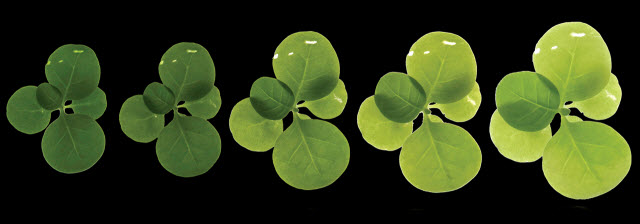
 A sensor protein was computationally designed and linked to gene components to enable a plant, Nicotiana tabacum, to display a loss of chlorophyll.Photo Credit: M.S. Antunes et al., PLOS ONEIn electronics, even the most advanced computer is just a complex arrangement of simple, modular parts that control specific functions; the same integrated circuit might be found in an iPhone, or in an aircraft. Colorado State University scientists are creating this same modularity in – wait for it – plants, by designing gene “circuits” that control specific plant characteristics – color, size, resistance to drought, you name it.
The relatively new, interdisciplinary field is synthetic biology – the design of genetic circuits, just like in electronics, that control different functions and can be easily placed in one organism or the next. Most of today’s synthetic biologists work with simple microorganisms, like E. coli or yeast.
Tackling plant complexity
A CSU team led by June Medford, professor of biology, and Ashok Prasad, associate professor of chemical and biological engineering, is doing the same thing, but in the much more complex biological world of plants.
Traditional plant genetic engineering involves inserting or modifying genes that control certain characteristics. Today’s plant synthetic biologists are taking a different approach.
“We are quantitatively analyzing the gene parts so we can make predictable functions,” Medford said. Using the cell phone analogy, “Apple didn’t go and reinvent a circuit to build the new iPhone; they took an existing circuit and tweaked it,” she said. “Once you have the quantification, and the device physics of the parts characterized, you can use a computer to tell you how to put them together.”
Plants in particular pose a special problem, Prasad added. “Not only is the biology much more complicated than single-celled microorganisms, they are also slow to grow and develop. As a consequence, just testing different genetic circuits becomes a major undertaking.”
Hundreds of circuits at a time
Tackling this problem, they’ve invented a method of characterizing not one or two, but hundreds of genetic circuits at a time that control plant functions. They first had to create a blueprint for part construction – the cell parts that make up the eventual circuits. For the testing, they used protoplasts, which are plant cells whose walls have been removed, so they’re little blobs of cytoplasm.
The researchers’ new method, published in Nature Methods Nov. 16, will pave the way to develop and screen hundreds of genetic circuits, opening the door for rapid new developments in plant synthetic biology.
Protoplasts are delicate, though, so the engineers employed mathematical modeling that accounted for all the special properties of each protoplast. Carrying out intensive data analysis and simulations led them to isolate properties of single protoplasts – a major achievement.
They demonstrated their method with the plant Arabidopsis, with later validation in the food grain species Sorghum bicolor – demonstrating their technique with a commercially relevant species.
The scientists were supported by a Department of Energy grant for working on a specific circuit that, when completed, will act like a hard switch that turns on and off a specific genetic function.
Collaborative effort
Co-first author Katherine Schaumberg and co-author Wenlong Xu, both graduate students in biomedical engineering, handled all the data analysis for the project, and helped develop the mathematical model.
Co-first author and research assistant professor Mauricio Antunes helped develop the experimental platform for the protoplast experiments, while postdoctoral associates Tessema Kassaw and Christopher Zalewski also played crucial roles in experiments and analysis.
“This was a true collaboration in which both sides participated fully in the entire endeavor, and should be a model for collaborations between computational modelers and experimental biologists,” Prasad said.











