Researchers at Sandia National Laboratories have developed a faster method for detecting per- and polyfluoroalkyl substances (PFAS), a group of persistent environmental contaminants often referred to as forever chemicals.
Traditional PFAS detection methods can require hours or even days to process a single sample because the compounds must be extracted, concentrated, and repeatedly processed before analysis. The new approach significantly shortens that workflow by enabling PFAS detection in minutes.
The method combines an adsorbent particle with a mass spectrometry technique known as desorption electrospray ionization (DESI). Researchers say the approach could make PFAS testing faster and potentially more accessible for laboratories studying environmental contamination.
A faster workflow for PFAS detection
PFAS are widely used in industrial and consumer products and are known for their persistence in the environment. Because they do not readily break down, the chemicals can accumulate in soil, water, wildlife, and humans.
Detecting PFAS in environmental samples is an important part of monitoring contamination and evaluating remediation technologies. However, current laboratory methods often require extensive sample preparation.

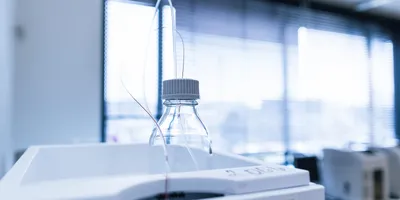
Traditional testing typically begins with a liter or more of water suspected to contain PFAS. The liquid is passed through specialized cartridges that extract the compounds, and the sample must be repeatedly concentrated before analysis.
According to Sandia chemist Ryan Davis, the time and cost associated with these steps can slow research and limit access to testing technologies.
“A common complaint of ours and others who are doing PFAS analysis is that it’s slow and can be costly depending on the technology,” Davis said.
Using ISA-DESI mass spectrometry
The Sandia research team developed an alternative method using desorption electrospray ionization coupled with mass spectrometry.
The process begins with an adsorbent particle placed in a liquid sample suspected of containing PFAS. After several minutes, the particle is removed and positioned in front of a mass spectrometer.
Electrically charged droplets are then sprayed onto the particle. The droplets dislodge PFAS molecules from the surface and carry them into the mass spectrometer for analysis.
This technique allows researchers to detect and identify PFAS compounds without the lengthy extraction and concentration steps required in conventional workflows.
Detecting PFAS at low concentrations
Early experiments showed that the ISA-DESI method could detect PFAS at extremely low concentrations.
Researchers initially observed detection at parts-per-million levels, then improved sensitivity to parts-per-billion, and eventually to low parts-per-trillion concentrations.
The entire analytical process can take approximately five minutes from sample preparation to measurement.
Researchers say the technique's unexpected sensitivity emerged during early testing.
“We had toyed with the idea of using DESI to confirm the presence of PFAS on adsorbent materials,” Davis said. “When we did some preliminary testing, not only did we confirm the presence of PFAS, but we noticed that we got results well beyond our standard analysis.”
Potential applications for environmental laboratories
Sandia scientists hope the method could support faster PFAS monitoring in environmental testing laboratories and improve access to water quality analysis.
The researchers also believe the ISA-DESI approach could eventually be adapted to detect other environmental contaminants or monitor chemical off-gassing in specialized research environments.
If further developed and commercialized, the method could provide laboratories with a faster analytical tool for detecting PFAS and other persistent pollutants in environmental samples.
This article was created with the assistance of Generative AI and has undergone editorial review before publishing.