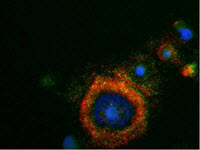
 CTCs characterization using ViewRNA for multiplex in situ RNA analysis.Image credit: Ryan Jeffs, Wikimedia CommonsScientists from the National University of Singapore (NUS) have developed a novel technique to efficiently culture clusters containing circulating tumor cells (CTCs) in 14 days that could be used to predict the outcome of cancer treatment as well as monitor the status of cancer. Using the technique, the team achieved a success rate of more than 60 per cent in culturing CTCs from patients with metastatic breast cancer, the highest known success record to-date. This breakthrough brings researchers a step closer towards enabling personalized cancer treatment and monitoring.
The study was conducted by scientists from the Mechanobiology Institute (MBI) and Cancer Science Institute of Singapore (CSI) at NUS and in collaboration with the National University Cancer Institute, Singapore (NCIS). A paper describing the work was published earlier in the medical journal Oncotarget.
Related article: Seeking Solutions to Brain Cancer Treatments
Professor Lim Chwee Teck, who is from MBI and one of the lead authors, explained, “Being able to capture CTCs and grow them efficiently from a blood sample is a big step forward in liquid biopsy for tumour diagnosis and cancer treatment monitoring. This could potentially mean that biopsy for cancer diagnosis and prognosis could be done using a blood test, which is minimally invasive, instead of having to remove cells from the tumour itself. Results of the blood tests could help doctors assess the best therapy options for a patient, and frequent blood tests can also be done during the course of an anti-cancer treatment to monitor a patient’s progress during treatment.”
Tests can potentially be done on the cultured CTCs to guide the selection of drug therapy, added Adjunct Associate Professor Lee Soo Chin, Associate Director (Research) and Senior Consultant of NCIS, who is also a Senior Principal Investigator from CSI, and the clinical lead for the study. “Cultured CTCs of individual patients can be tested for drug sensitivity to determine the responsiveness of the CTCs to the drugs that are commonly used in the treatment of cancers. This could allow doctors to decide on the most suitable drug for the patient based on the drug sensitivity results. As the CTCs can be cultured in a short time period, the entire testing process can take as short as four weeks–two weeks for culturing the CTCs and two weeks for drug screening. Patients will not have to wait a long time for the test results.”
Role of CTCs in cancer prognosis
Cancer is among the leading causes of death in Singapore today. More than a hundred types of cancers have been identified, each with distinct characteristics and treatment challenges. However, a major challenge in cancer management and treatment lies in its early detection and treatment, before the disease aggressively spreads to other parts of the body.
Cancer develops as a result of genetic anomalies which cause healthy cells to become cancerous and divide uncontrollably into a mass of abnormal cells, also known as tumours. Cancer metastases or spreads when cells gain the ability to escape from the primary tumour, circulate in the bloodstream, and a few cells eventually invade into other parts of the body to establish secondary tumors. These ’runaway’ cells are called CTCs and they can be found even at early stages of the disease.
Related article: Possible Key in Virus, Cancer Research Identified
The team has been able to obtain cultures from screening of samples from some early-stage breast cancer patients. Hence, analysing patients’ blood for CTCs may have potential applications in predicting patient progression or response to cancer treatment.
Said Adj Assoc Prof Lee, “Half of these early-stage breast cancer patients have been found to have CTCs in the culture after surgery and post-operative chemotherapy, despite them not having cancer that can be detected using conventional means such as scans and who are presumed cured. We will need to continue tracking these patients to determine if the persistence of these CTCs is associated with early cancer relapse.”
Capturing and growing CTCs efficiently
CTCs comprise many sub-populations and occur at extremely low frequencies in blood. According to Prof Lim, “The chance of getting CTCs in a blood sample is akin to trying to find a hundred people in a world of seven billion people.”
Owing to this rarity, the population of CTCs needs to be expanded before they can be used for clinical analysis. Currently, most methods used to culture CTCs have either lacked efficiency or required pre-selection techniques for the elimination of non-cancerous cells that led to the loss of some CTCs in the process.
In an attempt to overcome these setbacks, NUS scientists developed a novel methodology to efficiently culture clusters containing CTCs from blood samples. They created an ideal environment–using a combination of specially designed microwells and oxygen-deficient growth conditions–for tumor cells to grow while other non-cancerous cells gradually undergo cell death.
Tests were conducted on 226 clinical blood samples obtained from 92 metastatic or early-stage breast cancer patients who began anti-cancer therapy, and a success rate of over 60 per cent in culturing clusters containing CTCs was achieved using the novel technique, more than two to three times higher than conventional methods of culturing CTCs.
Related article: Breakthrough Technique Images Breast Tumors in 3-D with Great Clarity, Reduced Radiation
The team is also currently developing new technologies for liquid biopsies that will allow them to perform single cell analysis, so that each and every cell taken from the biopsy can be examined closely to obtain critical information that will be useful to scientists and clinicians to better treat the disease. Liquid biopsy, at present, is used to do a number count of CTCs to correlate with the severity of the cancer and track treatment outcomes.
Said Prof Lim, “Looking forward, my team and I will be embarking on research to develop novel technologies that can contribute towards personalized or precision medicine. Cancer is extremely difficult to treat due to presence of many sub-varieties of cancer cells, which may also further mutate and change. The genetic makeup and immune response of each individual can also result in very different outcomes despite receiving the same treatment. “One size fits all” approach has proven to be ineffective and only individual patient-derived information can help us do a better job. We are looking at developing technologies that can acquire such critical information so that clinicians can tailor and administer precise treatment for each individual patient.”