Infrastructure

The chemical fume hood is probably the single most-used piece of equipment in research laboratories. Often, the chemical hood is shared by lab personnel, and occasionally it’s shared between labs.

Water is the most commonly used laboratory reagent; however, the importance of water quality is often overlooked. Because impurities can be a critical factor in many research experiments, water purity ranks high in importance. There are several types of impurities and contaminants in water such as particulates, organics, inorganics, microorganisms and pyrogens that can adversely affect results.

Dr. Nathaniel Hentz is assistant director of the analytical lab at the Golden LEAF Biomanufacturing Training and Education Center (BTEC), where he develops bioanalytical assays in support of the various biomanufacturing processes taught at BTEC. Since 2008, Dr. Hentz has been responsible for developing and teaching undergraduate and graduate courses, industry short courses, and government (FDA and BARDA) training courses, with a focus on assay development and validation, quality control, and liquid-handling performance.

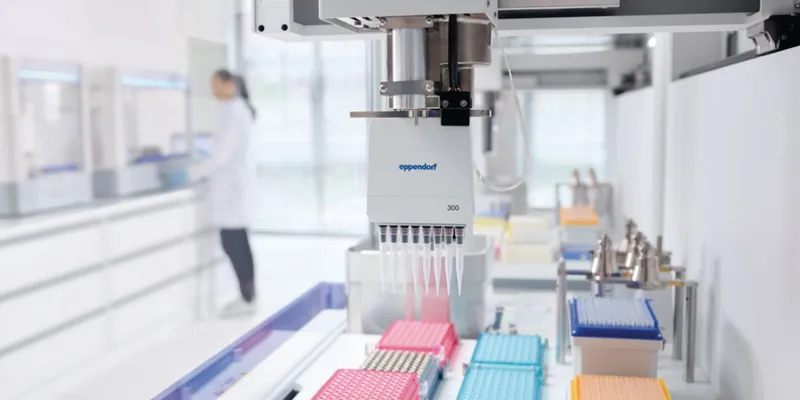
Automated liquid handling (ALH) systems span the range from semi-automated multichannel pipettors to room-sized systems. The industry is trending toward versatile, modular ALH systems—seemingly for every budget. Likewise, instrumentation, software, and methods have followed the trend toward greater user accessibility.

Whether to employ central washing stations or point-of-use washers located under a lab bench or in a corner is something that has to be addressed with regards to laboratory glassware washers. The former provide an economy of scale and are popular with lab workers who, almost universally, hate to “wash the dishes.” The downside for central washing stations is that glassware tends to disappear over time, due to breakage and operator error.

Glove boxes go by many different names and are used for many purposes. However, their essential attribute is the ability to maintain a completely separate environment from ambient. Glove boxes are completely closed compartments ranging in size from a few cubic feet to several hundred cubic feet and differ from other safety enclosures in two significant respects: users can introduce articles into glove boxes and manipulate them inside through ports fitted with gloves, and glove boxes typically use a specialized atmosphere.


Sample preparation can be a labor-intensive and expensive process. What are the factors that should be considered when evaluating the possible transition from manual to semi-automated or fully automated systems? How do they impact your return on investment?

Fire extinguishers need to be appropriate to the type of fire.

For many labs, automation provides the biggest return on sample preparation because it’s the key time-consuming bottleneck for many processes.

First responders have downloaded more than 10,000 copies of a guide to commercially available, hand-portable biodetection technologies created to help them determine what they might be up against in the field. Since many first responders do not always have immediate access to a computer, a mobile version of the guide is now available for cell phones and tablets.

Artel, the leader in liquid handling quality assurance, announced today that the Society for Laboratory Automation and Screening (SLAS) and Artel are working together to produce a conference short course for the 2015 annual meeting in Washington, D.C. “Liquid Handling Essentials – A Hands-on Workshop Bridging Fundamental Concepts to Practice,” will be presented on Saturday, February 7 from 8:30 a.m. to 4:30 p.m.