Optimizing Field Sampling Integration for Efficient Lab Operations
Seamless synchronization between external collection teams and internal analysis improves sample quality while accelerating reporting timelines for labs.
Craig Bradley BSc (Hons), MSc, has a strong academic background in human biology, cardiovascular sciences, and biomedical engineering, and is a SEO Editor.
Accurate analysis begins outside the laboratory walls. It starts at the source where agricultural, environmental, and industrial specimens originate. Establishing robust connections between field sampling activities and internal laboratory workflows ensures data integrity from the moment of collection. This synchronization is especially vital for agrilabs, where seasonal surges and expansive spatial data requirements increase the risk of bottlenecks. Deviations during this initial phase often lead to costly re-testing or invalid results. Consequently, integrating external collection procedures is a vital component of total quality management. Laboratory professionals must prioritize the alignment of remote collection protocols with central analytical standards to maintain the reliability of the entire testing lifecycle.
Establishing standardized protocols for collection
Consistency in external procedures minimizes variability before samples reach the bench. The validity of any analytical result depends entirely on the representativeness and quality of the specimen provided. Field sampling occurs in uncontrolled environments, introducing variables absent in sterile lab settings. Standard Operating Procedures (SOPs) must extend beyond the laboratory facility to govern the actions of field technicians. In the context of agrilabs, for instance, defining exact methodologies for soil core depth or plant tissue selection ensures that nutrient recommendations remain valid across thousands of acres.
A robust quality assurance plan incorporates strict Chain of Custody (CoC) documentation. This legal and technical necessity tracks the sample from the exact time of collection through transport, receipt, and disposal. Regulatory bodies, such as the EPA and FDA, mandate clear documentation to support the legal defensibility of data. When field sampling documentation lacks precision, the laboratory cannot verify sample identity or condition, rendering the subsequent high-precision analysis utilizing advanced instrumentation futile.
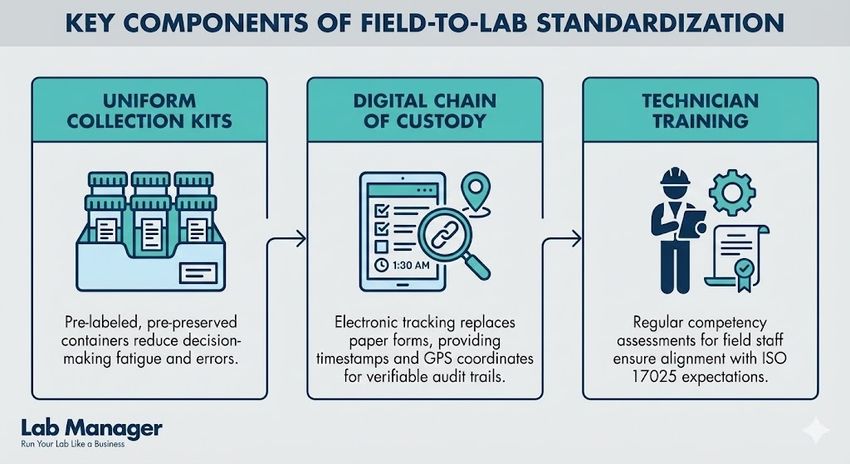
Key components of field-to-lab standardization
Uniform collection kits, a digital chain of custody, and technician training are essential for field-to-lab standardization.
GEMINI (2025)
Uniform collection kits: Pre-labeled, pre-preserved containers reduce decision-making fatigue and errors in the field.
Digital Chain of Custody: Electronic tracking replaces paper forms, providing timestamps and GPS coordinates for verifiable audit trails.
Technician training: Regular competency assessments for field staff ensure alignment with ISO 17025 competency expectations.
Leveraging digital tools for data synchronization
Electronic data capture reduces transcription errors and accelerates accessioning processes. Modern lab operations suffer when manual data entry acts as a bottleneck. Handwritten field logs often arrive at the laboratory illegible or incomplete, requiring clarification calls that delay processing. Integrating mobile field applications directly with a Laboratory Information Management System (LIMS) solves this disconnection. Field technicians input data—such as site conditions, sample volume, and collection time—directly into a tablet or smartphone. For agrilabs, this integration is essential for linking analytical data to specific field coordinates, facilitating precision agriculture applications.
Advanced Lab Management Certificate
The Advanced Lab Management certificate is more than training—it’s a professional advantage.
Gain critical skills and IACET-approved CEUs that make a measurable difference.
Automation via barcoding and QR codes further streamlines the transition from the field to the laboratory bench. Pre-coded sample containers allow technicians to scan and link metadata immediately. Upon arrival at the laboratory, receiving staff scan the container to verify receipt, instantly updating the status in the LIMS. This seamless digital thread eliminates manual transcription, which is widely recognized as a major source of clerical error in laboratory environments.
Benefits of digital integration
Feature
Benefit to lab operations
Real-time synchronization
Immediate instrument and reagent preparation based on incoming volume.
GPS geotagging
Verification of exact sampling location for spatial analysis and fraud prevention.
Mandatory data fields
Elimination of incomplete forms and capture of all necessary metadata.
Automated alerts
Instant notification of high-priority or short-holding-time samples.
Maintaining sample integrity during transport
Proper preservation techniques prevent analyte degradation during transit. The time gap between field sampling and analysis represents a critical vulnerability in the data lifecycle. Chemical and biological changes occur rapidly once a specimen leaves its source. Laboratory management must dictate specific preservation and transport protocols to mitigate these changes. This involves strict adherence to temperature controls, chemical fixation, and holding times. These parameters are often defined by standard methods such as ASTM, ISO, or Standard Methods for the Examination of Water and Wastewater.
Interested in lab tools and techniques?
Register for a FREE Lab Manager account to subscribe to our Lab Tools & Techniques Newsletter.
Monitoring environmental conditions during transport proves essential for compliance. Smart data loggers placed within shipping coolers monitor temperature excursions in real-time. If a sample exceeds the allowable temperature range during transport, the laboratory receives a flag immediately upon data upload. This capability allows for immediate rejection of compromised samples. It saves resources that would otherwise be wasted on analyzing degraded material.
For biological or clinical specimen handling, organizations like the World Health Organization (WHO) and the CDC emphasize that specimen integrity during transport is as critical as the analysis itself. For sensitive agricultural parameters, such as nitrate levels in plant tissue or volatile organic compounds (VOCs) in soil, even minor deviations in temperature or moisture control during the transport phase can invalidate results. Technical guides like ASTM D4840 or ISO 5667 provide specific chain-of-custody procedures to mitigate these risks.
Addressing specific challenges in agricultural testing
High-volume sample flows in agricultural sectors require specialized logistical strategies. Agrilabs face unique challenges due to the seasonal nature of testing and the sheer volume of samples processed during peak harvest or planting windows. Field sampling in this sector involves massive quantities of soil, plant tissue, and water samples that arrive in surges. Unlike clinical or environmental settings where individual sample granularity is paramount, agricultural testing often utilizes composite sampling to represent large acreage. This necessitates a distinct approach to lab operations where intake systems must handle rapid bulk accessioning without losing traceability.
Field sampling for precision agriculture relies heavily on spatial data. Agrilabs must integrate their reporting software with farm management systems, allowing results to generate automated fertilizer prescription maps. The integration of GPS data during the sampling phase is non-negotiable here. Furthermore, soil samples often require drying and grinding prior to analysis, adding a pre-analytical phase that must be tracked efficiently. Automated grinding stations and robotic handling systems often bridge the gap between the raw field sample and the analytical instrument, maintaining throughput speed while preventing cross-contamination between plots.
Strategies for future-proofing field operations
Continuous improvement in pre-analytical workflows sustains long-term data quality. As analytical technology becomes more sensitive, the importance of high-quality field sampling grows. Laboratories equipped with instruments capable of detecting parts per trillion cannot afford to analyze samples contaminated by poor field practices. Future-proofing lab operations involves a commitment to evolving field technologies. This includes the adoption of automated sampling devices, such as drones for water collection or robotic soil samplers, which remove human variability entirely.
Regular audits of the field sampling process provide necessary feedback loops. Laboratory quality managers should periodically observe field operations or conduct blind spike submissions to verify the accuracy of the collection team. By treating the field team as an extension of the laboratory rather than a separate entity, organizations ensure a unified approach to quality. This holistic view of the testing lifecycle fosters confidence in the final report, satisfying clients and regulatory auditors alike.
FAQ
Why is field sampling considered the most critical source of error?
Field sampling introduces uncontrolled variables such as weather, technician technique, and transport conditions that laboratory controlled environments cannot rectify.
How does LIMS integration improve field operations?
LIMS integration allows for real-time data transfer, automatic label generation, and immediate error checking, which reduces administrative time and prevents transcription mistakes.
What are the consequences of poor chain of custody documentation?
Gaps in documentation render data legally indefensible and may lead to the rejection of results by regulatory agencies or courts.
How do agrilabs handle seasonal sample surges?
Agrilabs utilize bulk accessioning protocols, automated pre-processing equipment, and tight integration with farm management software to manage high volumes efficiently.
This article was created with the assistance of Generative AI and has undergone editorial review before publishing.
Add Lab Manager as a preferred Google source to see more of our trusted coverage.
Craig Bradley BSc (Hons), MSc, has a strong academic background in human biology, cardiovascular sciences, and biomedical engineering. Since 2025, he has been working with LabX Media Group, where he focuses on translating complex science into content that’s clear, engaging, and helpful. Craig can be reached at cbradley@labx.com.