 Dr. Kim OrthPhoto courtesy of UT Southwestern Medical CenterDALLAS – UT Southwestern Medical Center researchers have uncovered a mechanism that a type of pathogenic bacteria found in shellfish use to sense when they are in the human gut, where they release toxins that cause food poisoning.
The researchers studied Vibrio parahaemolyticus, a globally spread, Gram-negative bacterium that contaminates shellfish in warm saltwater during the summer. The bacterium thrives in coastal waters and is the world’s leading cause of acute gastroenteritis.
“During recent years, rising temperatures in the ocean have contributed to this pathogen’s worldwide dissemination,” said Dr. Kim Orth, professor of molecular biology and biochemistry at UT Southwestern and senior author of the study, published today (July 5) in the online journal eLife.
About a dozen Vibrio species cause infection in humans, according to the Centers for Disease Control and Prevention, and Vibrio parahaemolyticus is one of the three most common culprits. Vibrio infections cause an estimated 80,000 illnesses and 100 deaths in the United States every year.
The study found that two proteins made by Vibrio parahaemolyticus work together to detect and capture bile salts in the intestines of people who eat raw or undercooked seafood containing the bacteria.
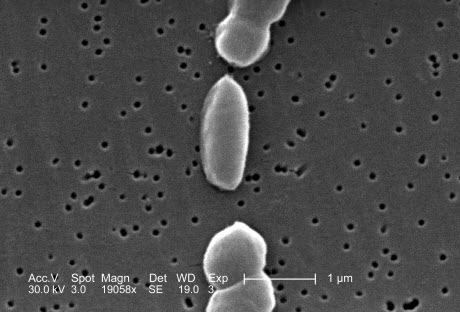 This scanning electron micrograph (SEM) depicts a number of Vibrio parahaemolyticus bacteria; Mag. 19058x. Vibrio parahaemolyticus is a bacterium in the same family as those that cause cholera. It lives in brackish saltwater, and causes gastrointestinal illness in humans.Photo Credit: Janice Carr Content Providers(s): CDC/ Janice Carr, Wikimedia Commons“When a person eats, acids in the stomach help break down the meal, and bile salts in the intestine aid in the solubilization of fatty food. When humans eat raw or undercooked shellfish contaminated with Vibrio parahaemolyticus, the bacteria use those same bile salts as a signal to release toxins,” said Dr. Orth, also an Investigator with the Howard Hughes Medical Institute (HHMI), holder of the Earl A. Forsythe Chair in Biomedical Science, and a W.W. Caruth, Jr. Scholar in Biomedical Research. Dr. Orth studies the strategies that bacterial pathogens use to outsmart their host cells.
Evidence is increasing that several bacterial pathogens that cause gastrointestinal illness, including the extremely toxic Vibrio cholerae, sense bile salts. But until now, the mechanism that those pathogens use for doing this has remained unknown, Dr. Orth said. In previous studies, only one bacterial gene had been implicated in receiving and transmitting the gut-sensing signal, Dr. Orth said.


“We discovered that not one, but two genes are required for Vibrio to receive the bile salt signal. These genes encode two proteins that form a complex on the surface of the bacterial membrane. Using X-ray crystallography, we found that these proteins create a barrel-like structure that binds bile salts and receives the signal to tell the bacterial cell to start making toxins,” she said.
Future experiments will aim to understand how binding of bile salt by this protein complex induces the release of toxins.
“Ultimately, we want to understand how other pathogenic bacteria sense environmental cues to produce toxins. With this knowledge, we might be able to design pharmaceuticals that could prevent toxin production, and ultimately avoid the damaging effects of infections,” she said.
The receptor pair could possibly act as a model to discover sensors in other bacteria where pharmaceuticals might be more applicable, Dr. Orth said, adding “we are in the early stages of this research.”
Co-lead authors were graduate student Peng Li and research scientist Dr. Giomar Rivera-Cancel, both in molecular biology. Other contributing authors included Dr. Lisa Kinch, an HHMI bioinformatics specialist; Dr. Dor Salomon, postdoctoral researcher; Dr. Diana Tomchick, professor of biophysics and biochemistry and director of the Structural Biology Core Facility; and Dr. Nick Grishin, professor of biophysics and biochemistry, an HHMI Investigator, and a Virginia Murchison Linthicum Scholar in Biomedical Research.
The research was supported by the National Institutes of Health, the Welch Foundation, the Department of Energy, and the HHMI.